
☰
All servicesLocal SEOGBP managementAEO | GEOSEO contentTechnical SEOLink buildingDesign & CROPPC managementIndustriesLaw firmsHome servicesPlumbersHVACElectriciansRoofersMedical practicesOrthopedicsPhysical therapyDental practicesGeneral dentistsOrthodontistsPeriodontistsEndodontistsRestaurants and coffee shopsTour operatorsAuto repair shopsLocationsPennsylvaniaState CollegeBellefonteAltoonaWilliamsportLock HavenLewistownPhiladelphiaPittsburghAllentownHarrisburgNew YorkNew York CityBuffaloRochesterAlbanyTexasHoustonDallasSan AntonioAustinUtahSalt Lake CityProvoSt. GeorgeConnecticutBridgeportNew HavenHartfordStamfordOhioColumbusClevelandCincinnatiWashingtonSeattleSpokaneTacomaNevadaLas VegasRenoHendersonPackagesAboutResourcesArticles
Home / Locations / Pennsylvania / Pittsburgh
SEO services in Pittsburgh, PA
Quick summary: SEO services in Pittsburgh cover the full stack: the Google map pack, the regular results under it, the website both depend on, and AI answers. The map pack is one part, and rivers and hills limit how far it carries. Galli Local is based in Bellefonte, Pennsylvania, and works with Pittsburgh businesses remotely. This page is for small business owners in the city and the Allegheny County suburbs.
What does SEO cover for a Pittsburgh business?
SEO is seven kinds of work. The table shows what each one means in Pittsburgh.
What do people in Pittsburgh search for beyond the map?
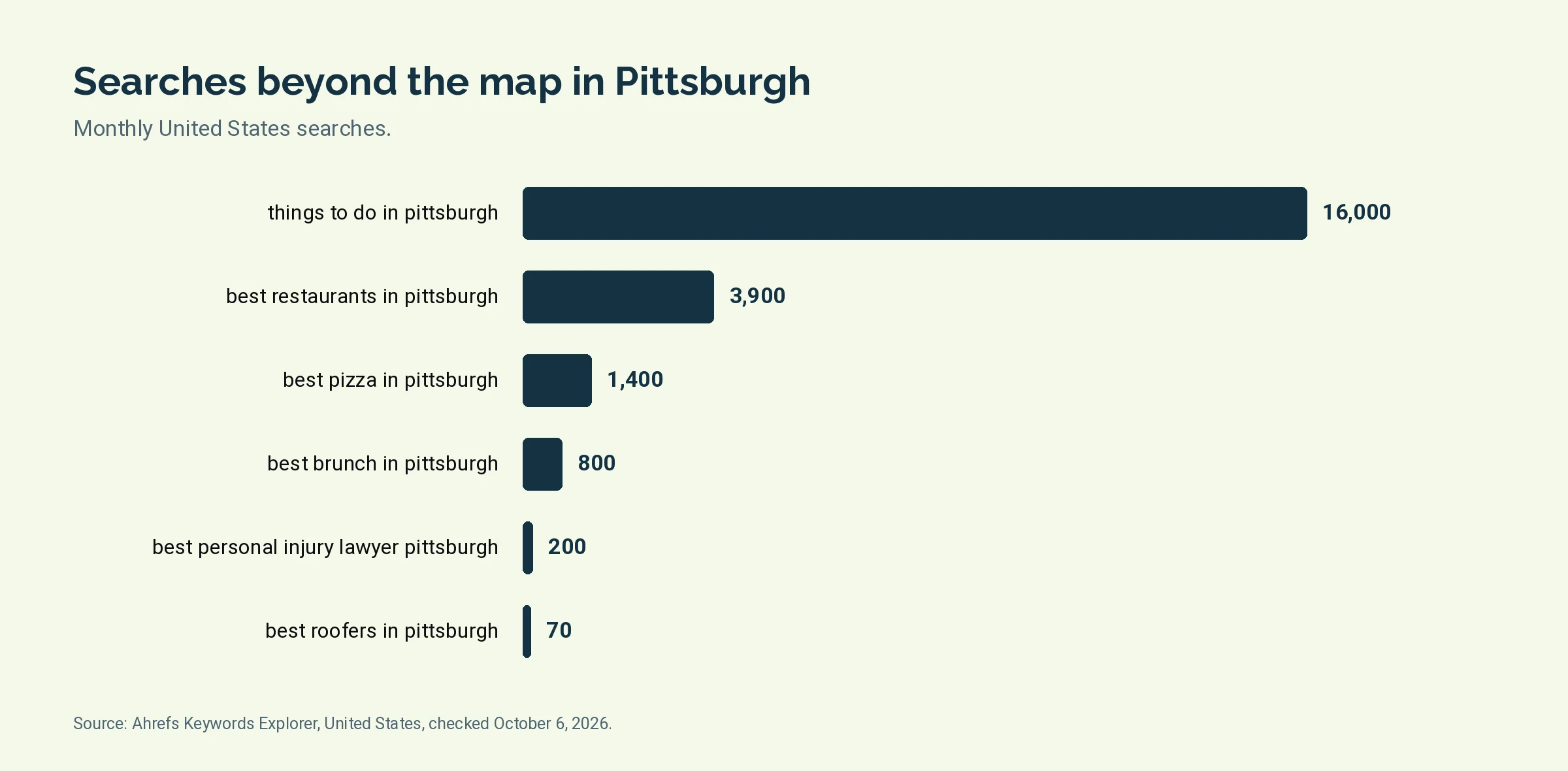
Pittsburgh has real volume in list searches. Ahrefs Keywords Explorer shows about 16,000 searches a month in the United States for "things to do in pittsburgh", about 3,900 for "best restaurants in pittsburgh", about 1,400 for "best pizza in pittsburgh" and about 800 for "best brunch in pittsburgh".
Service terms are much smaller: about 200 for "best personal injury lawyer pittsburgh", about 70 for "best roofers in pittsburgh" and about 50 for "best dentist in pittsburgh". Small numbers still matter, because a "best roofers" searcher is choosing a contractor, not browsing. The results are lists and reviews, so a suburban company outside the city line can appear there even where the map shuts it out.
Do AI tools name Pittsburgh businesses?
They do, though we have not tested Pittsburgh. Ask ChatGPT, Gemini, Google AI Overviews and Microsoft Copilot for a recommendation in your category, once for "Pittsburgh" and once for your own neighborhood or borough. With 90 neighborhoods, the two answers often differ, and the neighborhood answer is the one you can win. Note which sources each tool cites. AEO | GEO covers getting into them.
Local SEO and the map pack in Pittsburgh, PA
What makes ranking in Pittsburgh different?
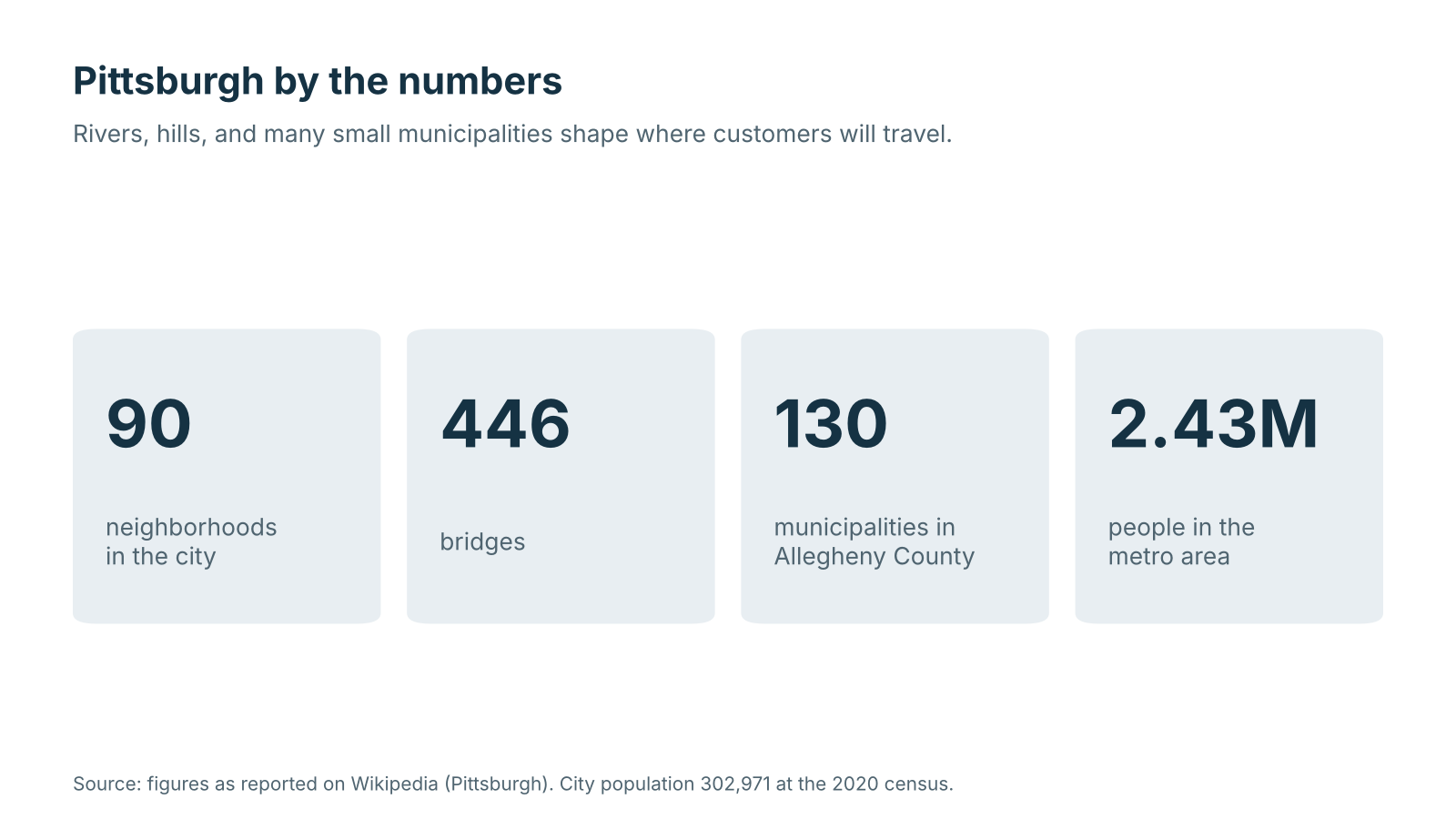
Pittsburgh had 302,971 residents at the 2020 census, in about 58 square miles. It sits where the Allegheny and Monongahela rivers meet to form the Ohio. The city has 90 neighborhoods, 446 bridges, and about 800 sets of public outdoor stairs built into its hillsides.
A mile on the map is not a mile on the ground
Google's distance factor works on location. Customers work on drive time. In most cities those match closely enough. In Pittsburgh they often do not.
A business on the South Side can be a short straight line from a searcher on the other side of the Monongahela and still be a bridge and a traffic light away. A shop at the bottom of a hill can be close on the map to a neighborhood at the top that no one drives down from for an oil change. So a Pittsburgh business can rank in a neighborhood whose residents will not make the trip, and miss one whose residents would.
This is why we read a Pittsburgh grid scan next to a street map. The question is which green points are places your customers come from.
The city is small and the metro is large
The metro area holds 2.43 million people, eight times the city's population. Allegheny County alone has 130 municipalities. Many "Pittsburgh" businesses are in a borough or township with its own name, its own mailing address, and its own map pack.
That cuts both ways. A business in a suburb will struggle to rank for searches made downtown. But it often has an easier path to leading its own borough, where there are fewer competitors than in the city's busiest neighborhoods.
Five sections, 90 neighborhoods
The city is usually divided into Downtown, the North Side, the South Side, the East End, and the West End. People search by neighborhood within those. A plan should name the neighborhoods you serve in the words residents use.
How far does a map ranking reach in Pittsburgh?
A grid scan is the only way to know, and here it has to be read with the terrain in mind. As a planning rule, the Local SEO program fits businesses that serve customers within about 5 to 20 miles of their address. We track a 5-mile community grid or a 10-mile city grid.
City businesses should start with the 5-mile grid. Expect an uneven shape: strong along your own side of the river and weaker across it. Suburban trades that drive to customers may need the 10-mile grid to cover several boroughs.
Which areas need their own pages?
Write each page with details that prove you know the place: the bridge or tunnel people take, where to park, how long the drive is at rush hour. Service area landing pages has the structure.
Is the Local SEO program a good fit for your Pittsburgh business?
See the Local SEO services page and the packages page. Other Pennsylvania markets include Philadelphia and Altoona, with the rest on the Pennsylvania page and the locations page.
Industries we work with in Pittsburgh, PA
- Health care. The economy has shifted toward health care, education, and technology since the 1990s.
- Law firms. See local SEO for law firms.
- Home services. Older housing on steep lots. Allegheny County runs its own plumber licensing program, separate from the state.
- Restaurants and coffee shops, clustered by neighborhood.
- Businesses serving the universities.
- Dental practices.
- Auto repair shops.
Pittsburgh, PA SEO FAQ
What is the difference between local SEO and SEO for a Pittsburgh business?
Local SEO wins the map pack near your address, usually on your own side of the river. SEO wins the regular results, which are not tied to distance in the same way. That makes SEO the way to reach neighborhoods a bridge away and searches that name the whole city.
Where should a Pittsburgh business start?
Start with a grid scan read next to a street map. With a verified profile, at least 10 reviews and a 3.5-star rating, begin the Local SEO program in your own neighborhood or borough, then add pages for the areas customers drive from.
Why do I rank across the river but get no customers from there?
Because Google measures location and customers measure drive time. A ranking in a neighborhood that is a bridge and a traffic jam away may never turn into visits. Focus on the areas your customers travel from.
My business is in a suburb. Should I target "Pittsburgh"?
Target your own borough or township first. It has its own map pack and fewer competitors. Add a page about serving the city if you really do.
Does Galli Local have an office in Pittsburgh?
No. Galli Local is based in Bellefonte, Pennsylvania, and works with clients remotely.
How many Pittsburgh neighborhoods can one business rank in?
It depends on the category and the competition. A grid scan shows where your top 3 area ends today, and that is the starting point for deciding which neighborhoods to add.
How long does local SEO take in Pittsburgh?
First map grid movement usually shows in 1 to 3 weeks. Reaching the top 3 on competitive terms takes 30 to 90 days.