
☰
All servicesLocal SEOGBP managementAEO | GEOSEO contentTechnical SEOLink buildingDesign & CROPPC managementIndustriesLaw firmsHome servicesPlumbersHVACElectriciansRoofersMedical practicesOrthopedicsPhysical therapyDental practicesGeneral dentistsOrthodontistsPeriodontistsEndodontistsRestaurants and coffee shopsTour operatorsAuto repair shopsLocationsPennsylvaniaState CollegeBellefonteAltoonaWilliamsportLock HavenLewistownPhiladelphiaPittsburghAllentownHarrisburgNew YorkNew York CityBuffaloRochesterAlbanyTexasHoustonDallasSan AntonioAustinUtahSalt Lake CityProvoSt. GeorgeConnecticutBridgeportNew HavenHartfordStamfordOhioColumbusClevelandCincinnatiWashingtonSeattleSpokaneTacomaNevadaLas VegasRenoHendersonPackagesAboutResourcesArticles
Home / Industries / Dental practices / Periodontists / Local SEO
Local SEO for periodontists
Local SEO for periodontists is the work of ranking a periodontal practice in the Google Maps top 3 for gum and implant searches, so patients who look for a specialist themselves can find one, while the practice keeps serving the dentists who refer to it. It is for periodontal specialty practices with a verified Google Business Profile at a real office.
This page covers local SEO for periodontics: implant and gum categories, the Business Profile, reviews, directories and map grid tracking. Review replies, insurance listings and advertising rules shared by every dental office are on the dental practices page.
How do patients search for a periodontist?
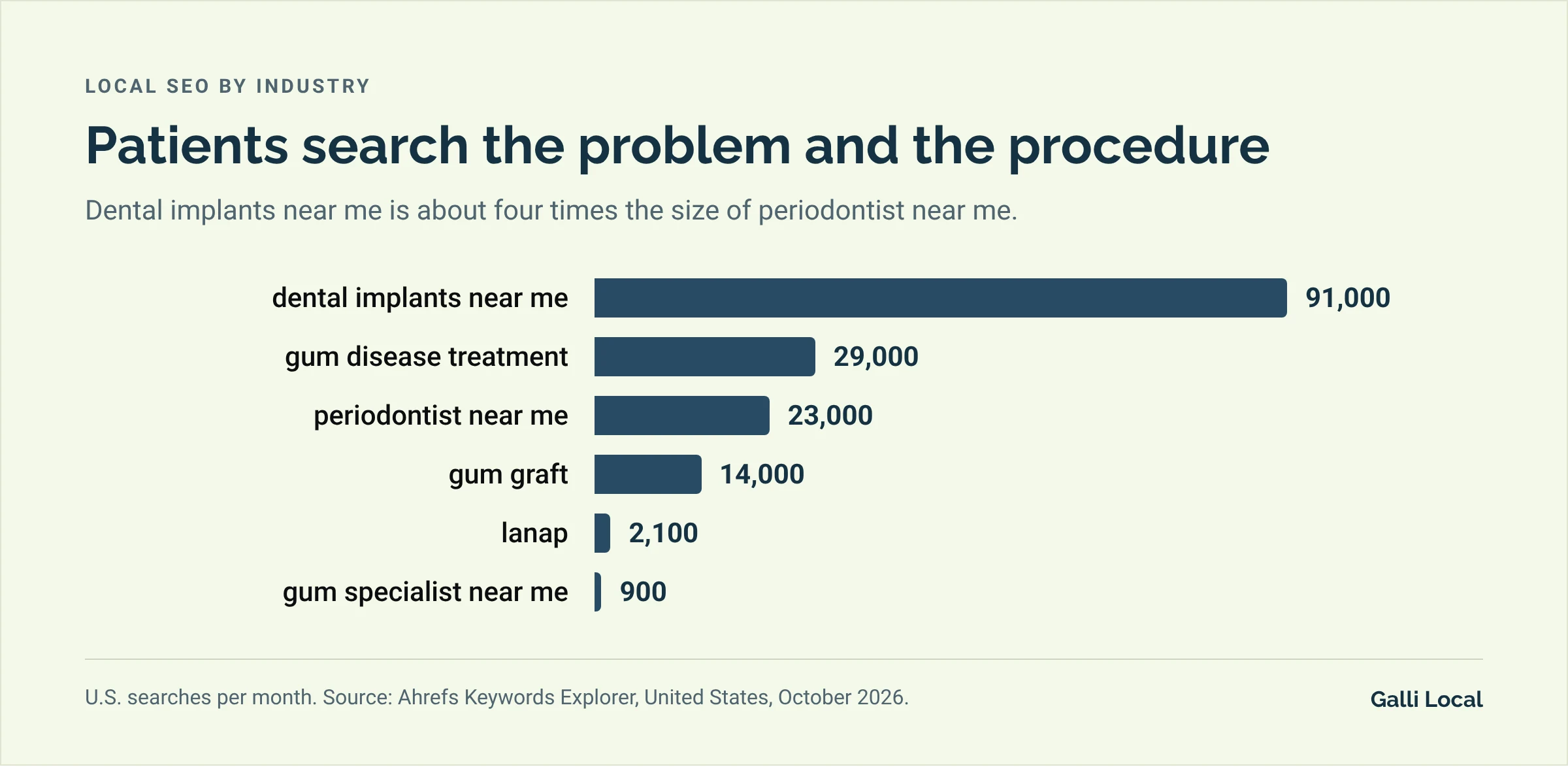
Many search for the problem or the procedure, because they do not know the word "periodontist".
Source: Ahrefs Keywords Explorer, United States, checked October 5, 2026.
The implant search is about four times the size of the specialty search. The need is also common: federal survey data from 2009 to 2014 found that 42.2% of U.S. adults aged 30 or older had periodontitis, and 7.8% had the severe form (National Institute of Dental and Craniofacial Research).
Who are a periodontist's two audiences?
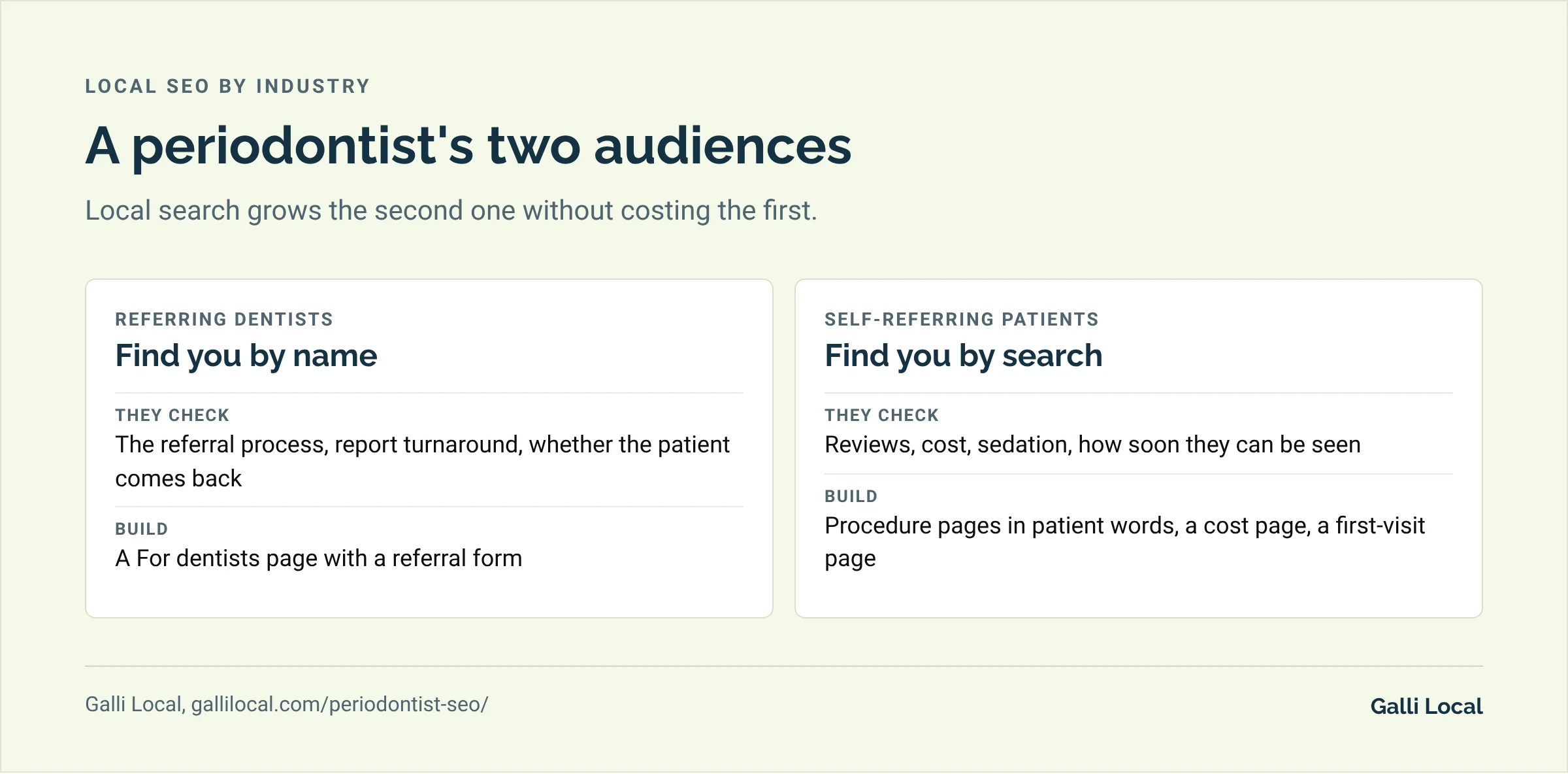
Referring dentists and self-referring patients. Most periodontal websites are written for neither.
Self-referring patients are the part of the practice that local search can grow.
How does a periodontist rank for implant searches?
With the right category, an implant page that reads as a specialist's, and reviews that mention implants.
Business Profile has a category made for this: "Dental implants periodontist". A periodontal practice can use "Periodontist" as primary and add it, or reverse the two if implants are most of the caseload.
Category names come from a published list of current Business Profile categories (Dalton Luka). Google's guidelines say to use as few categories as possible and the most specific that fit (Google Business Profile guidelines).
What else on a periodontal profile gets managed?
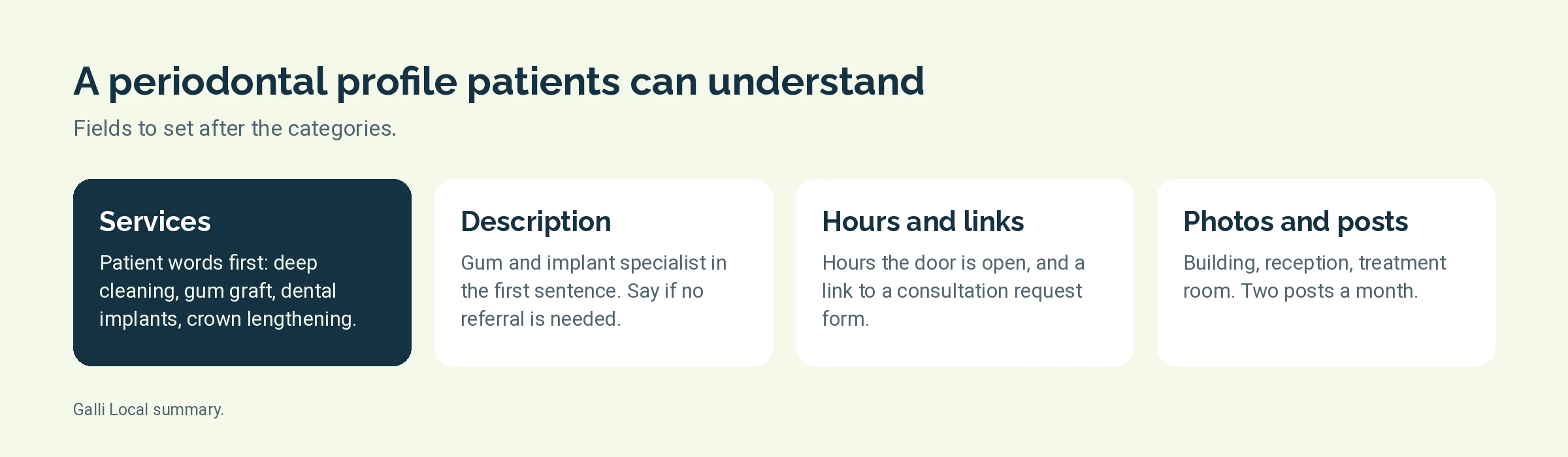
The categories above decide which searches the profile can appear for. The other fields decide whether a patient who has never heard the word "periodontist" understands what the office does. The GBP management bundle covers each one:
- Services: patient words first, clinical term second: "deep cleaning (scaling and root planing)", "gum graft", "dental implants", "crown lengthening", "laser gum treatment".
- Description: "gum and implant specialist" in the first sentence, and that no referral is needed if that is true of your office.
- Attributes and links: the accessibility attributes that apply, and an appointment link to a consultation request form.
- Hours: surgical days and consultation days are often different. List the hours the phone is answered and the door is open.
- Photos: the building, reception and a treatment room. Clinical before-and-after photos need written consent and are better kept on the website, where they can carry an explanation.
- Posts: two a month. Plain topics work: what a consultation covers, or how you report back to a patient's dentist.
- Edit monitoring: associates who rotate between offices produce duplicate practitioner listings. Those are claimed or reported.
Will ranking for patient searches upset referring dentists?
It can, if the site reads as though the practice wants to keep the patient. Most periodontists place the implant and send the patient back to the general dentist for the crown. Saying that on the implant page protects the referral relationship and reassures patients who like their dentist.
Wording that works for both audiences:
- "We work with your general dentist. After treatment, you return to them for regular care."
- "No referral is needed to book a consultation. If you have a dentist, we send them a report."
Periodontics is one of twelve dental specialties recognized in the United States (National Commission on Recognition of Dental Specialties and Certifying Boards). Use the title in the profile description, page titles and bio pages. It is the clearest difference from a general office that places implants.
Which procedure pages should a periodontal site have?
One page per procedure, titled in the words patients use, with the clinical term second.
- Dental implants, including who is a candidate and how long each stage takes
- Gum disease treatment, starting with deep cleaning and what happens if that is not enough
- Gum graft, for receding gums
- Laser gum treatment, naming the specific system only if the practice is trained on it
- Sedation options
- Cost and insurance, with honest ranges and which parts medical or dental plans may cover
"Gum disease treatment" and "gum graft" are research searches, with no "near me". Pages for them bring readers from a wide area, and some are local.
What review habits work for a periodontal practice?
Ask at the visit where healing is confirmed, not on the day of surgery. Implant patients are the most willing reviewers once the final tooth is in, though that visit often happens at the general dentist's office. A text from your office a few days after their last check with you covers that gap.
Replies must never confirm the reviewer was a patient or name a procedure. The dental settlements over review replies are covered on the dental practices page, and our review response playbook has safe templates.
What should the request say, and what about low ratings?
"If you were happy with your care here, would you share that on Google?" is enough. Do not suggest words such as "implant" or "painless" for the patient to use. Under the program, 1- and 2-star reviews are flagged for removal when they violate Google's policies. A review that complains about a fee is usually within policy, so it stays, and HIPAA still applies to the reply: no visit confirmed, no procedure, no amount.
Which directories matter for periodontists?
- American Academy of Periodontology "Find a periodontist" listing, for members
- American Board of Periodontology directory, for board-certified periodontists
- Provider locators run by the implant brands you place
The ADA's ethics code bars advertising that is false or misleading in a material respect (ADA News). Words such as "painless" and "permanent" on an implant page are the usual problems.
Which general listings come first?
Apple Maps, Bing Places, Yelp and Healthgrades should match the Google profile. Check the insurer directories as well, because a periodontist listed there as a general dentist will be missing from the specialist search a patient runs inside a plan's website.
What does map grid tracking show a periodontist?
The program tracks 10 keywords on a 5-mile community grid or 20 on a 10-mile city grid. General dentists far outnumber periodontists, so the 10-mile grid is usually the fair picture of a specialist's reach.
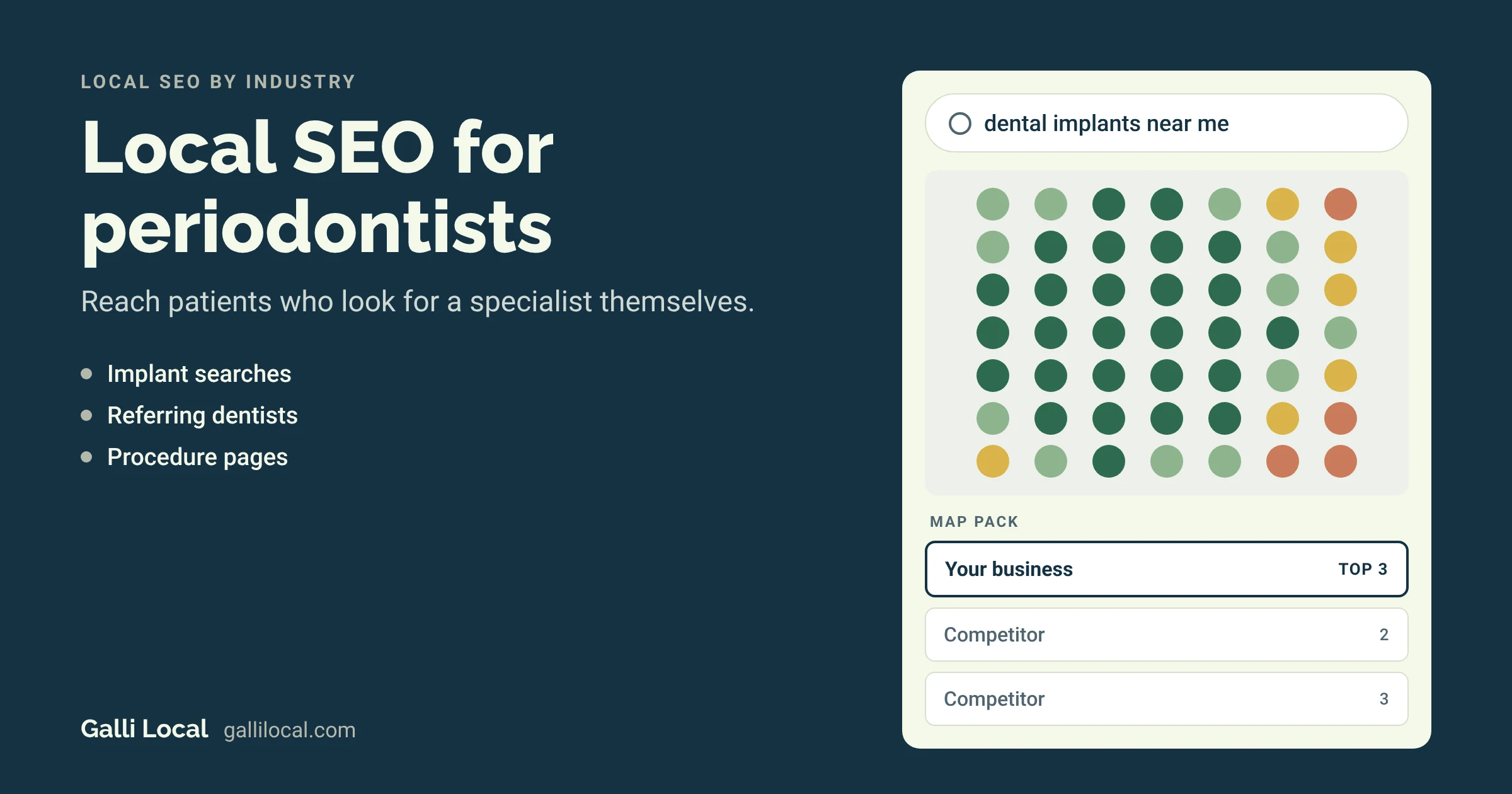
Expect two different maps. "Periodontist near me" often shows top 3 across most of the grid, because few offices hold the category. "Dental implants near me" is the hard one, since every general office with an implant page competes for it, and the grid tends to be strong near the office and thin farther out. That gap is what the implant page, the "Dental implants periodontist" category and implant reviews are there to close. First grid movement tends to show in 1 to 3 weeks, and top 3 on competitive terms in 30 to 90 days.
The monthly report shows average rank, coverage, top 3 share, calls, website clicks and direction requests. Local engagement signals on priority keywords are part of the program.
What is included, and what is not?
Content comes with the AEO | GEO bundle or the full agency stack, or case by case once a strategy is in place.
Other services for periodontists
- Periodontist marketing: the hub for this practice type
- SEO for dental practices
- AEO | GEO for dental practices
- SEO content for dental practices, for the research searches with no "near me"
Is Galli Local a good fit for your periodontal practice?
The Local SEO program starts at $850/mo per location. See Local SEO services, Packages and the table above for what is included. Galli Local is based in Bellefonte, Pennsylvania, works with practices remotely, and is new, so it has no periodontal client results to show yet. Our article on why a local business is not getting calls covers the common causes. Related pages: endodontists and orthodontists.
Periodontist local SEO FAQ
What primary category should a periodontist use?
"Periodontist" for a full-scope practice, with "Dental implants periodontist" as a secondary category. A practice that mostly places implants can test the reverse.
Can patients book with a periodontist without a referral?
In most practices, yes. Say so on the home page and the profile description, because many patients assume a referral is required.
Will marketing to patients cost us referrals from dentists?
It should not if the site says clearly that patients return to their general dentist for regular care. A "For dentists" page with a simple referral form helps too.
Should we build a page for LANAP or laser treatment?
Yes, if the practice is trained on that system and offers it. Name the system only if you use it, and describe results in measured terms.
How do we get reviews when the final crown is placed elsewhere?
Send a text from your office a few days after the patient's last check with you. Ask every patient the same way and offer nothing in return.