
☰
All servicesLocal SEOGBP managementAEO | GEOSEO contentTechnical SEOLink buildingDesign & CROPPC managementIndustriesLaw firmsHome servicesPlumbersHVACElectriciansRoofersMedical practicesOrthopedicsPhysical therapyDental practicesGeneral dentistsOrthodontistsPeriodontistsEndodontistsRestaurants and coffee shopsTour operatorsAuto repair shopsLocationsPennsylvaniaState CollegeBellefonteAltoonaWilliamsportLock HavenLewistownPhiladelphiaPittsburghAllentownHarrisburgNew YorkNew York CityBuffaloRochesterAlbanyTexasHoustonDallasSan AntonioAustinUtahSalt Lake CityProvoSt. GeorgeConnecticutBridgeportNew HavenHartfordStamfordOhioColumbusClevelandCincinnatiWashingtonSeattleSpokaneTacomaNevadaLas VegasRenoHendersonPackagesAboutResourcesArticles
Home / Digital marketing / Local SEO
Local SEO that gets you into the Google Maps top 3
Most people who need a lawyer, a doctor, or a contractor choose from the three businesses Google shows on the map. We optimize your Google Business Profile, clean up your citations, and build the local signals and pages that move you into that spot across your whole service area.
Why the map pack matters
The top map pack listing gets twice the clicks of the top organic result
14.8% for the top spot
The first map pack listing gets 14.8% of clicks. Across all searches, the first organic result gets 7.1%, about half as much.
It held up against AI answers
Map pack position 1 fell 16% in a year, from 17.6% to 14.8%. Organic position 1 fell 82% over the same period as AI answers took over the top of the page.
Three spots, then a drop
Google shows three listings. A business ranked fourth or lower only appears after the searcher taps through to more places, and most don't.
Source: First Page Sage, Google click-through rates by ranking position, September 2026.
The signals
What moves a map ranking
Google ranks local results on relevance, distance, and prominence. Pick one to see what we work on.
Does your profile match what the person searched for?
CategoriesPrimary and secondary categories chosen from what top-ranked competitors use.
Services and descriptionsEvery service listed in the words customers search.
Service and area pagesPages on your site that back up what the profile says.
What's included
What the Local SEO program covers
Google Business Profile optimization
Primary and secondary categories, services, and descriptions written around the terms people search, plus custom photos so Google has more to read.
Citation building and cleanup
Consistent name, address, and phone across the directories Google and AI tools check. Duplicates and outdated listings get fixed or removed.
Map grid tracking
10 keywords on a 5-mile community grid or 20 on a 10-mile city grid. Each scan shows where you rank from dozens of points across your area.
Local engagement signals
Google watches how people in your area search for and interact with businesses like yours. We run an ongoing program that strengthens those signals for your priority keywords. It builds on keywords your website and profile already support, which is why content and profile work come first.
Service and area page recommendations
Recommendations for a page on each core service and each nearby town you serve. Rankings that stall in one direction usually point to a town your site never mentions.
Review monitoring
1- and 2-star reviews are flagged for removal when they violate Google's policies. Review coaching comes with the GBP management bundle.
You get: more calls, website clicks, and direction requests from Google Maps, with a monthly map grid report that shows exactly where you rank.
How we choose which keywords to work on
Not every keyword is ready to move. We scan each candidate on the grid first and keep the ones that pass three checks.
A keyword that fails the first two checks is not dropped. It needs content first, on the website and the profile, and we tell you which page is missing.
We start with a focused set: 10 keywords on a 5-mile community grid or 20 on a 10-mile city grid. As a set reaches the top 3, the next tier is added. Loading every keyword at once slows the ones already climbing.
Good candidates usually follow one of these patterns:
- [service] near me
- [service] in [city]
- emergency [service]
- best [service]
Who the Local SEO program is for
The program fits businesses that win customers from a defined area and depend on calls, bookings, or walk-ins.
Typical clients are solo and two-partner law firms, plumbers and HVAC companies, dental and medical practices, restaurants and coffee shops, and tour operators.
How it works
From audit to the top 3
Step 1
Audit and qualify
We review your profile, reviews, website, and competitors, then pick keywords with enough presence to move and room left to climb.
Step 2
Fix the foundation
Categories, services, citations, and on-page content get corrected first, so Google recognizes what you do and where you do it.
Step 3
Build momentum
Engagement signals and new pages go to work on the first keyword set. First grid movement usually shows in 1 to 3 weeks; the top 3 on competitive terms takes 30 to 90 days.
Step 4
Report and expand
Each month you see what moved, which terms reached the top 3, and the next keywords we're adding and why they're ready.
What to expect in the first 45 days
Rankings move up and down early on. Google tests different results, and a keyword can gain three positions one week and give one back the next. The trend across several scans is what counts.
Once keywords reach the top 3, the effect depends on the business:
- Service trades such as plumbers see more calls
- Appointment businesses such as med spas see more website visits and bookings
- Restaurants and shops see more direction requests and walk-ins
What happens each month
Every monthly report answers three questions: what changed on the grid, how many calls and direction requests came from the profile, and what we will work on next.
What we report
Before and after on the grid
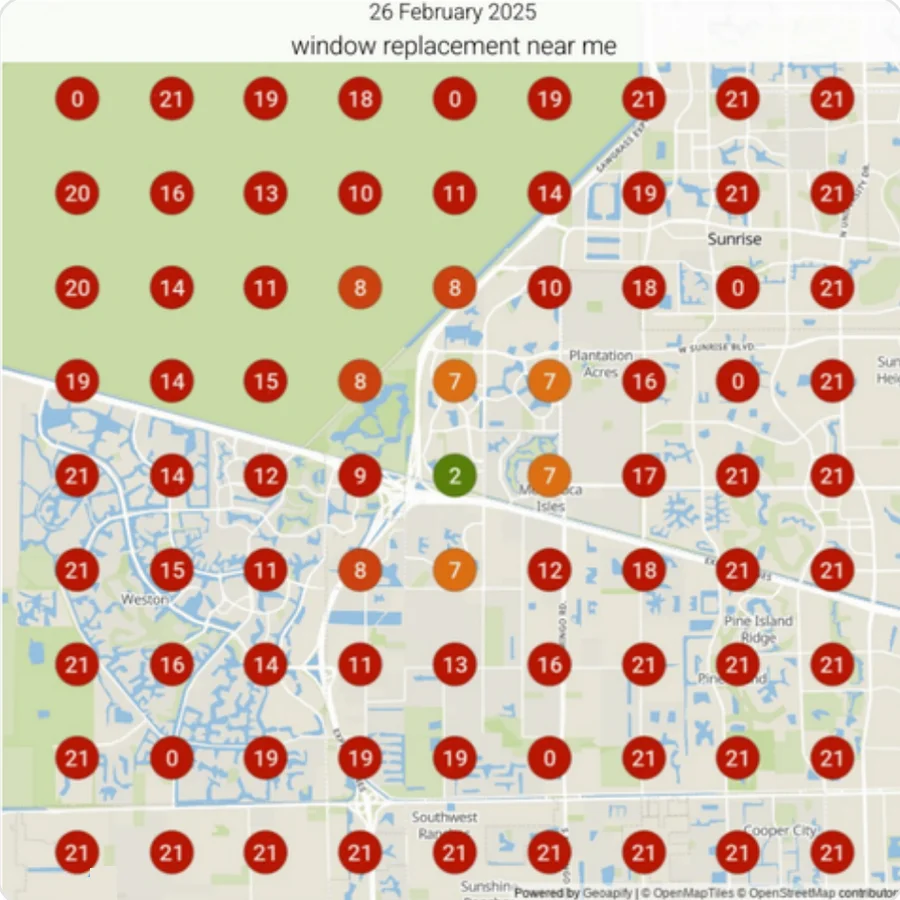
Before · Feb 26
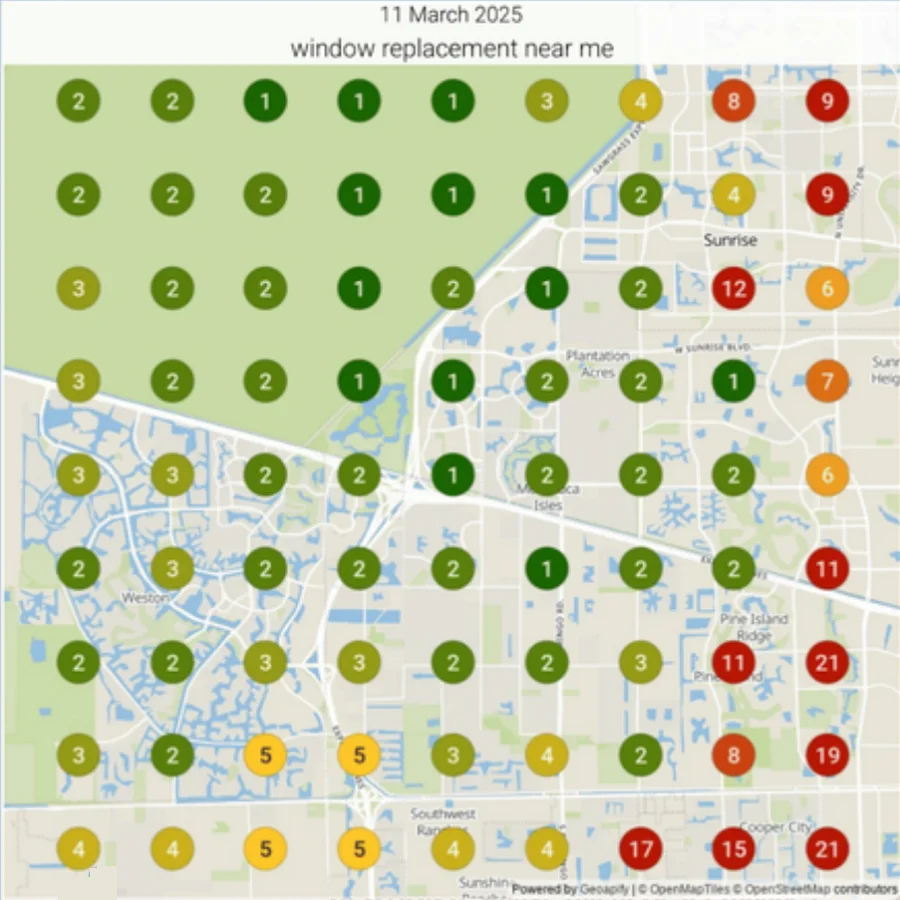
After · Mar 11 (13 days later)
Average rank
Your average position for a keyword across every point on the grid. Lower is better.
Coverage
The share of grid points where you show up in the top 20 results at all.
Top 3 share
The share of grid points where you're in the map pack. This is the number that turns into calls.
The business in this example report went from 1 of 81 grid points in the top 3 to 55. We report three numbers from every scan: average rank, coverage, and top 3 share, next to your profile's calls, website clicks, bookings, and direction requests.
What the grid tells us to fix
A grid scan is a diagnostic as well as a report. Three patterns come up again and again.
A keyword that shows no ranking at all. Google does not associate the business with that search. The cause is nearly always missing content: no service page and no mention on the profile.
A keyword that climbs more slowly than the rest. The page behind it is thinner than the pages behind the others. "Dentist near me" moves while "dental crowns near me" stalls, because the site has nothing on crowns.
A wall of poor rankings in one direction. The grid is green to the north and red to the south. That red area is usually a neighboring town the website never mentions. An area page for that town is what breaks the wall.
Each finding becomes a recommendation: a service page, an area page, or a set of questions answered on the page and the profile.
Local SEO explained
What is local SEO?
Local SEO is the work of getting a business to appear when someone nearby searches for what it sells. Google answers most of those searches with a map and three listings, called the map pack or local pack. Those listings come from Google Business Profiles, not from websites.
How Google ranks local results
Google says local ranking rests on three things. Relevance is how well a profile matches the search. Distance is how far the business is from the searcher. Prominence is how well known the business is, judged by reviews, links, and mentions across the web. Because distance is part of the formula, rankings change from one block to the next, which is why we measure them on a grid instead of with a single number.
What local SEO work involves
- Categories: the right primary and secondary categories, matched to what top-ranked competitors use
- Profile details: services, attributes, and hours filled in and kept current
- Citations: the same name, address, and phone number on every directory
- Reviews: a steady flow of new reviews, each with a reply
- Website pages: a page for each service and location, with LocalBusiness schema that ties the site to the profile
Local SEO vs. traditional SEO
Traditional SEO ranks web pages. Local SEO ranks a business listing. They support each other: a strong service page helps the profile rank for that service, and a strong profile sends visitors to the page. Most local businesses need both, and the profile is usually the faster place to start. See SEO content and AEO | GEO for the other two parts.
Why rankings change from one street to the next
Google weighs how close a business is to the person searching. A plumber can rank first for a search made outside the shop and ninth for the same search made four miles away. Larger cities and more competitors shrink that radius.
This is why a single "we rank number one" claim tells you little. A grid scan runs the search from dozens of points and shows where the top-3 area ends. Our guide on grid rank scans vs. zip code ranking explains how to read one.
What local SEO cannot do
It cannot put a business in the top 3 in a city where it has no address and no real presence. Fake addresses and virtual offices break Google's rules and lead to suspensions.
For towns beyond your map radius, the honest options are area pages that rank in the regular results, ads targeted to that town, or a staffed second location.
Free local SEO guides and tools
- The Google Maps field guide for local businesses: A four-week plan: measure, reviews, photos, and visits, with a printable review card and shot list.
- Why isn't my phone ringing? A four-stage diagnostic: Twenty checks across visibility, listing, website, and call handling, with fixes for each.
- How to read a map grid report: The color bands, the key numbers, seven common patterns, and six grid scan tools compared.
- Local SEO launch checklist for new businesses: A 30-day checklist: profile, core listings, website basics, first reviews, and tracking.
- The local SEO calendar: The weekly, monthly, and quarterly routine, plus a month-by-month seasonal plan.
- Law firm SEO hiring scorecard: Eight questions, an answer key, a contract checklist, and a score sheet for three agencies.
- Google Maps cheat sheet for plumbers and home service companies: Two pages: categories, photos, review prompts, and directories for plumbers and home service companies.
- Google Maps cheat sheet for dental and medical offices: Two pages: categories, photos, review prompts, and directories for dental and medical offices.
- Google Maps cheat sheet for restaurants and coffee shops: Two pages: categories, photos, review prompts, and directories for restaurants and coffee shops.
- Google Maps cheat sheet for tour operators: Two pages: categories, photos, review prompts, and directories for tour operators.
- See all tools and resources
Local SEO FAQ
Common questions about local SEO
How long does local SEO take?
First grid movement usually shows in 1 to 3 weeks. Reaching the top 3 on competitive terms takes 30 to 90 days, depending on your starting point, reviews, and competition.
What does my business need to qualify?
A verified Google Business Profile, at least 10 reviews, and a 3.5-star or better rating. If you're short on any of these, we fix that first.
Do you work with multi-location businesses?
Yes. Each location needs its own landing page with an address and phone number that match its profile exactly, and each one gets its own grid.
What happens if we stop?
Rankings tend to fade gradually over several weeks, not overnight. The profile, citation, and content work you paid for stays with you.
How much does local SEO cost?
Pricing depends on the size of the grid and the number of keywords tracked. Current rates are on the packages page.
Do I need a website to rank in the map pack?
Yes, for this program. Google uses your website to confirm what you do and where, so the profile needs to link to a site that covers your services.
How do you measure results?
With monthly grid scans for a fixed set of keywords, plus calls, direction requests, and website clicks from the profile's Performance report.
Is there a contract?
Packages start with a three-month term, then continue month to month.
Why am I ranking well near my office but nowhere else?
Proximity. Rankings fade with distance, and faster where competitors are closer to the searcher. Reviews, citations, and area pages widen the radius over time.
Why aren't you working on all of our keywords at once?
Effort spread across too many keywords moves none of them far. We start with the ones closest to the top 3 and add more as they get there, usually after 30 to 60 days.
Why does one keyword show no ranking on the grid?
Google is not connecting your business with that search. A service page and a matching entry on your profile usually fix it.
Why do we rank well on one side of town and not the other?
The weak side is often a neighboring community your site never mentions. Content for that area is the usual fix.
Do engagement signals replace content and profile work?
No. They build on it. A keyword with no supporting page or profile entry has nothing to strengthen.
Often paired with AEO | GEO, which adds a full directory audit and consolidation, and SEO content for the area pages that break through stalled rankings. New to map grids? Read how to read a map grid report.