
☰
All servicesLocal SEOGBP managementAEO | GEOSEO contentTechnical SEOLink buildingDesign & CROPPC managementIndustriesLaw firmsHome servicesPlumbersHVACElectriciansRoofersMedical practicesOrthopedicsPhysical therapyDental practicesGeneral dentistsOrthodontistsPeriodontistsEndodontistsRestaurants and coffee shopsTour operatorsAuto repair shopsLocationsPennsylvaniaState CollegeBellefonteAltoonaWilliamsportLock HavenLewistownPhiladelphiaPittsburghAllentownHarrisburgNew YorkNew York CityBuffaloRochesterAlbanyTexasHoustonDallasSan AntonioAustinUtahSalt Lake CityProvoSt. GeorgeConnecticutBridgeportNew HavenHartfordStamfordOhioColumbusClevelandCincinnatiWashingtonSeattleSpokaneTacomaNevadaLas VegasRenoHendersonPackagesAboutResourcesArticles
Home / Industries / Dental practices / Orthodontists / Local SEO
Local SEO for orthodontists
Local SEO for orthodontists is the work of ranking an orthodontic practice in the Google Maps top 3 for braces, Invisalign and orthodontist searches, and answering the cost questions patients ask before they ever book a consultation. It is for orthodontic specialty practices with a verified Google Business Profile at a real office that want more new-patient exams from parents and from adults.
This page covers local SEO for orthodontics: main and satellite office profiles, cost pages, reviews, directories and map grid tracking. Review replies, insurance listings and advertising rules shared by every dental office are on the dental practices page.
How do patients search for an orthodontist?
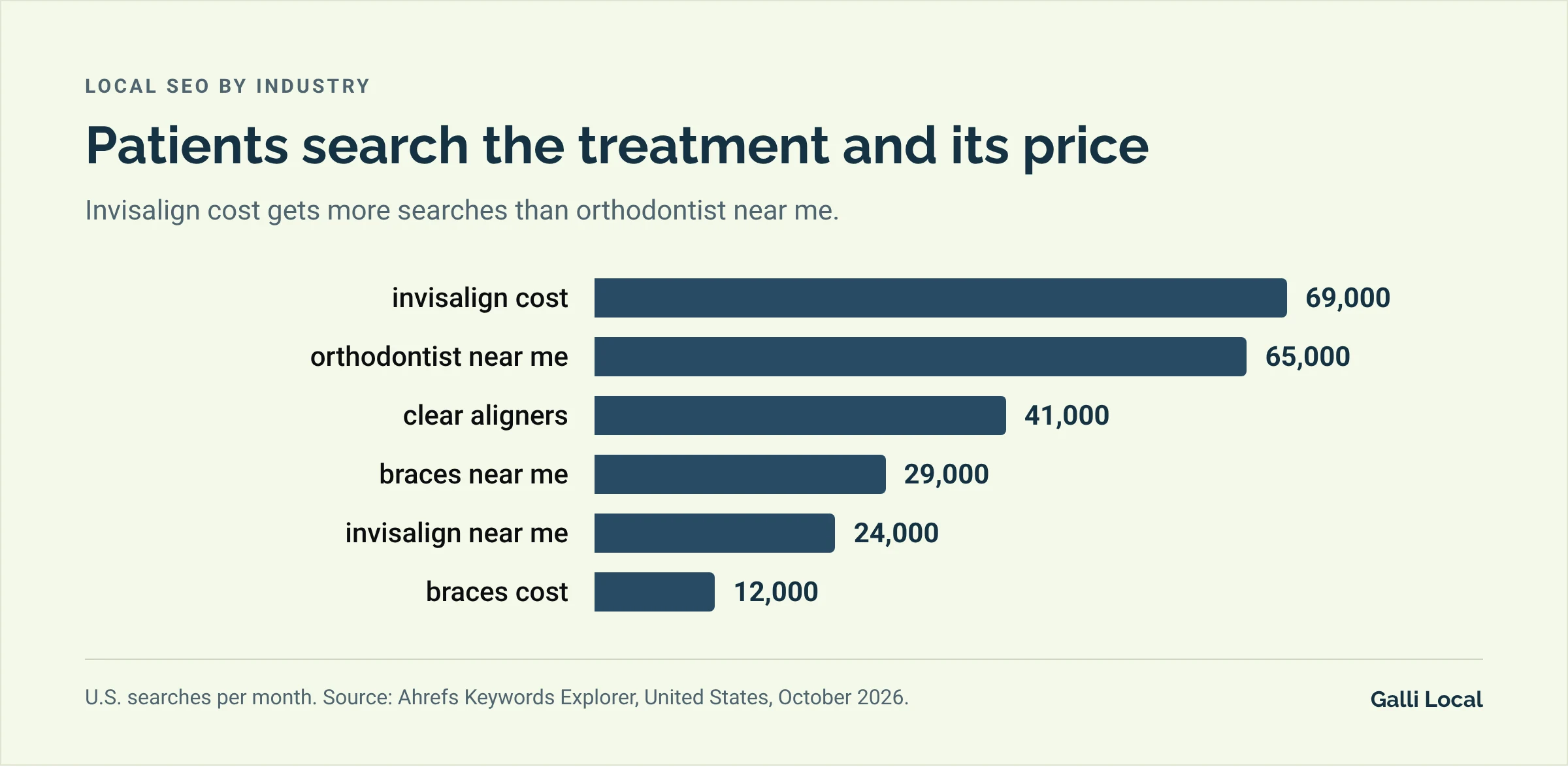
They search for the treatment and its price as much as for the specialist.
Source: Ahrefs Keywords Explorer, United States, checked October 5, 2026.
"Invisalign cost" gets more searches than "orthodontist near me". Taken together, the two cost searches are larger than any single "near me" search on the list. An orthodontic site without a real cost page leaves its largest search to someone else.
What should a cost page say?
A cost page should give a real range for your office, say what moves the price, and explain how patients pay. Cost questions are also the searches where an AI answer tends to appear first, and those answers cite pages that state numbers plainly.
Include:
- A price range for braces and for aligners at your office, with what the fee covers: records, visits, retainers
- What changes the price: case length, age, type of appliance
- Monthly payment options and whether a down payment is required
- How orthodontic insurance benefits usually apply, including lifetime maximums
- What the first exam costs. If it is free, say so in the first paragraph
Check your state dental board's rules before publishing fees or offers.
Who are the two audiences?
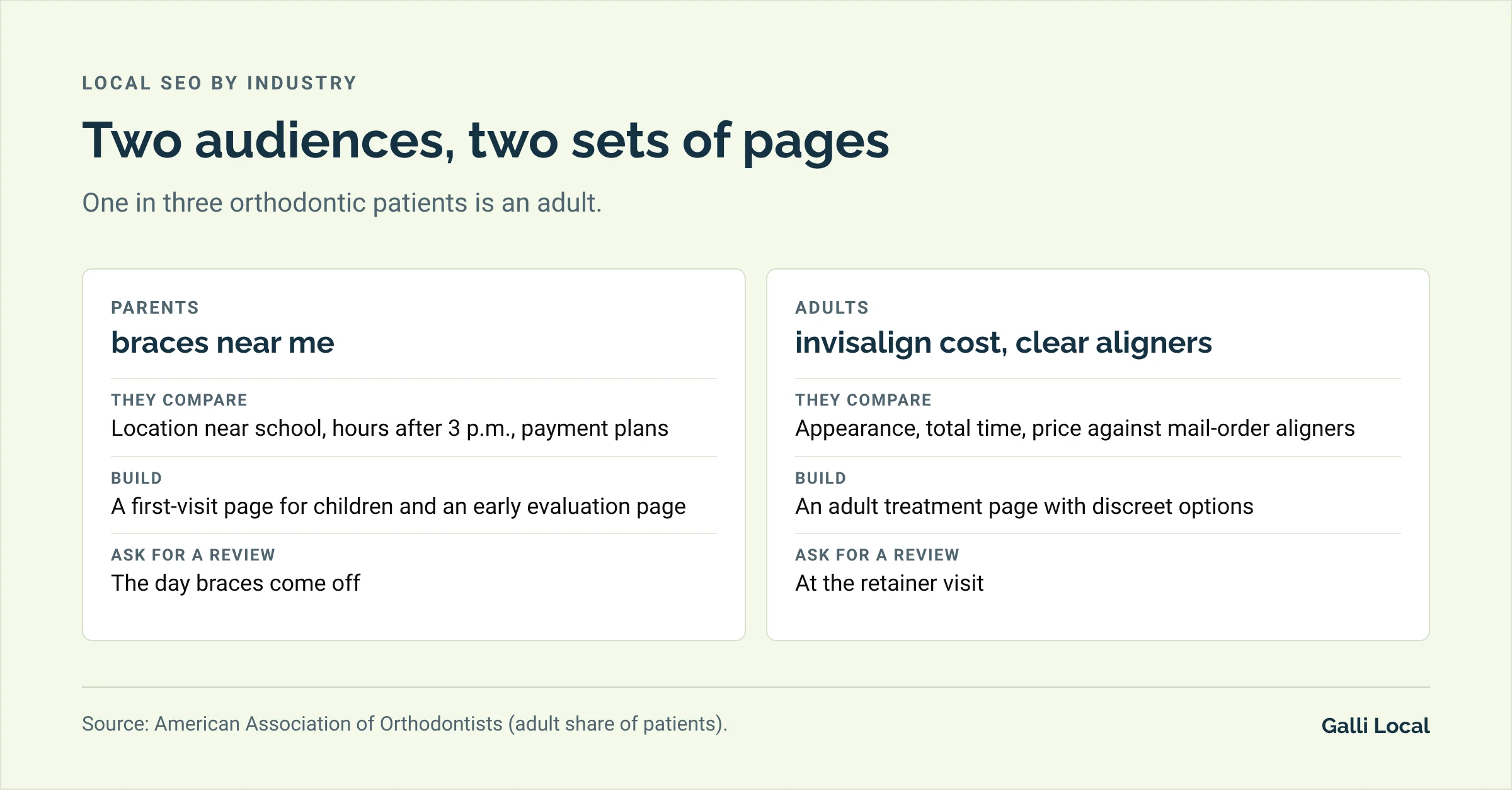
Parents and adults, and they need different pages. The American Association of Orthodontists says one in three orthodontic patients is an adult (American Association of Orthodontists).
How does an orthodontist compete with general dentists who offer aligners?
By making the specialty visible wherever Google and patients look. Orthodontics is one of twelve formally recognized dental specialties (National Commission on Recognition of Dental Specialties and Certifying Boards). The ADA's ethics code limits who may announce as a specialist, and state dental boards set their own rules.
- Primary category: "Orthodontist". Only a specialty practice should hold it. Category names come from a published list of current Business Profile categories (Dalton Luka).
- The word "orthodontist" in the profile description and page titles, next to the treatment names. "Invisalign from a board-certified orthodontist" is a claim a general office cannot make. Use "board-certified" only if it is true of the doctor named.
- A page that explains the difference in plain terms, without running down general dentists, who are also your referral sources.
Why do satellite offices rank poorly?
Because many are open one or two days a week, and the profile is closed the rest of the time. Google's guidelines require a location to be staffed during its stated hours (Google Business Profile guidelines), and businesses listed as open have been shown to rank better than closed ones at the time of a search (BrightLocal).
A satellite office open Tuesdays and Thursdays is at a disadvantage on the other five days. Three things help:
- List the true hours. Listing five days for a two-day office breaks the guidelines and produces angry reviews from people who found a locked door.
- Give each office its own location page with its own address, hours, photos and driving directions.
- Ask patients seen at the satellite to review that office's profile, not the main one. A satellite with six reviews next to a main office with 400 looks like an afterthought.
What does profile management cover for an orthodontic practice?
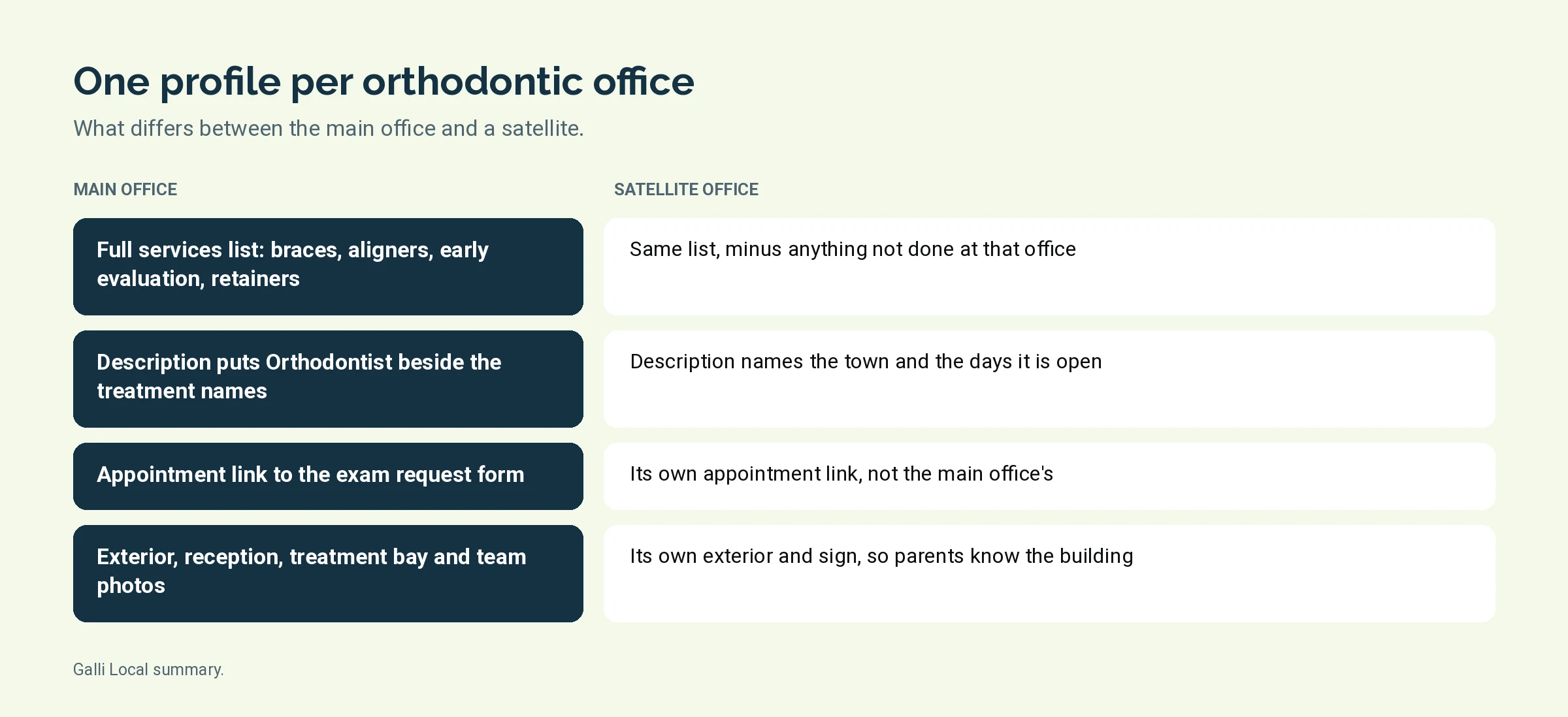
Each office, main or satellite, has its own profile, and each one is managed as its own listing. With the GBP management bundle that means:
Smile photos of a minor need a parent's written permission before they go on a profile. Suggested edits get checked on every profile, because a satellite's hours are the field the public most often "corrects".
What review and photo habits work for orthodontists?
Orthodontics has a built-in review moment: the day braces come off or the last aligner is finished. Ask then, in the office.
Before-and-after smile photos are the most persuasive images an orthodontist has. Each one needs written permission, and a parent's signature for a minor.
For review requests, the FTC's review rule, in effect since October 21, 2024, bans offering anything in exchange for a review that must be positive (FTC). Contests and reward points for reviews are common in orthodontic offices. Have that program checked against the rule.
How should replies and low ratings be handled?
Most orthodontic reviews are written by a parent about a child. A reply never confirms that the child, or anyone, is a patient, and never mentions treatment, length of care or a balance owed. HIPAA applies to the practice's reply no matter what the parent posted. A neutral request helps too: "Would you tell other families about your experience on Google?"
Under the program, 1- and 2-star reviews are flagged for removal when they violate Google's policies. A real complaint about a missed appointment fee stays, and gets a short reply that moves the conversation to a phone call.
Which directories and ads matter for orthodontists?
- American Association of Orthodontists "Find an orthodontist" listing, for members
- American Board of Orthodontics directory, for board-certified orthodontists
- The provider locators of the aligner and bracket brands you offer
Orthodontist is one of the health categories Google lists for Local Services Ads in the United States (Google Local Services Help).
Which general listings come first?
Apple Maps, Bing Places and Yelp, with one listing per office and the true days open on each. Satellites are where these go wrong: many directories copy the main office's hours onto every address.
What does map grid tracking show an orthodontist?
The program tracks 10 keywords on a 5-mile community grid or 20 on a 10-mile city grid, and each office gets its own grid. A grid shows the practice's rank for one search at every point across that area.
Families choose an orthodontist they can reach after school for two years of visits, so read the grid against school locations. A top 3 rank for "braces near me" around the high school and nothing around the two middle schools tells you where the next area page and the next review requests should go. For a satellite, compare the days: a grid run on a day the office is closed will look worse than one run on an open day.
The monthly report shows average rank, coverage, top 3 share, calls, website clicks and direction requests. The program also includes local engagement signals for priority keywords.
What is included, and what is not?
Content is not sold separately. It comes with the AEO | GEO bundle or the full agency stack, or case by case once a strategy is in place.
Other services for orthodontists
- Orthodontist marketing: the hub for this practice type
- SEO for dental practices
- AEO | GEO for dental practices, which matters most for the cost questions above
- SEO content for dental practices
Is Galli Local a good fit for your orthodontic practice?
The Local SEO program starts at $850/mo per location. See Local SEO services, Packages and the table above for what is included. Galli Local is based in Bellefonte, Pennsylvania, works with practices remotely, and is new, so it has no orthodontic client results to show yet. Our article on ranking in the Google local 3-pack covers the basics. Related pages: periodontists and endodontists.
Orthodontist local SEO FAQ
Should an orthodontist publish prices?
Yes, as a range, where your state board allows it. "Invisalign cost" gets about 69,000 U.S. searches a month according to Ahrefs, more than "orthodontist near me", and a page with real ranges is how a practice appears for it.
What primary category should an orthodontic practice use?
"Orthodontist". Add "Dentist" as a secondary category only if you want to appear for general searches, which most specialty practices do not.
Can a part-time satellite office have its own Business Profile?
Yes, if it has its own signage and is staffed during the hours listed. List only the days it is open.
Can we reward patients for leaving reviews?
Not if the reward depends on the review being positive, under the FTC's review rule. Have any contest or points program reviewed against that rule and Google's own policies.
How do we compete with general dentists on Invisalign searches?
Use the "Orthodontist" category, put the specialist title next to the treatment name in titles and descriptions, and publish a cost page. Those are things a general office cannot or usually does not do.