
☰
All servicesLocal SEOGBP managementAEO | GEOSEO contentTechnical SEOLink buildingDesign & CROPPC managementIndustriesLaw firmsHome servicesPlumbersHVACElectriciansRoofersMedical practicesOrthopedicsPhysical therapyDental practicesGeneral dentistsOrthodontistsPeriodontistsEndodontistsRestaurants and coffee shopsTour operatorsAuto repair shopsLocationsPennsylvaniaState CollegeBellefonteAltoonaWilliamsportLock HavenLewistownPhiladelphiaPittsburghAllentownHarrisburgNew YorkNew York CityBuffaloRochesterAlbanyTexasHoustonDallasSan AntonioAustinUtahSalt Lake CityProvoSt. GeorgeConnecticutBridgeportNew HavenHartfordStamfordOhioColumbusClevelandCincinnatiWashingtonSeattleSpokaneTacomaNevadaLas VegasRenoHendersonPackagesAboutResourcesArticles
Home / Locations / Pennsylvania / Philadelphia
SEO services in Philadelphia, PA
Quick summary: SEO services in Philadelphia cover the full stack: the Google map pack around your address, the regular results that reach the rest of the city, the website both depend on, and AI answers. The map pack is one part, and here it is a neighborhood-sized part. Galli Local is based in Bellefonte, Pennsylvania, and works with Philadelphia businesses remotely. This page is for small business owners who have been told they can "rank in Philadelphia" and want to know what that really means.
What does SEO cover for a Philadelphia business?
SEO is seven kinds of work. The table shows what each one means in Philadelphia.
What do people in Philadelphia search for beyond the map?
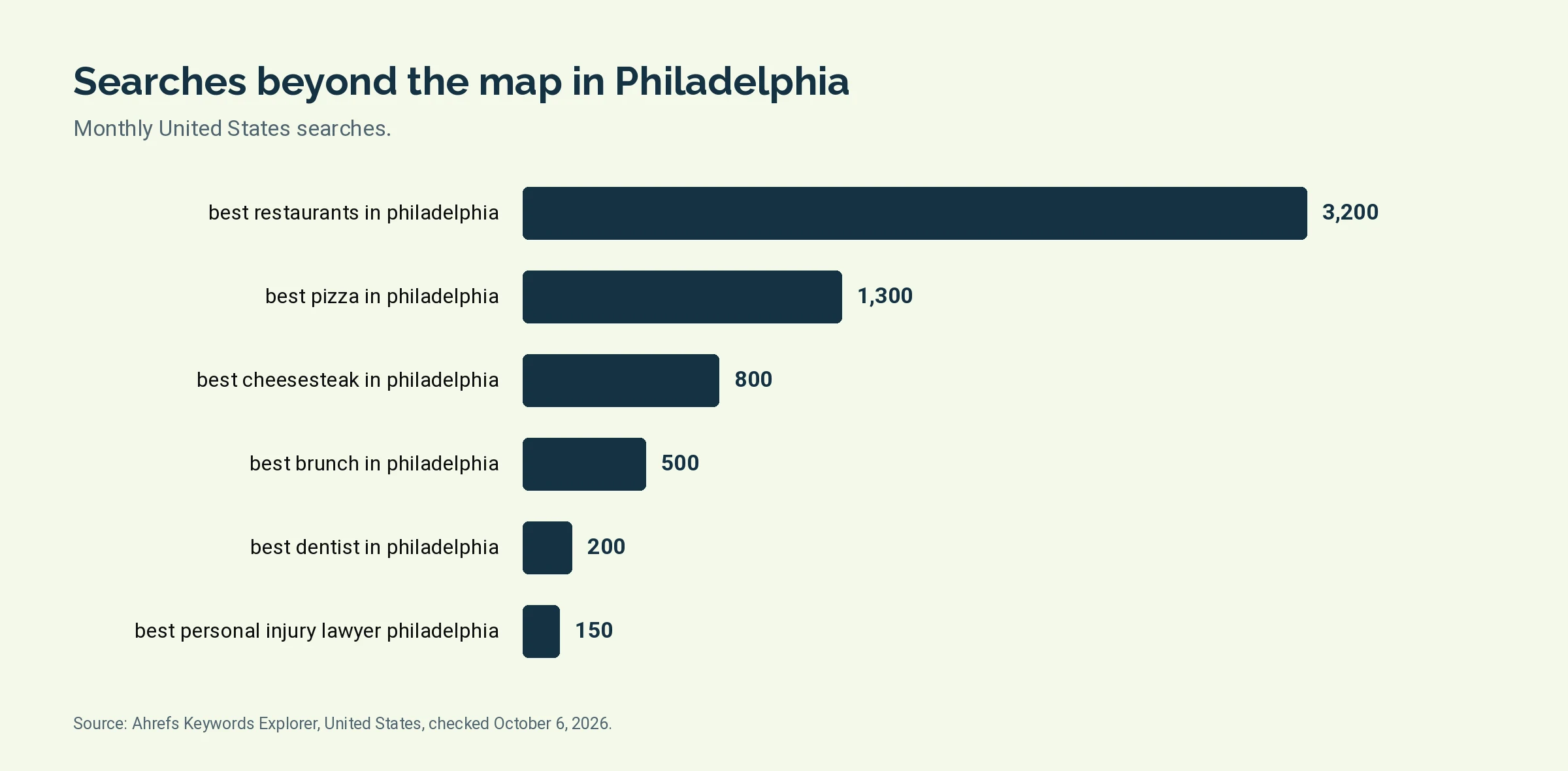
Here the "best" searches are real. Ahrefs Keywords Explorer shows about 3,200 searches a month in the United States for "best restaurants in philadelphia", about 1,300 for "best pizza in philadelphia", about 800 for "best cheesesteak in philadelphia" and about 500 for "best brunch in philadelphia".
Professional terms are smaller and harder: about 200 for "best dentist in philadelphia", about 150 for "best personal injury lawyer philadelphia" and about 100 for "philadelphia contractor license". "Best mechanic in philadelphia" is too small to measure. These results are lists and articles, not maps, so a business in any of the 18 planning districts can compete with a page worth citing.
Do AI tools name Philadelphia businesses?
They do, though we have not tested Philadelphia. A city of 1.6 million gives AI tools plenty of reviews, articles and lists to draw on, so answers tend to repeat the names those sources repeat. Ask ChatGPT, Gemini, Google AI Overviews and Microsoft Copilot for the best in your category and your neighborhood, and write down which sources are cited. Those sources are your target list. AEO | GEO covers the work.
Local SEO and the map pack in Philadelphia, PA
What makes ranking in Philadelphia different?
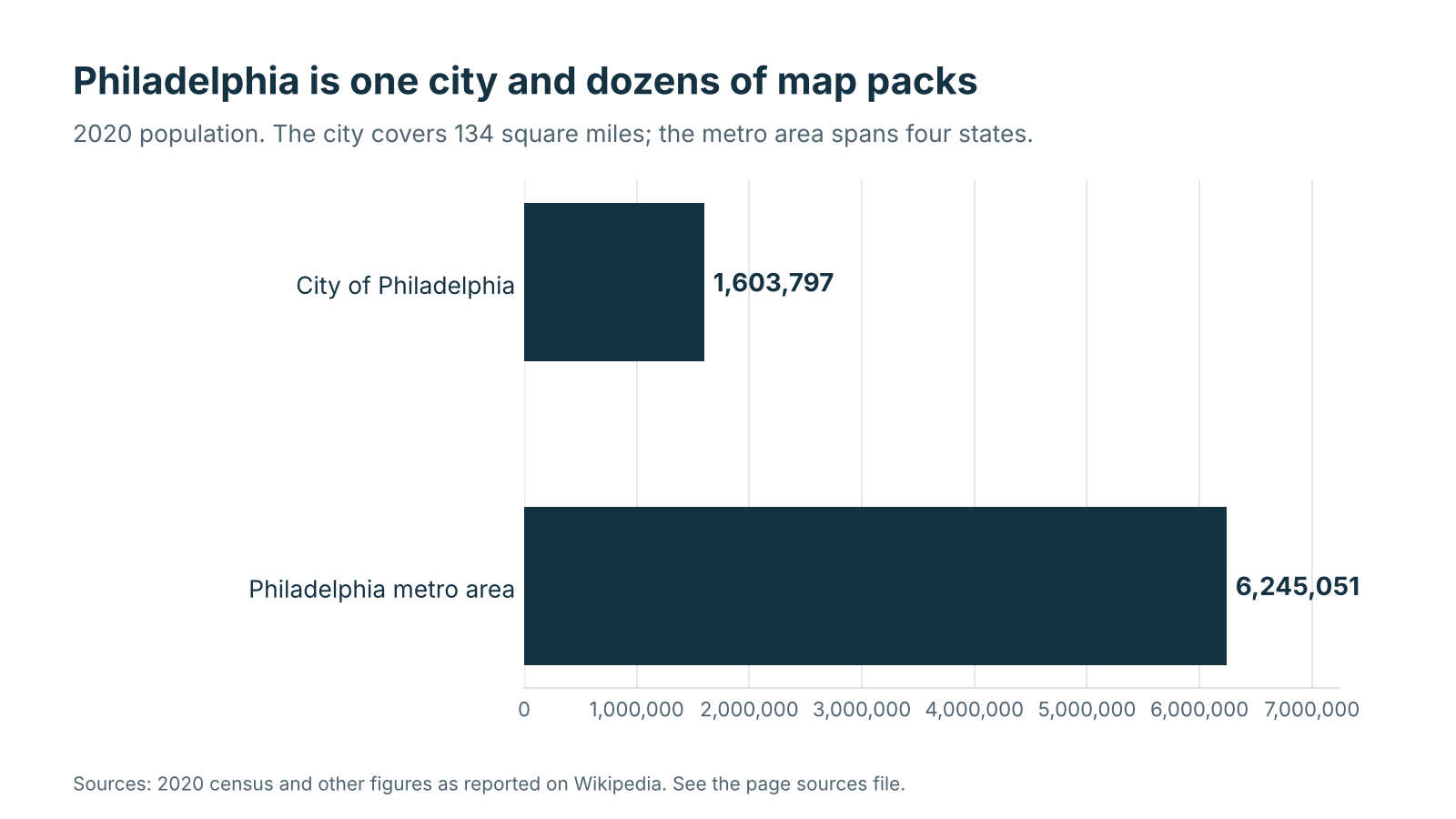
Philadelphia had 1,603,797 residents at the 2020 census, in 134 square miles. It is the sixth-largest city in the country. The metro area around it holds 6,245,051 people across four states.
No small business ranks across all of that from one address. Google weighs how close a business is to the searcher, and in a dense city there is almost always a competitor closer. The practical result is that Philadelphia is not one market. It is dozens.
"Philadelphia" is a section, then a neighborhood
The city is usually described as Center City plus six surrounding sections: North, Northeast, South, Southwest, West, and Northwest Philadelphia. The city's own planning process divides it into 18 districts. Residents think smaller still, in neighborhoods.
That is how people search. Someone in South Philadelphia looking for a dentist types "dentist near me" and gets South Philadelphia dentists. A practice in the Northeast is not in that map pack, and no amount of work on its profile will put it there.
The honest target is a neighborhood cluster
A good plan for a Philadelphia business answers three questions:
- Where do I hold the top 3 today? A grid scan shows the edge.
- Which neighborhoods sit just past that edge? Those are the next targets.
- Which parts of the city will I never reach from here? Those need ads, area pages that rank in the regular results, or a second location.
An agency that promises "page one in Philadelphia" for a service business is describing something that does not exist on the map.
How far does a map ranking reach in Philadelphia?
Not far. As a planning rule, the Local SEO program fits businesses that serve customers within about 5 to 20 miles of their address, and larger cities with more competitors shrink the area where any one business holds the top 3.
We start Philadelphia businesses on the 5-mile community grid. In crowded categories such as restaurants, dentists, and personal injury law, the top 3 area often covers only part of that grid on the first scan. Seeing the edge is the point. How to read a map grid report explains the patterns.
Which areas need their own pages?
In most towns, area pages are for neighboring boroughs. In Philadelphia they are for neighborhoods and sections of the same city.
Each page should say something true about serving that neighborhood: parking, transit, the kind of housing, the jobs you do there. Service area landing pages covers the structure.
Is the Local SEO program a good fit for your Philadelphia business?
See the Local SEO services page and the packages page. If you are weighing ranking work against ads, read local SEO vs. Google Ads. Other Pennsylvania markets include Pittsburgh and Allentown, with the rest on the Pennsylvania page and the locations page.
Industries we work with in Philadelphia, PA
- Law firms. Philadelphia is one of the most crowded legal markets in the state, and Pennsylvania's Rule 7.2 requires ads to name the city or town of the office. See local SEO for law firms.
- Restaurants and coffee shops. Dense, with heavy review counts.
- Medical practices and dental practices.
- Home services. Row houses, old plumbing, and tight parking make this its own trade. Philadelphia also runs its own plumber licensing.
- Tour operators around the historic district.
- Auto repair shops.
Philadelphia, PA SEO FAQ
What is the difference between local SEO and SEO for a Philadelphia business?
Local SEO wins the map pack in your neighborhood and the ones beside it. SEO wins the regular results for citywide and "best" searches, which no single address can hold on the map. In Philadelphia the second is the only route to customers in other sections of the city.
Where should a Philadelphia business start?
Start with a 5-mile grid scan to find the edge of your top 3 area. With a verified profile, at least 10 reviews and a 3.5-star rating, the Local SEO program comes first. Then add pages for the neighborhoods just past that edge.
Can my business rank across all of Philadelphia?
No, not on the map from one address. Google weighs distance, and the city has 1.6 million people in 134 square miles. A realistic target is your neighborhood and the ones next to it.
Does Galli Local have an office in Philadelphia?
No. Galli Local is based in Bellefonte, Pennsylvania, and works with clients remotely.
Should I create a page for every Philadelphia neighborhood?
No. Write pages for your own neighborhood and the ones that border it, where the grid shows you fading. Dozens of thin neighborhood pages do more harm than good.
Can a suburban business rank in Center City?
Rarely on the map. An area page that ranks in the regular results, or ads aimed at Center City, are the realistic ways to reach it.
How long does local SEO take in Philadelphia?
First map grid movement usually shows in 1 to 3 weeks. Reaching the top 3 on competitive terms takes 30 to 90 days, and crowded categories in a city this size tend to sit at the longer end.
Is a co-working space address allowed on Google?
Only if you have clear signage, customers can reach you there during your stated hours, and your own staff are present. Otherwise the profile risks suspension.