
Quick summary: Google Ads produces leads within days, and the leads stop when the budget stops. Local SEO takes three to six months to build, then produces calls from the map pack and organic results without a cost per click. For most local businesses the best return comes from running ads first for immediate leads, then shifting budget toward SEO as organic rankings take hold.
Owners usually ask this question with a fixed monthly budget and a need for calls. The answer depends on how soon you need leads and how long you plan to stay in business at that location.
What is the difference between local SEO and Google Ads?
Local SEO is the work of ranking your Google Business Profile in the map pack and your website in the organic results. You pay for the work. You do not pay Google for clicks.
Google Ads, also called pay-per-click or PPC, places your business in sponsored positions. You pay each time someone clicks. Local Services Ads are a related format where you pay per lead.
| Local SEO | Google Ads (PPC) | |
|---|---|---|
| Where you appear | Map pack and organic results | Sponsored positions at the top |
| Cost model | Monthly fee or your time | Pay per click, plus management |
| Time to first leads | 1 to 6 months | Days |
| What happens if you stop | Rankings hold, then slowly decline | Leads stop the same day |
| Geographic reach | Strongest near your address | Any area you choose to target |
| Trust | Reviews and rankings read as earned | Labeled as sponsored |
| Best for | Lower cost per lead over time | Speed, new markets, promotions |
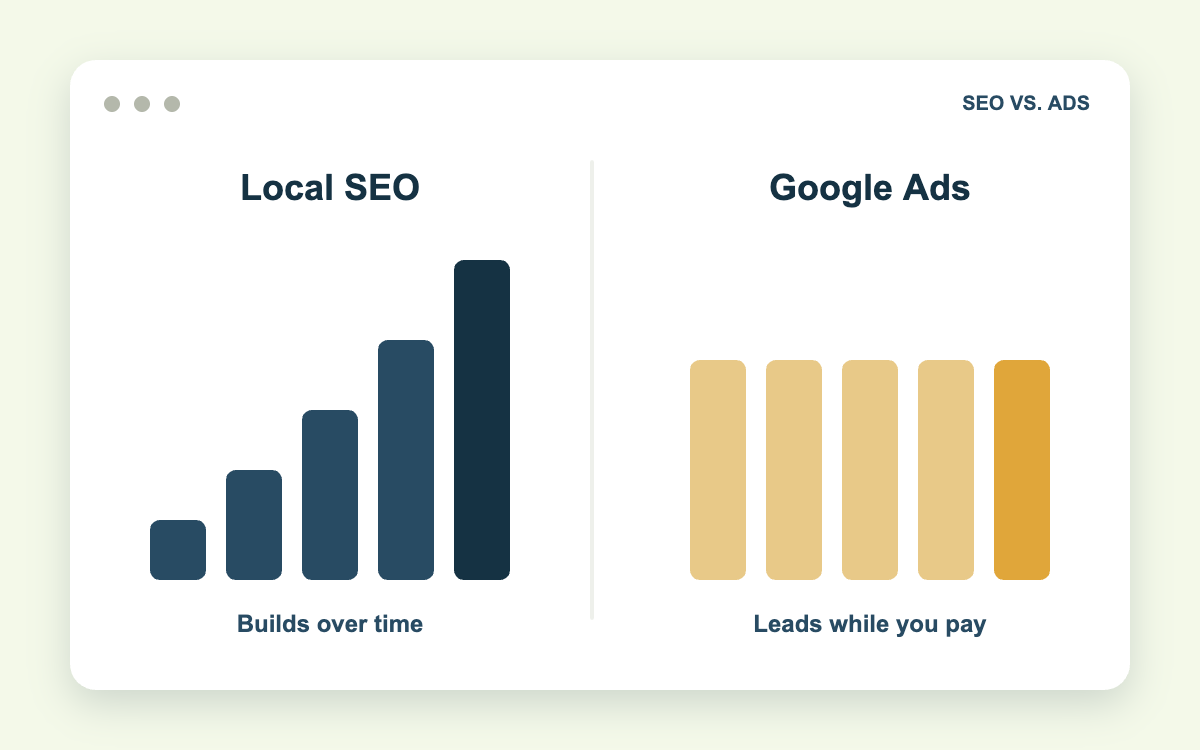
How much does each one cost?
Costs vary widely by industry and city. The structure of the cost is what matters for comparing them.
Google Ads cost is linear. Each lead has a price. If a click costs $20 and one in ten clicks becomes a lead, each lead costs $200. Double the leads and the spend doubles. Competitive categories such as personal injury law, roofing, and emergency plumbing have some of the highest click prices in search.
Local SEO cost is mostly fixed. You pay a similar amount each month whether it produces 10 calls or 100. Early on, the cost per lead is high because rankings have not moved yet. As rankings improve, the same monthly cost is spread across more calls.
A worked example
These numbers are illustrative. Use your own figures to run the same math.
| Month | Ads spend | Ads leads | SEO spend | SEO leads |
|---|---|---|---|---|
| 1 | $2,000 | 10 | $1,500 | 0 |
| 3 | $2,000 | 10 | $1,500 | 4 |
| 6 | $2,000 | 10 | $1,500 | 12 |
| 12 | $2,000 | 10 | $1,500 | 25 |
| 12-month total | $24,000 | 120 | $18,000 | about 130 |
In this example, ads cost $200 per lead every month. SEO produces no leads in month one and costs about $60 per lead by month twelve. Over the first year the totals are close. In year two the gap widens, because the SEO leads continue at the same fixed cost.
The pattern holds across most local markets, though the timing shifts with competition.
When is Google Ads the better choice?
- You need calls this month. A new business with no reviews and no rankings cannot wait for SEO.
- You want customers outside your map radius. Ads can target a city 20 miles away where your profile will not rank.
- The service is urgent and high-value. Emergency repairs and legal intake often justify a high click price.
- You are testing. Ads show which services and messages convert before you invest in content.
- Demand is seasonal. You can turn ads up for AC season and down afterward.
When is local SEO the better choice?
- You plan to be at this address for years. Rankings and reviews are assets tied to the location.
- Your ad costs keep rising. Click prices in competitive categories trend upward.
- Customers compare before calling. Reviews and map position influence that comparison.
- Your budget is limited. A modest SEO budget can still compound. A modest ads budget may buy only a few clicks a day.
- You want leads from AI tools. Assistants cite businesses based on reviews, listings, and website content, and ads do not appear in those answers the same way.
What do Local Services Ads add?
Local Services Ads sit above standard ads for many home service and professional categories. They show your reviews and a verification badge, and you pay per lead.
They draw the star rating and review count from your Google Business Profile. A business with strong reviews tends to get more leads from the same budget, which is one way SEO work directly improves ad performance.
Why the best ROI usually comes from both
The two channels share inputs and cover each other's gaps.
- Months 1 to 3: ads carry lead volume while SEO work begins on the profile, citations, reviews, and location pages.
- Months 4 to 9: organic and map leads grow. Use ads data to pick which keywords deserve content.
- Month 10 onward: shift ad budget to what organic cannot reach, such as distant cities, new services, and peak season.
Take an HVAC company spending its whole budget on ads. Leads are steady, but margins shrink each year as click prices rise. Moving a third of that budget into SEO lowers the blended cost per lead within a year, and the ads that remain convert better because the profile now shows more reviews.
Both channels also depend on the same landing pages. A slow page with a buried phone number wastes ad clicks and organic visits alike.
How should you measure ROI?
Compare both channels on the same terms.
- Cost per lead: total cost, including management fees, divided by qualified calls and forms
- Cost per booked job: leads that became customers
- Revenue per channel: tracked with call tracking and form source data
- Payback period: how many months until the channel returns more than it cost
Judge ads monthly. Judge SEO over rolling 90-day periods, since rankings move gradually.
Free spreadsheet: Local SEO vs. Google Ads budget calculator. A spreadsheet that compares cost per lead and revenue for ads and SEO over 12 months.
Frequently asked questions
Is SEO or PPC better for a new local business?
Start with ads for immediate leads and set up your Google Business Profile and review requests on day one. Add SEO investment as revenue allows.
How long does local SEO take to work?
Expect early movement in one to three months and meaningful lead volume in three to six, longer in competitive metro areas.
Do Google Ads improve organic rankings?
No. Google states that advertising has no effect on organic or map rankings. Ads can still help indirectly by producing customers who leave reviews.
Can I stop ads once SEO is working?
You can reduce them. Many businesses keep a smaller budget for areas and services where they do not rank organically.
Find the right split for your budget
We manage both channels, so the recommendation is based on your numbers. Our local SEO services build the long-term asset, and PPC management covers immediate demand.
Landing pages affect both, which is where design and CRO fits. Compare what each level includes on our packages page.
Contact Galli Local to request a budget review. Share your current monthly spend and lead count, and we will show you the cost per lead for each channel and where the next dollar should go.
Sources: Google: how Google Ads works with organic results, Google: how local results are ranked