
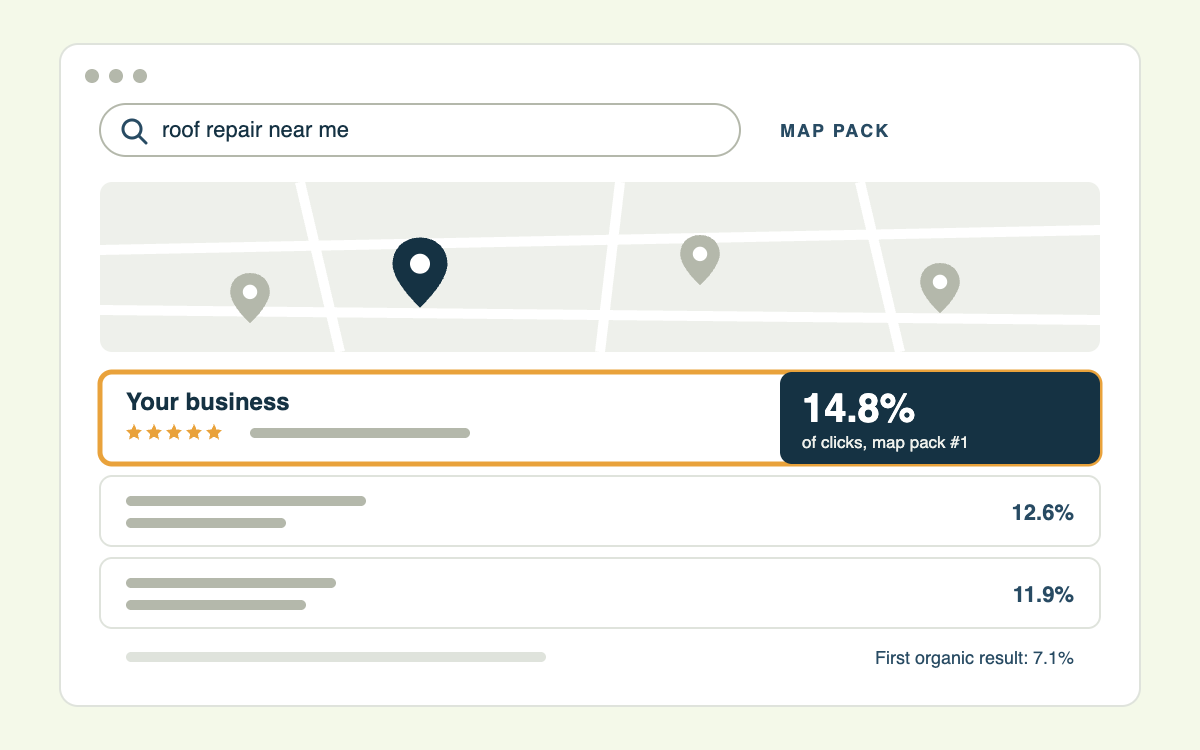
A single ranking number tells you very little about local search. Google shows different map results depending on where the searcher is, so a business can be first at its front door and invisible two miles away. A map grid report fixes that by checking your ranking from dozens of points across your service area.
What a map grid report shows
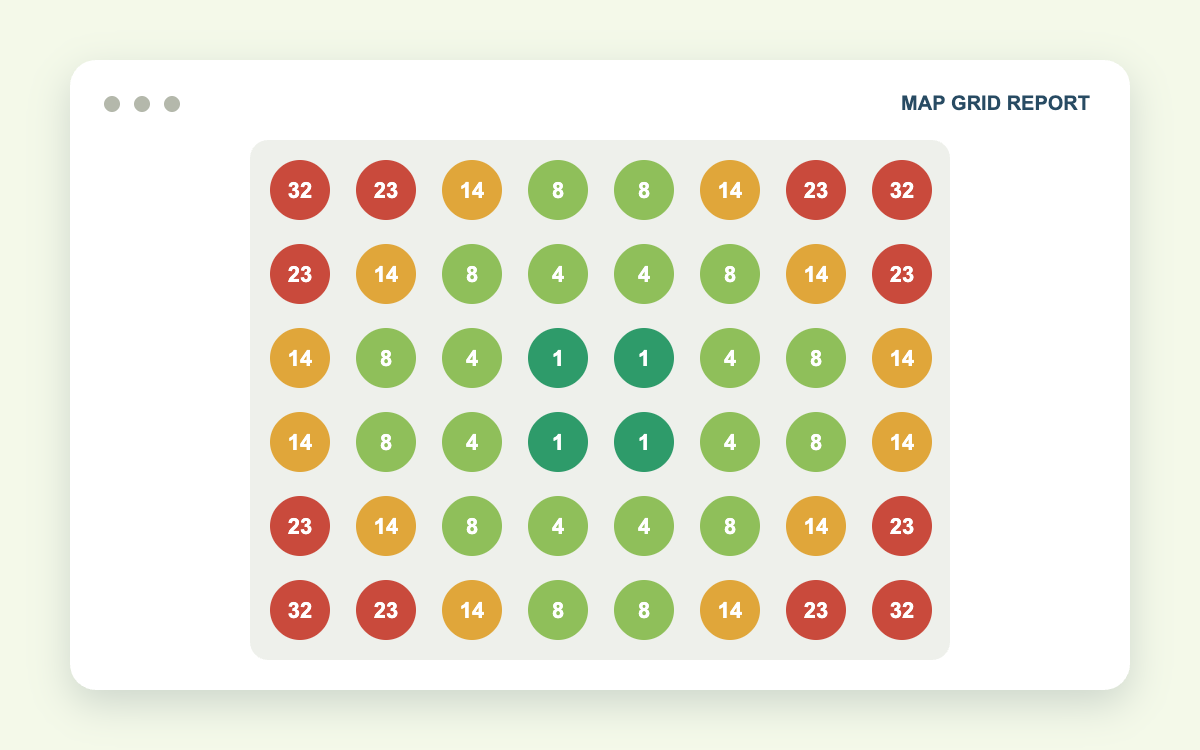
Picture a grid laid over your city, often 5 miles across for a neighborhood-focused business or 10 miles for a citywide one. At each point, a search runs for one keyword, such as "personal injury lawyer near me," and records where your business appears in the map results. Each dot shows that position. Green dots are top 3, yellow dots are close, and red means you're far down the list or missing.
Grid scan tools compared
Several tools produce grid reports. They draw on the same Google Maps results and differ in grid size, pricing, and what they call their numbers.
Plans change often, so confirm details with the vendor. Entry plans for most of these start at roughly $25 to $40 a month.
Why two tools can show different numbers for the same business
- Grid size and spacing. A wide grid includes more distant points, so average rank looks worse than on a tight grid.
- How missing points are counted. Some tools leave "not found" points out of the average. Others count them as a low rank.
- Cut-off depth. Most tools check the top 20 results at each point.
- Time of scan. Open or closed status changes rankings.
The practical rule: pick one tool and one setup and keep both fixed. A number only means something next to an earlier number produced the same way.
The tool matters less than what you do with the scan. A grid shows where you rank. It doesn't fix the profile, the citations, or the pages behind a weak area. That work is what our local SEO services cover, with a grid report each month to show what changed.
The three numbers that matter
Average rank is your average position across every point on the grid. Lower is better. Coverage is the share of points where you appear in the top 20 at all. Top 3 share is the share of points where you're in the map pack, the three listings most people call. Top 3 share is the number most closely tied to phone calls.
Read them together. Low coverage means Google barely connects you to the keyword, so the page or profile may need more content behind that term before anything else. High coverage with a weak top 3 share means you're close, and steady work can move you up.
Reading the shape of the grid
The pattern often says more than the averages. Strong results near your office that fade in one direction usually point to nearby towns your website never mentions. Areas that stay red month after month often line up with a competitor's office or a neighborhood your profile doesn't cover. Area pages and service content are how a business breaks through those stalled parts of the grid. Our SEO content service builds those pages.
What moves a business into the 3-pack
Google's local ranking comes down to relevance, distance, and prominence. You can't move your office, but you can work on the rest:
- Profile accuracy: the right primary and secondary categories, plus services and descriptions written around real search terms
- Reviews: a steady flow of new reviews with responses. Profiles with fewer than about 10 reviews, or under 3.5 stars, struggle to hold the top 3
- Citations: the same name, address, and phone everywhere your business is listed
- Website support: service and area pages that match what people search, linked from your profile
- Local engagement: real activity on your profile for the terms you want to rank for
Our Local SEO program covers all five and reports them on a grid every month.
Choosing which keywords to track
Start with a short list. A keyword with decent coverage and room to climb is a better starting point than one you already own or one where you don't show up at all. Add new terms as the first set reaches the top 3. Loading every keyword at once spreads effort thin and slows down the ones closest to breaking through.
What to expect over time
Rankings often move within the first few weeks, then bounce around while Google tests results. Reaching the top 3 on competitive terms usually takes 30 days or more. Judge progress by calls as well as dots: look at your profile's calls, website clicks, and direction requests next to the grid each month.
Want to see your own grid? Request a free map grid audit, or read what to ask before hiring an SEO company.
Free guide: How to read a map grid report. The color bands, the key numbers, seven common patterns, and six grid scan tools compared.
More articles
How to get your business named in ChatGPT and Google AI Overviews
Hiring an SEO company for your law firm: what to ask first
All articles