
Quick summary: SEO (search engine optimization) is the work of ranking in Google's results, including the map. AEO (answer engine optimization) is the work of having your content used as the direct answer to a question. GEO (generative engine optimization) is the work of getting your business named and cited when an AI tool such as ChatGPT, Gemini, Perplexity, or Google's AI Overviews writes a response. For a local business, the three share most of their groundwork, and the map pack still comes first.
What is the difference between AEO, GEO, and SEO?
The difference is the result you are trying to earn. SEO earns a position. AEO earns the answer box. GEO earns a mention inside an answer that an AI tool writes from several sources.
| SEO | AEO | GEO | |
|---|---|---|---|
| Stands for | Search engine optimization | Answer engine optimization | Generative engine optimization |
| The goal | Rank in the map pack and the organic results | Be the direct answer to a question | Be named or cited in an AI-written response |
| Where it shows | Google Maps, the map pack, the regular results | Featured snippets, voice answers, the top of an AI answer | ChatGPT, Gemini, Perplexity, Google AI Overviews and AI Mode |
| What it rewards | A complete Business Profile, reviews, service pages, links | A clear answer in the first lines, FAQ sections, numbered steps | Matching business details across the web, reviews, mentions on trusted sites |
| How you measure it | Map grid scans, rankings, calls, direction requests | Whether your page is the one quoted | How often you are named across a fixed list of questions |
| Best for | "Near me" and service-plus-town searches | "How", "what", and "how much" questions | "Who should I hire" and comparison questions |
Is AEO the same thing as GEO?
Nearly. In practice the two names describe the same job from two angles, which is why we write the service as AEO | GEO and sell it as one thing.
GEO is the term with a research paper behind it. A team of researchers from Princeton University and IIT Delhi published "GEO: Generative Engine Optimization" in November 2023. The paper describes generative engines as systems that answer a query by pulling information from several sources and summarizing it with a language model. In the authors' own benchmark, their methods raised a source's visibility in those responses by up to 40%. That figure comes from a test set, not from local business searches, so treat it as proof the idea works and not as a forecast.
AEO is the older, looser term. It grew out of featured snippets and voice search, where the goal was to be the one answer read aloud. If an agency quotes you separate fees for AEO, GEO, and "AI SEO", ask what work differs between them. Usually nothing does.
AEO vs SEO: do you need both?
Yes, and you already do most of AEO when you do SEO well. Google says so directly. Its guidance for site owners states that there are no additional requirements to appear in AI Overviews or AI Mode and no special optimizations needed, and that SEO best practices still apply. A page has to be indexed and eligible to show in regular Search before it can be used as a supporting link in an AI answer.
So a page that cannot rank cannot be cited by Google's AI features either. What AEO adds is how the page is written:
- the answer in the first one or two sentences
- numbered steps for any process
- short FAQ sections phrased the way customers ask
- facts tied to a named source
- schema that states your business name, address, and services
Our guide to local schema markup covers the last item.
GEO vs SEO: what changes for a local business?
Two things change: where the AI tool looks, and how you know whether it worked.
Where it looks. Google ranks your Business Profile and your pages. An AI tool builds a picture of your business from many places at once: your website, your profile, directories, review sites, news coverage, and forums. It favors a business it can confirm in more than one place. A firm whose name, address, and phone number match everywhere is easy to confirm. A firm with three old addresses floating around is not. That makes citation cleanup, which has always been part of local SEO, the first GEO task as well. See what is NAP consistency and the top 20 local business directories.
How you measure it. A ranking is a position you can check. An AI answer changes from one session to the next, even for the same question. The only fair measure is a fixed list of questions, asked on a schedule, with a count of how often you are named. One good or bad answer tells you nothing.
What should a local business do first?
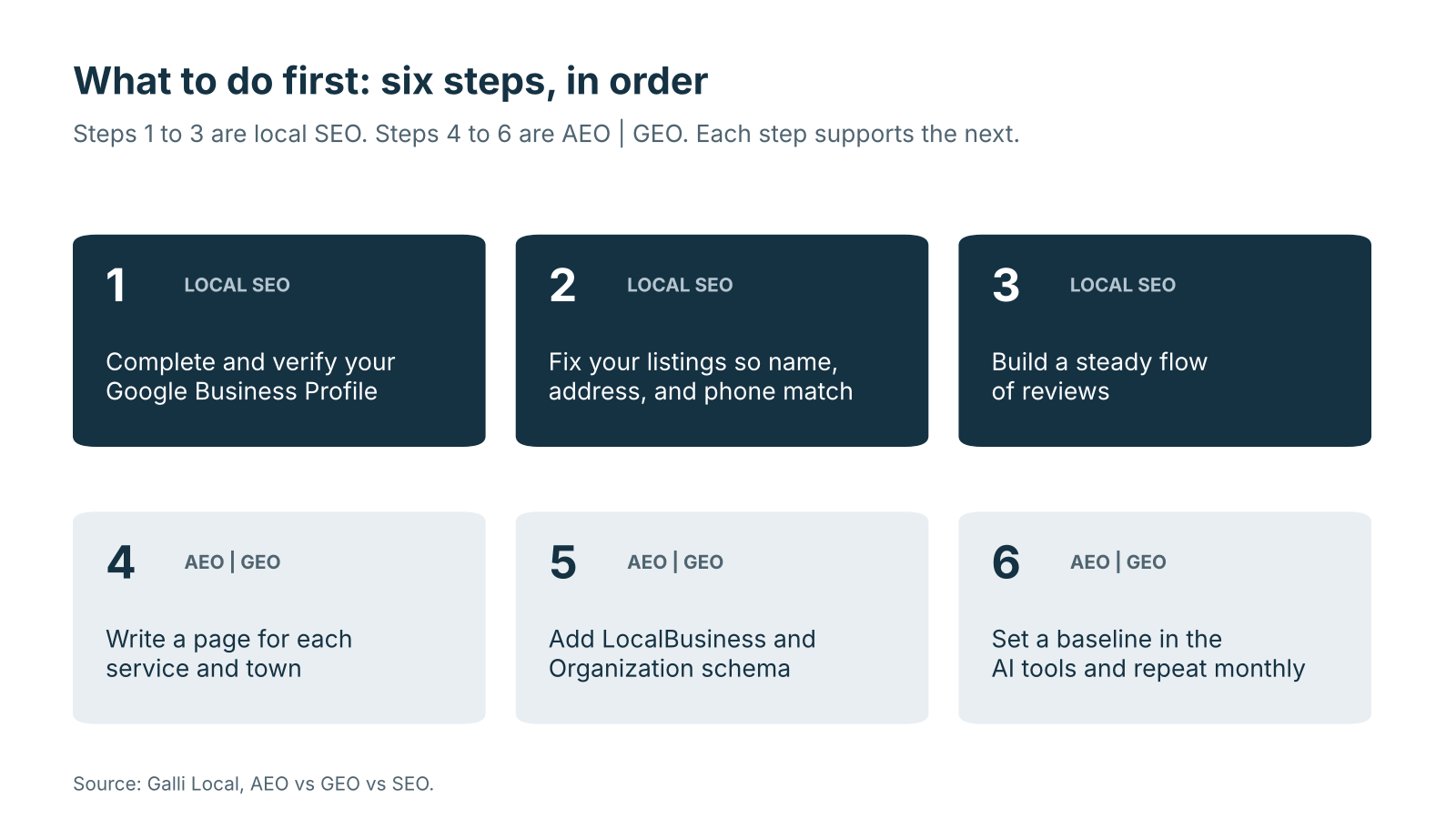
Work in this order. Each step supports the next, and the first three are local SEO.
- Complete and verify your Google Business Profile. Pick the right primary category, list every service, and add current photos. Our guide on how to optimize your Google Business Profile walks through it.
- Fix your listings. Make your name, address, and phone number match on every directory. Remove duplicates.
- Build a steady flow of reviews. Reviews move the map pack, and AI tools read review sites as independent confirmation.
- Write a page for each service and each town you serve. Put the answer first. Add an FAQ section.
- Add schema. LocalBusiness and Organization markup with links to your official profiles.
- Set a baseline in the AI tools. Write ten questions a customer would ask, run them in ChatGPT, Gemini, Perplexity, and Google, and record who gets named. Repeat every month.
Steps 1 to 3 are covered by the Local SEO program. Steps 4 to 6 are the AEO | GEO work. The article on getting your business named in ChatGPT and Google AI Overviews goes deeper on step 6.
Where does the map pack still matter more?
For any search where the person wants to call, book, or drive somewhere today. Someone who types "plumber near me" or "dentist in State College" is choosing a business, not reading an explanation. Google answers that search with a map and three listings, and those listings come from Business Profiles.
AI answers have taken over a different kind of search: the question. "How long does a water heater last" used to send a visitor to a blog post. Now the answer often appears at the top of the page. That shift matters for content. It matters much less for the search that ends in a phone call.
A simple way to split your effort:
| The customer is | Example search | Put your effort into |
|---|---|---|
| Ready to buy | "emergency plumber near me" | Map pack: profile, reviews, grid tracking |
| Comparing options | "best family lawyer in [town]" | Map pack first, then listings and reviews that AI tools read |
| Asking a question | "do I need a lawyer for a DUI" | Answer-first pages and FAQ sections |
| Asking an AI tool who to hire | "who should I hire to fix my furnace" | Consistent listings, reviews, and mentions on local sites |
If your profile is unverified, has few reviews, or does not rank anywhere on the map, AEO and GEO are too early. Fix the map first. The guide on how to rank in Google's local 3-pack covers that.
When is AEO | GEO worth paying for?
When three things are true: your Business Profile already works, your site has service pages, and you sell something people research before they call. Legal, medical, and home repair services fit that description. So does any business that has moved, rebranded, or changed phone numbers and suspects old listings are still out there.
At Galli Local, AEO | GEO is bundled with the Local SEO program and GBP management because all three use the same listings and reviews. You pay for the cleanup once. The bundle is quoted, and the packages page lists what it includes. No one can guarantee a mention in an AI answer. What can be controlled is whether the web describes your business clearly and the same way everywhere.
Common questions about AEO, GEO, and SEO
Is SEO dead because of AI?
No. Google states that SEO best practices still apply to its AI features, and a page must be indexed and eligible for regular Search before an AI Overview can link to it. For local buying searches, the map pack still drives the calls.
Which should a local business do first: SEO, AEO, or GEO?
Local SEO first. A verified Business Profile, matching listings, and steady reviews are the base for all three. AEO and GEO build on that base and do little without it.
Are AEO and GEO different services?
Not in practice. Both aim to get your business used or named in an AI answer, and the work is the same: clean listings, answer-first pages, schema, and tracking. That is why we write it as AEO | GEO.
How do I know if AI tools mention my business?
Ask them. Write a fixed list of questions a customer would ask, run it in ChatGPT, Gemini, Perplexity, and Google on a schedule, and count how often you are named. Answers vary by session, so judge the trend across the full list.
Do I need an llms.txt file or special AI markup?
No. Google says no AI-specific files or markup are needed to appear in AI Overviews or AI Mode. Accurate listings and well-structured pages do more.
How long does AEO | GEO take to show results?
Listing corrections take four to eight weeks to spread across directories. Changes in AI mentions usually follow over the next few months, and no one can guarantee them.
Find out where you stand on the map and in AI answers
Request a meeting. It includes a free map grid audit, and we will show you which of the steps above your business still needs. More guides are on the articles page.