
☰
All servicesLocal SEOGBP managementAEO | GEOSEO contentTechnical SEOLink buildingDesign & CROPPC managementIndustriesLaw firmsHome servicesPlumbersHVACElectriciansRoofersMedical practicesOrthopedicsPhysical therapyDental practicesGeneral dentistsOrthodontistsPeriodontistsEndodontistsRestaurants and coffee shopsTour operatorsAuto repair shopsLocationsPennsylvaniaState CollegeBellefonteAltoonaWilliamsportLock HavenLewistownPhiladelphiaPittsburghAllentownHarrisburgNew YorkNew York CityBuffaloRochesterAlbanyTexasHoustonDallasSan AntonioAustinUtahSalt Lake CityProvoSt. GeorgeConnecticutBridgeportNew HavenHartfordStamfordOhioColumbusClevelandCincinnatiWashingtonSeattleSpokaneTacomaNevadaLas VegasRenoHendersonPackagesAboutResourcesArticles
Home / Industries / Home services / Local SEO
Local SEO for home service companies
Quick summary: Local SEO for plumbers and HVAC companies is the work of getting a trade business into the Google map pack across the towns it drives to, not only the block around the shop. Galli Local runs it for small plumbing, heating, and cooling companies. This page covers how homeowners search, how to set up and maintain a service-area profile, which directories count, how the map grid is tracked across your towns, and what Google checks before it runs your Local Services Ads.
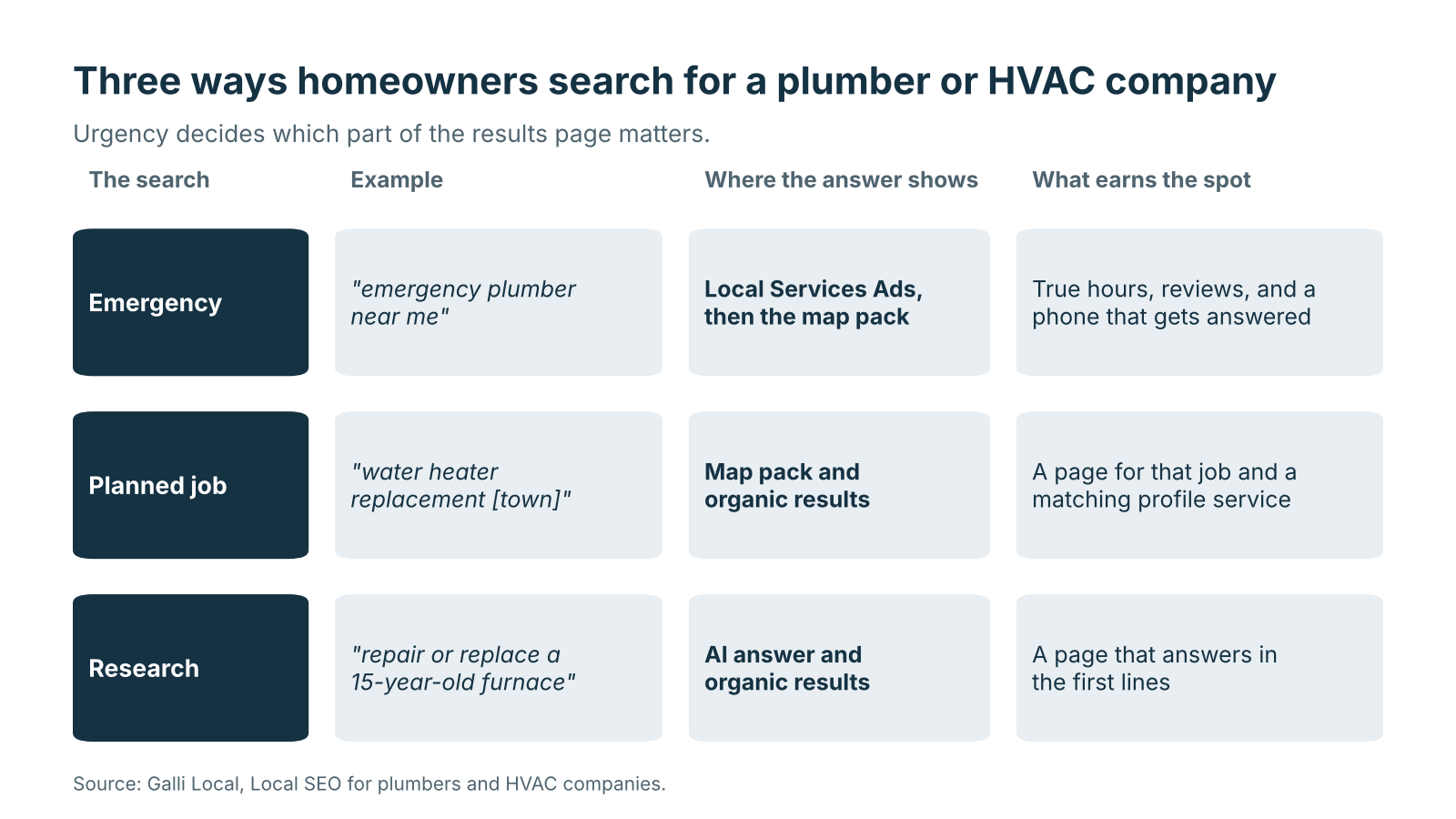
How do homeowners search for a plumber or HVAC company?
Home service searches split by urgency, and urgency decides which part of the results page matters.
Emergency searches are where a trade business lives or dies on the map. The caller picks from the first few names and calls until someone answers. That makes two things on your profile worth more than anything else: hours that are true, and a number that is picked up.
Planned jobs are different. The homeowner compares two or three companies and reads reviews. This is where a page for each service pays off, because a profile with no page behind "tankless water heater installation" rarely ranks for it.
When we asked four AI tools who to call for an emergency plumber and which HVAC company to hire in State College, the companies they named were mostly ones with a map listing, a rating, and wording about 24-hour service. The full results are in our State College AI search study.
How should a service-area business set up its Business Profile?
This is the part most trade companies get wrong, and it is specific to businesses that go to the customer.
Address and service area
Google's guidelines treat a business that serves customers at their homes as a service-area business. Three rules follow from that:
- One profile per real location. You get a profile for the office or shop you work from, not one for each town you serve.
- Hide the address if customers do not come to you. If you have no counter or showroom, the address stays off the listing and you set a service area instead.
- Keep the service area realistic. Google says it should not reach farther than about two hours of driving from your base.
The service area you set tells customers where you work. It does not make you rank there. Rankings are still measured from your real address, which is why a company based on one side of a county ranks well there and fades on the far side. The fix is content: a page on your site for each town you want calls from. Our guide to service area landing pages shows how to write them.
A hidden address still has to be real. The Local SEO program needs a verified Business Profile at a real physical address. A rented mailbox or a virtual office breaks Google's rules and gets profiles suspended.
Categories
The place cards we saw in our study carried categories such as "Plumber", "HVAC contractor", and "Air conditioning contractor". Pick the primary category for the work you most want, then add the others as secondary categories.
A company that does both plumbing and HVAC has to choose. The primary category carries the most weight, so a shop that makes most of its money on heating and cooling but lists "Plumber" first is competing in the wrong pack. We decide by scanning both on a grid and checking what the top-ranked companies in your area use.
Fields that matter for a trade
- Hours. If you take emergency calls at night, the hours should say so. If you do not, they should not.
- Services. List each job by the name customers use: drain cleaning, water heater repair, furnace installation, mini-split installation.
- Service area. Towns or counties you will drive to today, not the ones you hope to reach.
- Photos. Covered below.
- Booking or estimate link. Send it to a short form, not your home page.
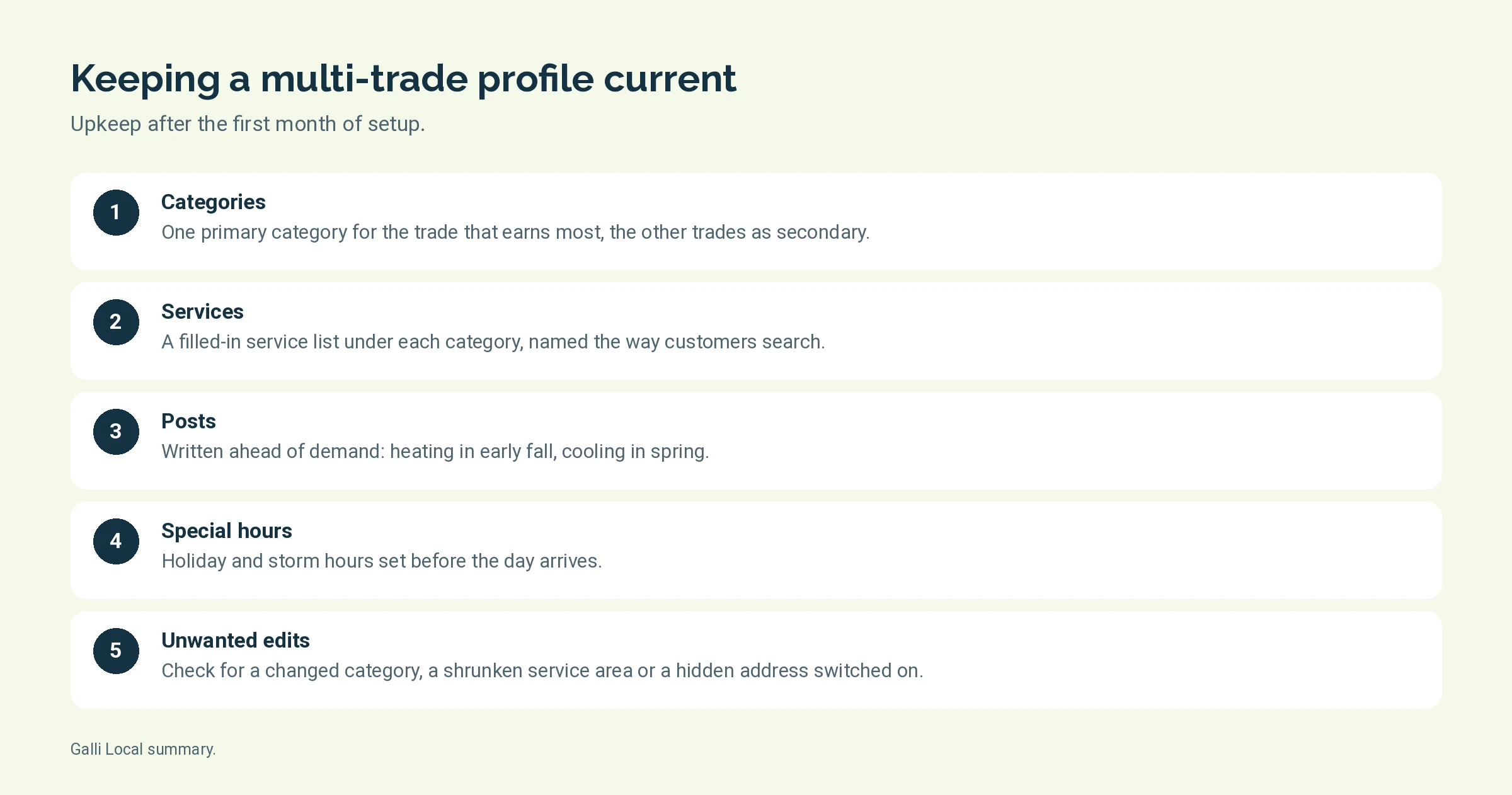
Keeping the profile current when you run more than one trade
A company with several trades has more to keep straight than a single-trade shop.
- Secondary categories. With "Plumber" or "HVAC contractor" as the primary category, the others go in as secondary: "Electrician", "Roofing contractor", "Air conditioning contractor", or "Handyman/Handywoman/Handyperson" for small repair work. Add one only if you take that work every week.
- Services under each category. A company with three trades should have three filled-in service lists, not one long list under the primary.
- Description. Name the trades, the towns, and your license or registration number.
- Posts. Post ahead of demand: furnace tune-ups in early fall, AC checks in spring.
- Special hours. Set holiday and storm hours before the day arrives.
- Unwanted edits. A hidden address switched back on, a service area cut down, a category changed. We check for them and reverse the wrong ones.
Posting and edit monitoring are part of GBP management, which is bundled with the Local SEO program.
What reviews and photos work for home services?
Reviews
Ask at the end of every job, while the tech is still in the driveway or right after the invoice is sent. A steady flow matters more than a burst, and reviews that mention the job and the town help the profile match those searches.
Two rules apply to how you ask. Google does not allow payment, discounts, or free services in exchange for a review, and it does not allow asking only your happy customers. The FTC's rule on reviews and testimonials also bans fake reviews and requires employees to disclose their connection if they post one.
Our guides on getting more Google reviews and responding to negative reviews have wording you can copy.
Replies and removal requests
Reply to every review. For a good one, name the job and the town: "Glad we could get the heat back on in Pleasant Gap." For a bad one, do not argue the invoice in public. Say you want to fix it and give the office contact.
The Local SEO program monitors reviews and flags 1- and 2-star reviews for removal when they break Google's policies. The usual cases are a review meant for a company with a similar name or one from a person you never served. A fair complaint about price stays up, and only Google decides what comes down.
Photos
Customers want proof that you are a real local company. A useful set for a trade business:
- your trucks, with the company name readable
- your techs in uniform
- finished work: a new water heater, a clean furnace install, a re-piped wall
- before and after pairs
- your shop or office from the street, if customers visit
Which directories matter for plumbers and HVAC companies?
Start with the listings that customers and AI tools both read.
- Google Business Profile and Bing Places. Bing listings fed most of the Copilot Search answers in our study.
- Yelp and the Better Business Bureau. Yelp was cited by Google's AI Overview for the plumber question.
- Angi, HomeAdvisor, and Houzz. The large home service directories. Claim the free listing before you pay for leads.
- Nextdoor and Apple Business Connect.
- Manufacturer dealer locators. If you are an authorized dealer for a furnace or water heater brand, get listed on the brand's "find a dealer" page.
- Local sites. Your chamber of commerce and any builders' association you belong to.
Your name, address, and phone number must match on every one. A trade company that has moved shops or changed its number usually has old listings still out there. See what is NAP consistency to audit your own.
How is a service-area company's map ranking tracked?
A trade company has a different ranking in every town it drives to. A map grid lays points across your territory and records where you appear in Google Maps from each one.
A company with more than one trade usually needs the 20-keyword grid, so each trade gets its own emergency term and its own planned-job terms. The monthly report shows average rank, coverage, and top 3 share, plus calls, website clicks and direction requests. Strong near the shop and blank two towns over is the normal starting picture. The map grid report explainer shows how to read one.
The program also includes local engagement signals on priority keywords, added in tiers as each set reaches the top 3.
What about service and town pages?
The grid shows where a page is missing. If one town stays blank, it likely has no area page. The program gives you the list of pages to add and what each should cover. Writing them is not included. That is SEO content for home service companies, which comes with the AEO | GEO bundle and the full agency stack.
What is not included in the Local SEO program?
- Technical work. Speed, indexing and schema are covered by SEO for home service companies and technical SEO.
- Content writing. Service pages, town pages and articles.
- Links. Supplier, association and local links are link building.
- Ads. Google Ads and Local Services Ads run under PPC management.
Which licensing and advertising rules apply?
Rules for trades vary by state, and sometimes by city. Three points apply almost everywhere.
Local Services Ads have their own screening. Google's published requirements include a license check at the state level where the law requires one, insurance, and a verified Business Profile. HVAC companies also go through background checks on the business, the owner, and the techs. For plumbers, Google lists the background check for select advertisers only. Google says the process usually takes three to four weeks after you submit documents, so start before the busy season.
HVAC technicians who handle refrigerant need EPA certification. Under Section 608 of the Clean Air Act, technicians who add or remove refrigerant must be certified. The certification does not expire. If your techs hold it, say so on your site and profile.
Some states require a registration number in your ads. Pennsylvania is one example: registered home improvement contractors must show their number on advertisements, and we read that to include a website. Check your own state's rule before you publish.
Do not call a registration a license, and do not claim a license you do not hold. This section is a summary, not legal advice.
Which package fits a plumbing or HVAC company?
Most trade companies start with the Local SEO program, which starts at $850/mo per location. It covers Business Profile optimization, citation cleanup, map grid tracking, and recommendations for service and area pages. The Local SEO services page lists everything in it.
Trades often pair it with ads. Local Services Ads and Google Ads bring calls while map rankings build, and PPC management covers both. The article on local SEO vs. Google Ads compares the two. Current rates are on the packages page.
Is this a good fit for your company?
Other industries are on the industries page, including local SEO for law firms and local SEO for medical practices.
Local SEO by trade
- Local SEO for plumbers: emergency and after-hours searches, honest hours, and how far one address reaches.
- Local SEO for HVAC companies: seasonal demand, and repair searches versus replacement searches.
- Local SEO for electricians: licensing, residential versus commercial work, and EV charger searches.
- Local SEO for roofers: storm-driven demand, high-value jobs, and insurance claim wording.
By location: Pennsylvania, State College, PA, Philadelphia, PA, Pittsburgh, PA, New York, Texas, Connecticut, Ohio, Utah, Washington State, Nevada.
Other services for home service companies
- Marketing for home service companies: the hub, with every service in one place
- SEO for home service companies: organic rankings for planned-job and research searches
- AEO | GEO for home service companies: being named when a homeowner asks an AI tool who to call
- SEO content for home service companies: service and town pages written for you
Common questions about local SEO for plumbers and HVAC companies
Should a plumber hide the address on a Google Business Profile?
Yes, if customers never come to your location. Google's guidelines say a business that only serves customers at their homes should hide its address and set a service area.
Does setting a bigger service area help me rank in more towns?
No. The service area tells customers where you work, and it does not change rankings. Rankings are measured from your real address, and area pages on your website are what extend them.
Can I create a Business Profile for each town I serve?
No. Google allows one profile per real, staffed location. Profiles at addresses where you have no office break the guidelines and risk suspension of all your listings.
How long does local SEO take for a plumbing or HVAC company?
First map grid movement usually shows in 1 to 3 weeks. Reaching the top 3 on competitive terms takes 30 to 90 days, depending on your reviews and how many competitors are nearby.
Can I offer a discount for a Google review?
No. Google's policy bans discounts, payment, and free services in exchange for a review, and the FTC's rule bans incentives tied to a positive review.