
☰
All servicesLocal SEOGBP managementAEO | GEOSEO contentTechnical SEOLink buildingDesign & CROPPC managementIndustriesLaw firmsHome servicesPlumbersHVACElectriciansRoofersMedical practicesOrthopedicsPhysical therapyDental practicesGeneral dentistsOrthodontistsPeriodontistsEndodontistsRestaurants and coffee shopsTour operatorsAuto repair shopsLocationsPennsylvaniaState CollegeBellefonteAltoonaWilliamsportLock HavenLewistownPhiladelphiaPittsburghAllentownHarrisburgNew YorkNew York CityBuffaloRochesterAlbanyTexasHoustonDallasSan AntonioAustinUtahSalt Lake CityProvoSt. GeorgeConnecticutBridgeportNew HavenHartfordStamfordOhioColumbusClevelandCincinnatiWashingtonSeattleSpokaneTacomaNevadaLas VegasRenoHendersonPackagesAboutResourcesArticles
Home / Industries / Medical practices / Local SEO
Local SEO for medical practices
Local SEO for medical practices is the work of getting a practice into the three Google Maps listings a patient sees when they search for a specialty, a symptom or a clinic nearby. It is for independent and group practices with a verified Google Business Profile at a real office that want more new-patient calls and bookings from the towns around them.
This page covers physician practices and clinics. Dental offices have their own page, local SEO for dental practices, and two medical specialties have their own pages: orthopedic practices and physical therapy clinics.
How do patients search for a medical practice?
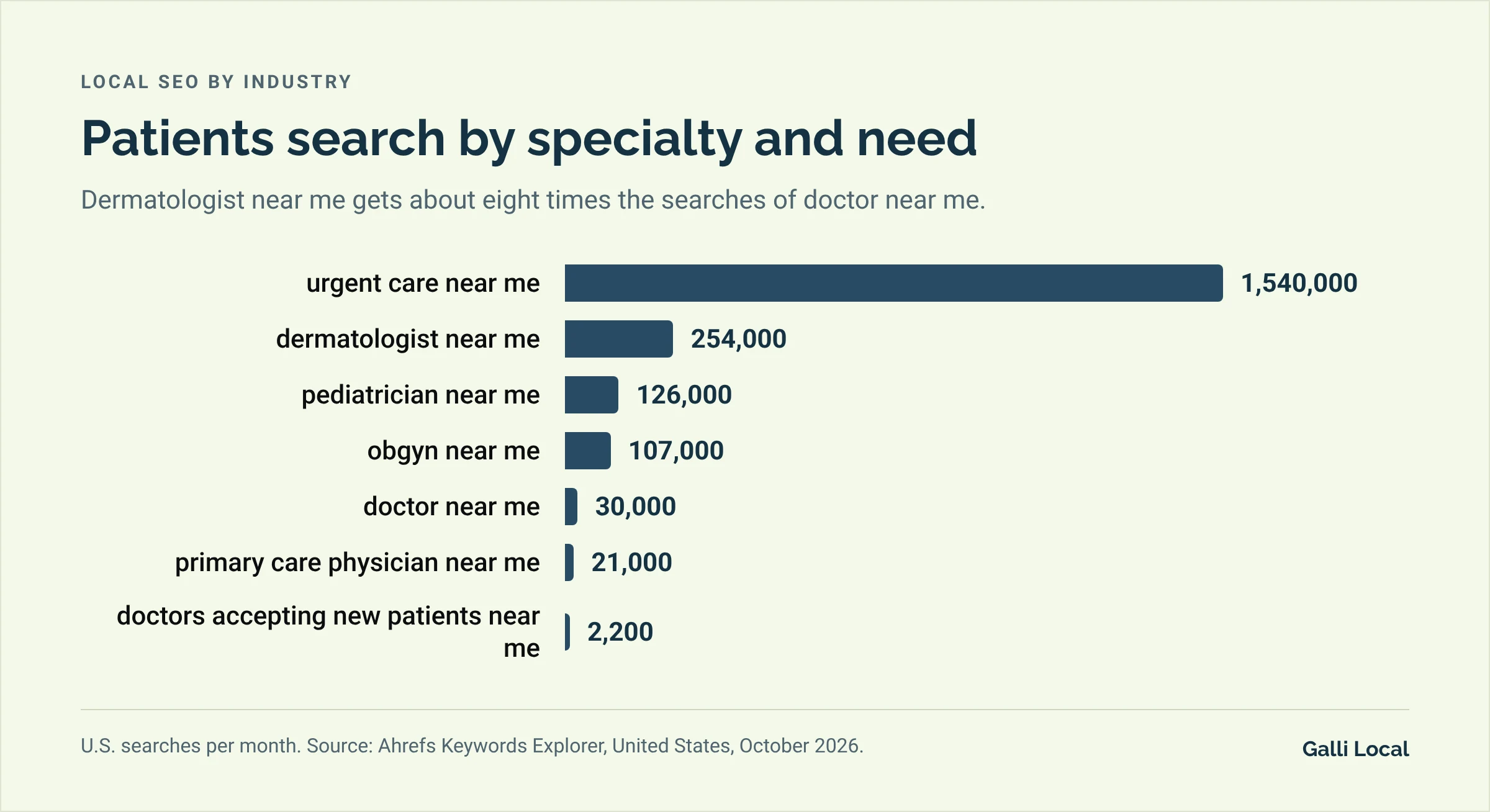
Patients search by specialty or by need far more often than they search for a "doctor". The numbers below are U.S. searches per month.
Source: Ahrefs Keywords Explorer, United States, checked October 5, 2026.
"Dermatologist near me" gets about eight times the searches of "doctor near me". The specialty name is the keyword. A practice whose profile and website lead with a brand name and a vague line such as "comprehensive care" is hard for Google to match to any of these searches.
Should each provider have a Business Profile, or only the practice?
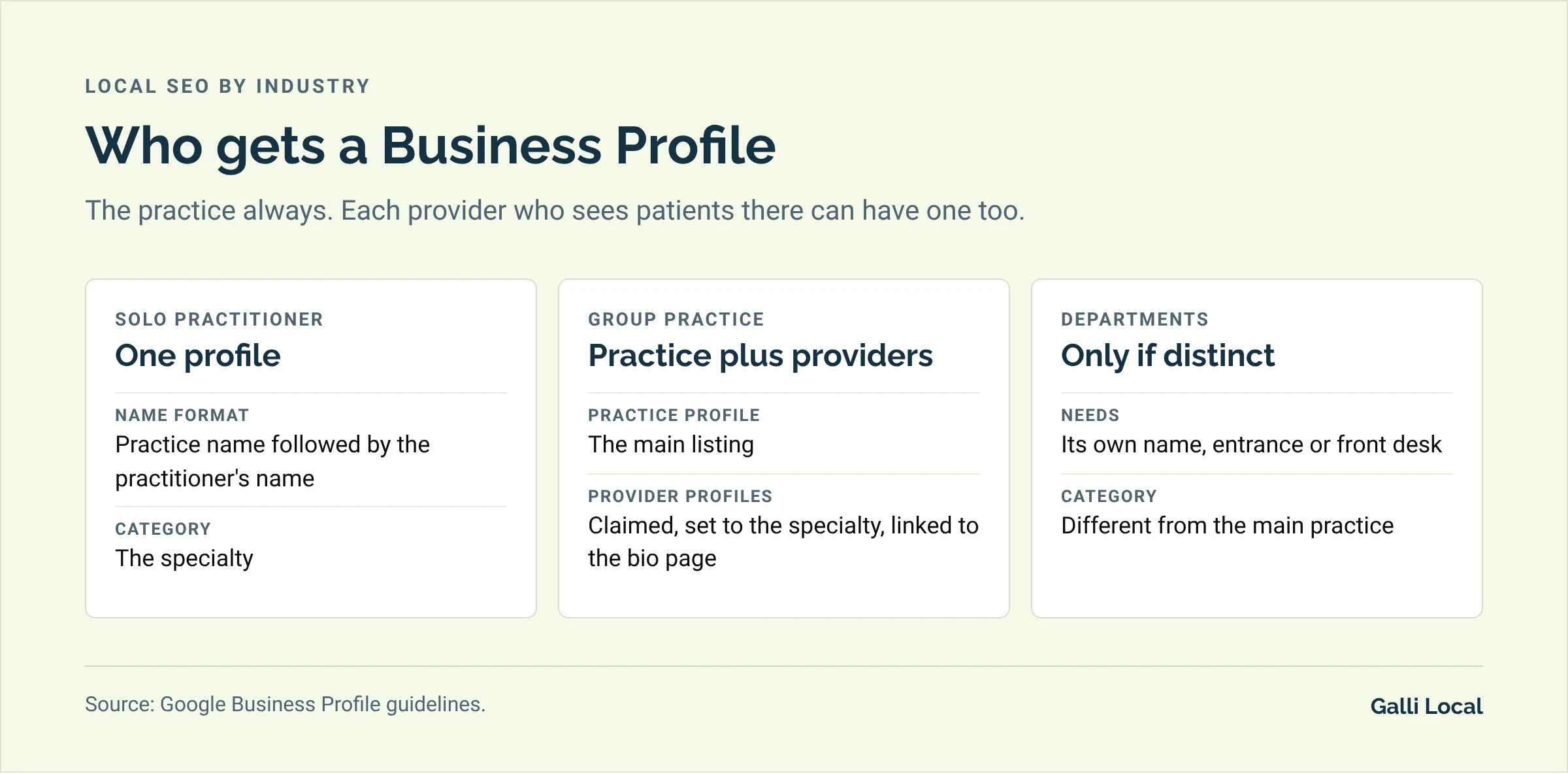
The practice should always have one, and each public-facing provider may have one too. Google's guidelines allow an individual practitioner to have a profile if they see patients at the listed location during stated hours (Google Business Profile guidelines).
Provider profiles often exist already, because Google creates them from outside data. Left alone, they collect reviews the practice never sees and can outrank the practice profile for the specialty search.
In practice, unclaimed provider profiles are the most common problem we expect to find on a medical grid scan. They split reviews across five or six listings, and the practice profile ends up looking thin next to a competitor that has kept everything in one place.
Which Business Profile categories fit a medical practice?
Use the most specific category that describes the practice, and as few as possible. Google's guidelines say the same.
Category names come from a published list of current Business Profile categories (Dalton Luka).
Which profile fields matter most for a medical office?
- Hours, including early, evening and weekend blocks you really staff. In late 2023 Joy Hawkins of Sterling Sky showed open businesses outranking closed ones, and Google's search liaison confirmed that openness had recently become a stronger local ranking signal (BrightLocal).
- Appointment link that opens the booking page or patient portal sign-up, not the home page.
- Services, named the way patients say them: annual physical, sports physical, mole check, well-child visit.
- New-patient status. If the panel is open, say so on the website in plain text. Few people search the phrase, but those who do are ready to book.
What does Google Business Profile management cover for a medical practice?
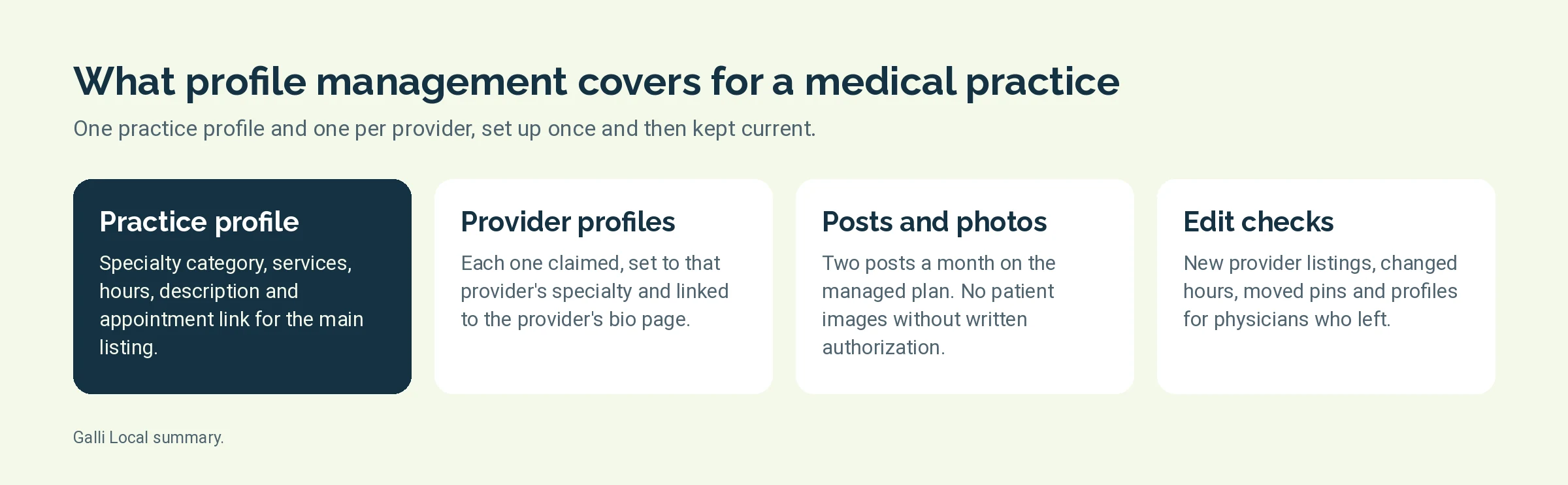
A medical practice rarely has one profile to manage. It has the practice profile and one for each provider, and the work covers all of them. The Local SEO program sets them up. Monthly upkeep comes with the next package, Local SEO + GBP management.
- Categories. The practice profile carries the specialty category from the table above, or "General practitioner" where that is the closer match. Each provider profile carries that provider's own specialty.
- Description. Specialties, the conditions and visit types you see most, ages treated, the towns you serve and whether the panel is open. No claims about outcomes.
- Attributes. Wheelchair access, languages spoken and appointment options, where Google offers them for the category.
- Posts. Two a month on the managed plan: a new physician, flu shot clinic hours, a second location, a holiday schedule. Never a patient image or story without written authorization, which HHS requires before patient information is used for marketing.
- Edit monitoring. Google builds provider listings from outside data, and the public can suggest edits to any of them. We check for new provider listings, changed hours, moved map pins and a profile for a physician who has left.
What can a medical practice say in a review reply?
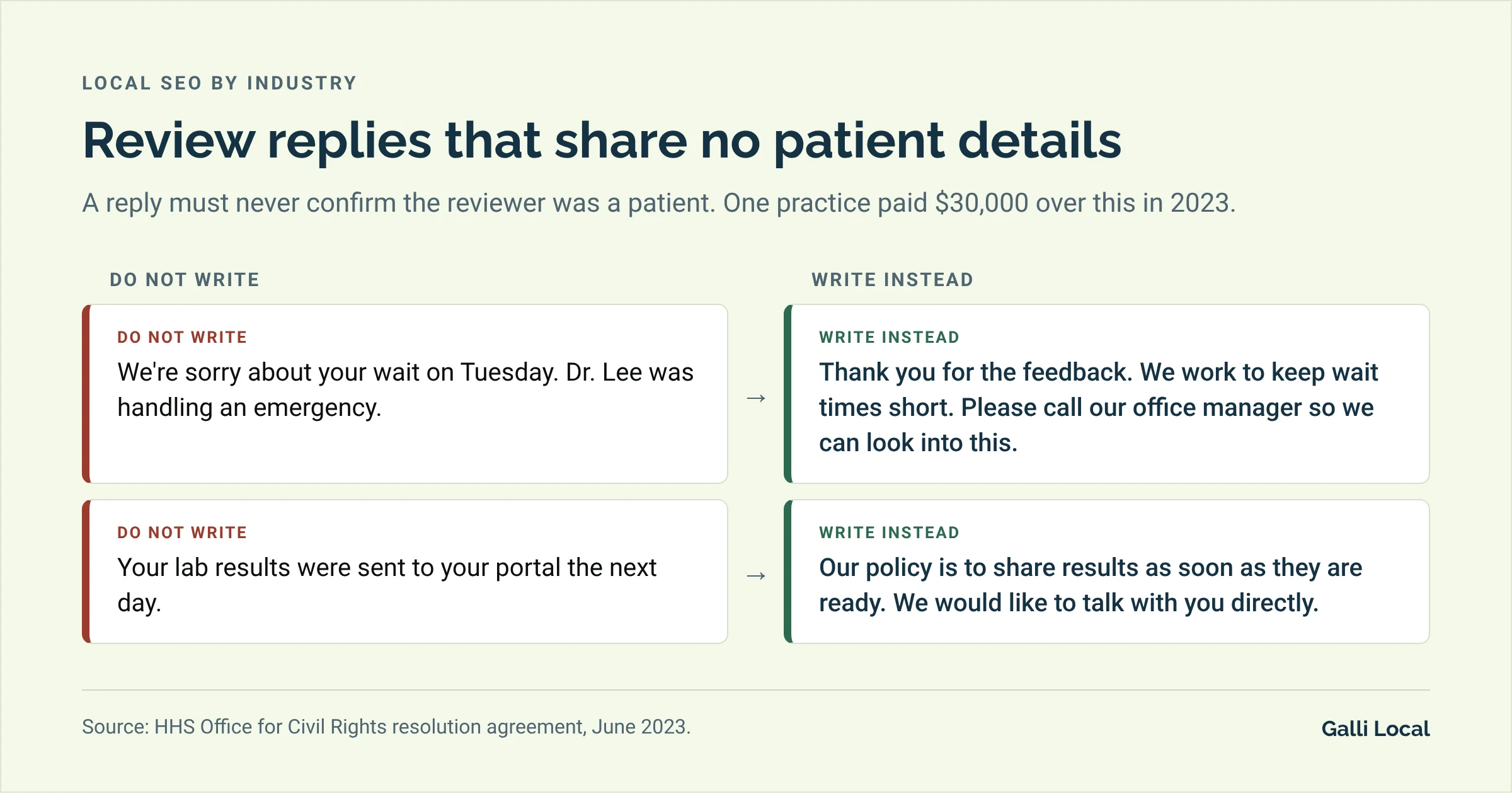
A medical practice's review reply must never confirm that the reviewer is or was a patient. A visit date, a diagnosis, a bill or an insurance detail in a public reply is a disclosure of protected health information, even if the reviewer wrote it first.
In June 2023 the HHS Office for Civil Rights settled with Manasa Health Center, a New Jersey psychiatric practice, for $30,000 after it disclosed patient information in replies to negative online reviews (HHS Office for Civil Rights).
Replying still matters. In BrightLocal's 2026 survey, 80% of consumers said they were likely to use a business that responds to all of its reviews (BrightLocal Local Consumer Review Survey). Our review response playbook has templates.
When asking for reviews, ask every patient the same way. The FTC's review rule, in effect since October 21, 2024, bans offering anything in exchange for a review that must be positive (FTC).
When should a practice ask for a review, and which reviews can be removed?
Ask the same day, at checkout or through the message system the practice already uses. Decide first where you want reviews to land. Most practices are better served by sending every patient to the practice profile, so reviews build in one place instead of spreading across six provider listings. Plain wording works: "If you have a minute, would you share your experience on Google?"
We write the request and reply templates and coach the front desk. Your staff sends the requests from your own system, so patient contact details stay inside the practice. HHS requires a written business associate agreement before a covered entity shares patient information with a vendor, so do not hand a patient list to any marketing company without one.
Only Google can remove a review. 1- and 2-star reviews are flagged for removal when they violate Google's policies, such as spam, a review about a different business, a former employee's post or abusive language. A complaint about a wait or a bill from a real person is not a violation. Never send Google records to prove a point about a reviewer.
Which directories matter for medical practices?
Health directories matter more than general business directories, because patients, insurers and AI tools all read them.
- Insurer provider directories. Under the No Surprises Act, health plans must verify directory information at least every 90 days and update it within two business days of a change, and providers must send plans their current information (Claritev). Answer those verification requests. They are free citation cleanup.
- The NPI registry. The practice address and taxonomy code here feed many other directories.
- Healthgrades, Zocdoc, WebMD Care and Vitals.
- Hospital and health system "find a doctor" pages, for providers with privileges or an affiliation.
- Your state medical board's license lookup.
The practice name, address and provider names should match on all of them. Our guide to NAP consistency explains why a mismatch costs rankings.
What advertising and privacy rules apply to medical marketing?
Three sets of rules apply: HIPAA for patient information, your state medical board for advertising claims, and Google's own checks for ads.
- Patient photos and testimonials on the website need written authorization.
- State boards regulate claims about results and board certification. Check your board's rule before publishing either.
- Google's Local Services Ads are open to some specialties in the United States, including primary care physicians, dermatologists and orthopedic surgeons. Google lists state licenses, malpractice insurance and a National Provider Identifier among its requirements (Google Local Services Help).
Tracking tools on appointment and portal pages are a separate privacy question for your compliance officer. We flag them when we find them.
What does the Local SEO program include for a medical practice?
The program starts at $850/mo per location. See the Local SEO services page for the full program, GBP management for monthly upkeep, and the Packages page for the rest. Our State College AI search study shows which sources AI tools cited for an urgent care question.
How is the map grid tracked, and how do you read it?
The program tracks 10 keywords on a 5-mile community grid or 20 keywords on a 10-mile city grid. Primary care and pediatrics draw from close by and usually fit the community grid. A specialty that patients travel for, or a practice in a larger city, usually needs the city grid and the longer keyword list.
Every point is one search from that location, marked with the rank of your profile. On a medical grid, look at which listing is ranking as well as where. If a provider profile shows up for the specialty term and the practice profile does not, reviews and calls are going to a listing the front desk may not watch. Hospital-owned clinics also tend to hold the points nearest their campus, so the gains for an independent practice usually come from the neighborhoods between campuses. The monthly report lists average rank, coverage, top 3 share, calls, website clicks and direction requests.
Are service and area pages part of the program?
The program tells you which pages are missing: a page for each specialty, the conditions and visit types patients search, each provider and each office. It does not include writing them. For that, see SEO content for medical practices.
What is not included?
- Technical work on the site, including speed, schema and how the site hands off to a patient portal. See SEO for medical practices and technical SEO.
- Content writing, such as condition pages and provider bios. See SEO content.
- Link building, such as hospital affiliation and local health organization links. See link building.
- Ads, including Google Ads and Local Services Ads for eligible specialties. See PPC management.
Other services for medical practices
- Medical practice marketing overview: every service for physician practices on one page
- SEO for medical practices: the website work behind specialty and condition searches
- AEO | GEO for medical practices: being named when a patient asks an AI tool for a specialist
- SEO content for medical practices: specialty, condition and provider pages written for you
Is Galli Local a good fit for your practice?
Galli Local is based in Bellefonte, Pennsylvania, and works with practices remotely. It is a new agency, so there are no medical case studies to show yet. Founder Steven Galli ran marketing for an orthopedic practice before working in Stryker's Endoscopy division, which is covered on the About page.
Medical SEO by specialty and location: orthopedic practices, physical therapy clinics, Pennsylvania medical practices and State College, PA. Browse all industries we work with.
Medical practice local SEO by location
- Medical practice SEO in Pennsylvania
- Medical practice SEO in New York
- Medical practice SEO in Texas
- Medical practice SEO in Connecticut
- Medical practice SEO in Ohio
- Medical practice SEO in Utah
- Medical practice SEO in Washington State
- Medical practice SEO in Nevada
- Medical practice SEO in State College, PA
- Medical practice SEO in Philadelphia, PA
- Medical practice SEO in Pittsburgh, PA
Medical practice local SEO FAQ
How long does local SEO take for a medical practice?
First movement on a map grid usually shows in 1 to 3 weeks, and the top 3 on competitive specialty terms usually takes 30 to 90 days. Timing depends on your reviews, your competitors and how many provider profiles need cleanup.
Should every doctor in the practice have a Business Profile?
Each public-facing provider can have one, and many already do because Google creates them. Claim each one, set its category to the provider's specialty and link it to that provider's bio page.
Can we reply to a negative review without breaking HIPAA?
Yes, if the reply never confirms the reviewer was a patient and shares no detail about care, dates, costs or insurance. A safe reply thanks the person, states a general office policy and invites a direct call.
Which category should a multi-specialty practice use?
Use "Medical group" or "Medical clinic" on the practice profile, and put each specialty on the provider profiles. That lets the practice appear for broad searches and each provider for a specialty search.
Do insurance directories affect Google rankings?
They affect what Google and patients see about the practice. Insurer directories are widely read listings of your name, address and providers, so errors there spread to other sites and to patients choosing by plan.
Do you work with dental offices too?
Yes. Dental offices have a separate program page because their searches, categories and advertising rules differ from a physician practice.