
Quick summary: NAP consistency means your business name, address, and phone number appear the same way on your website, your Google Business Profile, and every directory that lists you. Inconsistent NAP data lowers Google's confidence in your location, splits reviews across duplicate listings, and sends customers to dead phone numbers. A citation audit finds the errors, and a cleanup corrects them at the source.
Every business that has moved, changed phone providers, or rebranded has old information sitting somewhere online. Most owners never see it. Customers and search engines do.
This guide explains how NAP data works, where bad records come from, and how to fix them.
What does NAP stand for?
NAP stands for name, address, and phone number. Many SEOs add a W for website (NAP+W). A mention of these details on another site is called a citation.
Citations appear on:
- Maps and search platforms: Google, Apple Maps, Bing Places
- Review and directory sites: Yelp, Yellow Pages, Better Business Bureau
- Social platforms: Facebook, Nextdoor, LinkedIn
- Industry directories: Avvo, Healthgrades, Angi, Houzz
Why is NAP consistency important for local SEO?
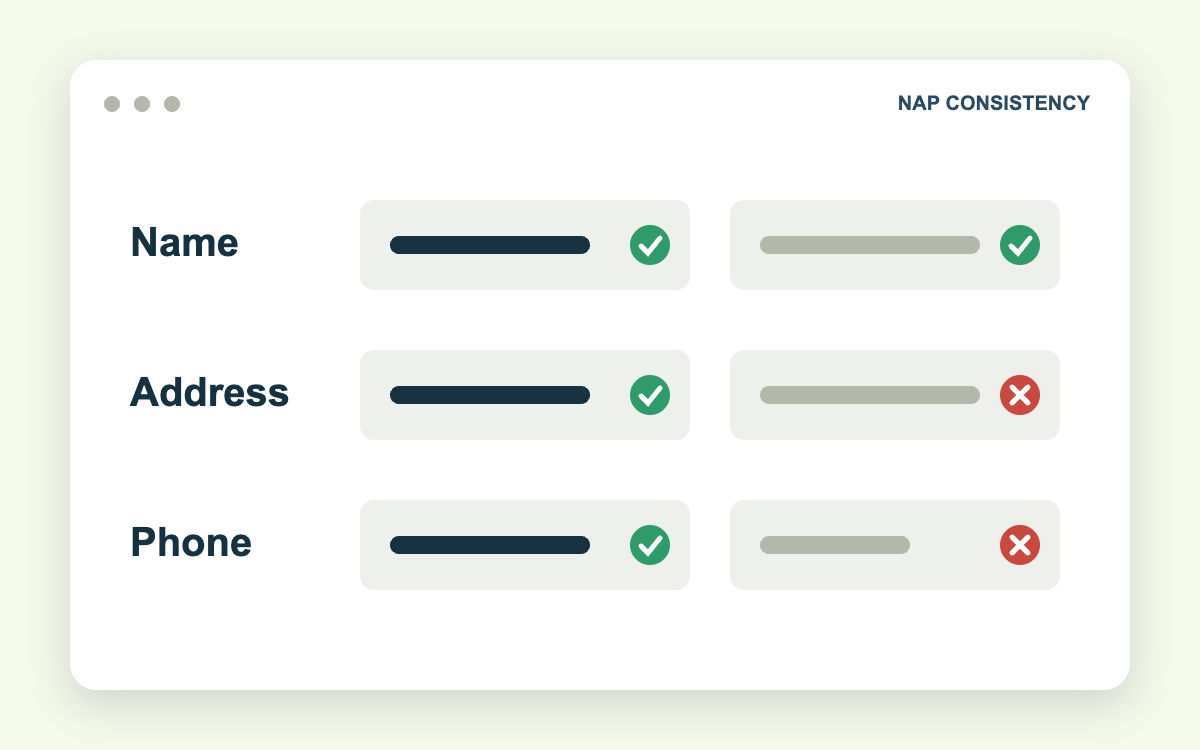
Search engines build a record of your business by comparing what they find across the web. When the records agree, Google can be confident about who you are and where you operate. When they conflict, that confidence drops.
How much do citations affect rankings now?
Less than they used to for the map pack. Whitespark's 2026 Local Search Ranking Factors report shows citation signals continuing to decline as a direct local pack factor.
The same report found that three of the top five factors for visibility in AI search tools are citation factors. Assistants such as ChatGPT and Google's AI Overviews pull business facts from directories and data providers. Wrong data there becomes a wrong answer.
So the reason to care has shifted. Clean citations are now a baseline for trust, and they directly shape what AI tools say about you.
How does inconsistent NAP data hurt your business?
There are three kinds of damage, and only one of them involves rankings.
Lost calls. A customer finds an old number on Yellow Pages, reaches a disconnected line, and calls the next business. You never know it happened.
Split authority. An old address often becomes a duplicate listing. Reviews, photos, and links get divided between two records, and neither looks as strong as it should.
Weaker entity signals. Conflicting addresses make it harder for Google to pin your location, which matters because proximity is the second-ranked local pack factor.
Here is how it usually plays out. A law firm moves to a new suite in 2022 and updates its website and Google profile. In 2026, Apple Maps still shows the old suite, Yelp lists a tracking number from a past marketing vendor, and a data aggregator is still distributing the old address to navigation apps.
Where does bad NAP data come from?
| Cause | What happens |
|---|---|
| Office move | Old address stays on sites you never updated |
| New phone system | Old number persists on dozens of directories |
| Call tracking numbers | A vendor's tracking number gets scraped and republished |
| Rebrand or new DBA | Two business names circulate at once |
| Data aggregators | One outdated record gets redistributed to many sites |
| Past agencies | Listings created under logins you no longer have |
Aggregators deserve attention. Companies such as Data Axle, Foursquare, and TransUnion (formerly Neustar Localeze) license business data to apps, car navigation systems, and directories. One wrong record there can keep reappearing after you fix individual sites.
What counts as an inconsistency?
Not every difference matters. Google normalizes common formatting.
- Fine: "Street" vs. "St.", "Suite 200" vs. "Ste 200", "(555)" formatting differences
- A problem: a different phone number, a different suite or street number, an old business name, a missing suite in a multi-tenant building, a different website domain
Focus on real conflicts. Spending hours changing "Ave" to "Avenue" does not move anything.
How to run a citation audit and cleanup
- Set your canonical NAP. Write down the exact name, address, phone, and website URL you want everywhere. Match it to your Google Business Profile and your state registration.
- List every past version. Old addresses, old numbers, tracking numbers, former names.
- Search each variant. Search each old phone number and address in quotes to find where they still live. Citation tools speed this up.
- Fix the core platforms first. Google, Apple Business Connect, Bing Places, Yelp, and Facebook.
- Correct the data aggregators. Data Axle, Foursquare, and TransUnion.
- Claim and merge duplicates. Request removal or merging rather than leaving old listings to linger.
- Fix industry directories. These often rank on page one for your brand name.
- Recheck in 60 days. Aggregator updates take weeks to flow downstream.
Keep a spreadsheet with each listing URL, login, and status. It becomes the record you use at the next move or phone change.
Should you use call tracking numbers?
Yes, with care. Use your real local number as the primary number on directories. On your Google Business Profile, you can set a tracking number as primary and keep your real number as an additional number so Google still connects the two.
On your website, dynamic number insertion swaps numbers for visitors without changing the number in the page code that crawlers read.
Free spreadsheet: Citation audit worksheet. A spreadsheet to record your correct details, every past version, and the status of 20 directories.
Frequently asked questions
Does NAP have to match exactly, character for character?
No. Abbreviations and punctuation differences are normalized. The number, street, suite, business name, and website need to be the same.
How long does citation cleanup take?
Core platforms update within days. Aggregator corrections can take four to eight weeks to reach downstream sites. Plan for about two months to see a clean audit.
How many citations does a local business need?
Quality matters more than quantity. The major platforms, the three main aggregators, and five to ten directories specific to your industry and city cover most businesses.
Do multi-location businesses need separate citations for each location?
Yes. Each location needs its own listing with its own address, a local phone number, and a link to its own location page.
Find the wrong listings before your customers do
A citation audit shows every place your old address or phone number still appears. It is included in our local SEO services, along with cleanup and aggregator submissions.
Because AI tools rely on this data, the same cleanup supports our AEO and GEO services. For background on that, see how to get your business named in ChatGPT and Google AI Overviews.
Contact Galli Local to request a citation audit. Send your current address and any past addresses or phone numbers, and we will show you where each one still appears.
Sources: Whitespark Local Search Ranking Factors, BrightLocal: data aggregators