
☰
All servicesLocal SEOGBP managementAEO | GEOSEO contentTechnical SEOLink buildingDesign & CROPPC managementIndustriesLaw firmsHome servicesPlumbersHVACElectriciansRoofersMedical practicesOrthopedicsPhysical therapyDental practicesGeneral dentistsOrthodontistsPeriodontistsEndodontistsRestaurants and coffee shopsTour operatorsAuto repair shopsLocationsPennsylvaniaState CollegeBellefonteAltoonaWilliamsportLock HavenLewistownPhiladelphiaPittsburghAllentownHarrisburgNew YorkNew York CityBuffaloRochesterAlbanyTexasHoustonDallasSan AntonioAustinUtahSalt Lake CityProvoSt. GeorgeConnecticutBridgeportNew HavenHartfordStamfordOhioColumbusClevelandCincinnatiWashingtonSeattleSpokaneTacomaNevadaLas VegasRenoHendersonPackagesAboutResourcesArticles
Home / Industries / Dental practices / Local SEO
Local SEO for dental practices
Local SEO for dental practices is the work of getting your office into the three Google Maps listings patients see when they search "dentist near me", an emergency term, or a dentist who takes their plan. It is for general, pediatric, cosmetic and specialty practices with a verified Google Business Profile that want more new-patient calls and bookings from the area around the office.
How do patients search for a dentist?
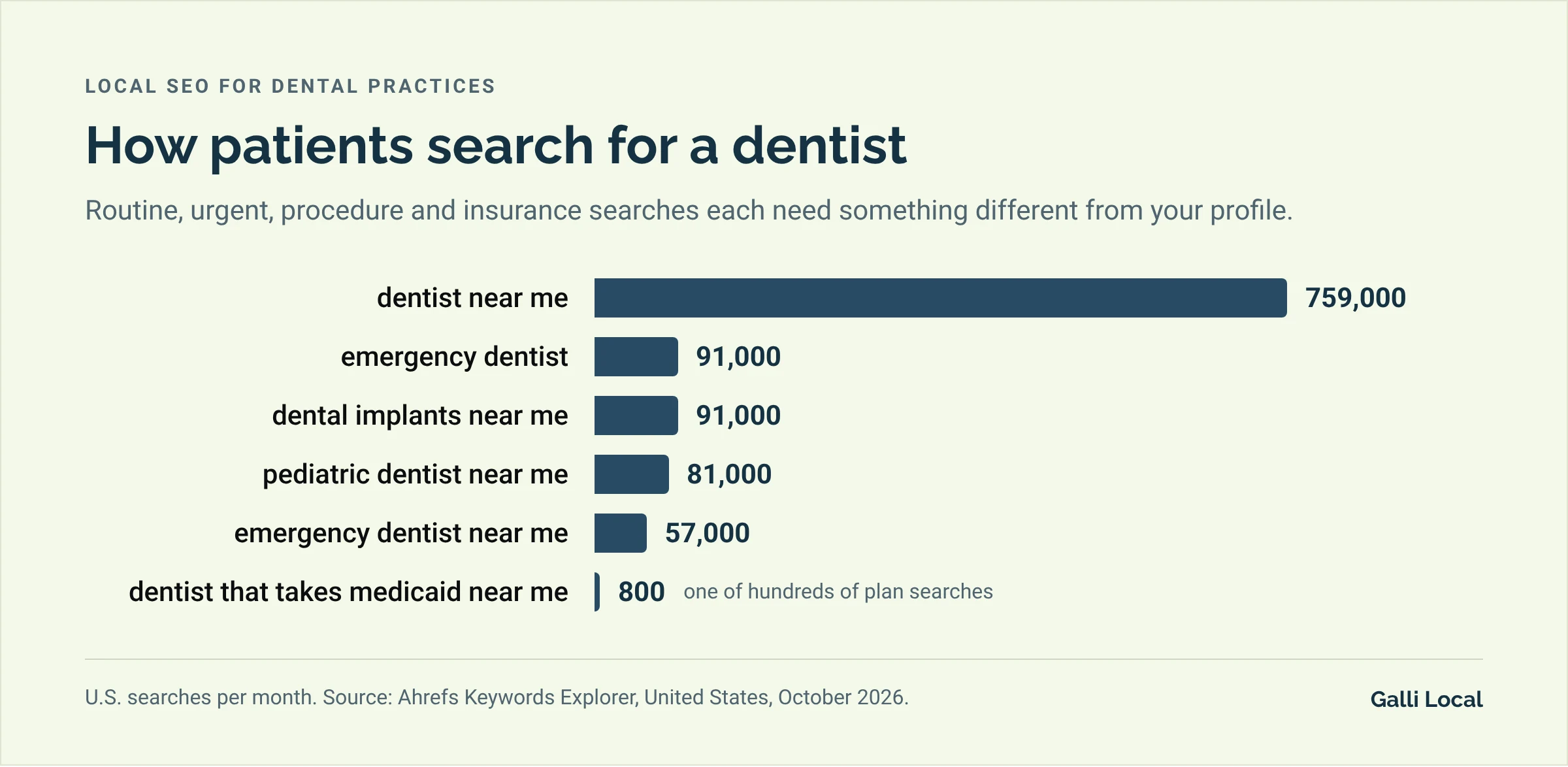
Most dental searches fall into one of three groups: a routine search for a nearby office, an urgent search, or a search tied to insurance or a specific procedure.
Source: Ahrefs Keywords Explorer, United States, checked October 5, 2026.
The insurance row looks small, and that is the point. Patients do not search one insurance phrase. They search hundreds of versions, one for each plan and town, and each version has only a handful of searches. A page on your site that lists every plan you accept is how you show up for all of them.
Which Business Profile categories should a dental practice use?
Use "Dentist" as the primary category for a general practice, and add only the secondary categories that match work you do every week. Google's own guidelines say to use as few categories as possible and to pick the most specific one that fits (Google Business Profile guidelines).
Category names are taken from a published list of current Business Profile categories (Dalton Luka).
In practice, a general practice that sets a specialty as its primary category loses ground on "dentist near me", which is the largest search it can win. Keep the broad category on top and let service pages carry the specialties.
Which profile fields matter most for a dental office?
These are the fields we check first on a dental profile:
- Hours, including any evening, weekend or same-day emergency hours you really staff
- Appointment link that goes straight to your booking page, not the home page
- Services, written as the procedure names patients use: crowns, root canal, Invisalign, dentures
- Insurance information, covered below
How does insurance show up on a dental profile?
Google has shown a "Check insurance info" link on health care profiles. When the feature launched in 2020, Seer Interactive reported that Google filled it in from third-party data and that an office could not type the plan list in directly. If your profile still works that way, its plan list is only as good as the data in the directories Google reads.
Two things follow from that. Your carrier directory listings need the right address and the right provider names. And your website needs an insurance page with each accepted plan named in plain text, because that page is the one part of this you fully control.
What does Google Business Profile management cover for a dental office?
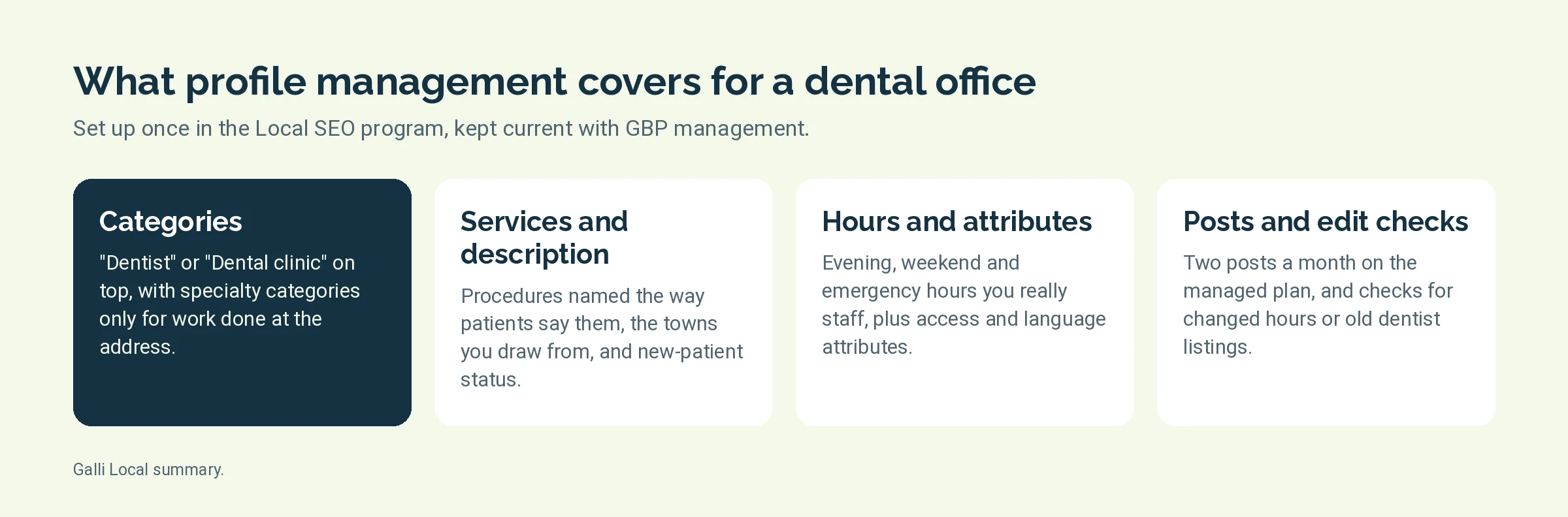
The Local SEO program sets the profile up once: primary and secondary categories, services, the description and photos. Ongoing management is the next package up, Local SEO + GBP management, and it keeps the profile current every month. The work is the same list either way.
- Categories. "Dentist" or "Dental clinic" on top for a general office, checked against what the top three offices on your map use. "Oral surgeon" or "Dental hygienist" are added only when that person works at the address.
- Description. Written for a new patient: who you see, the procedures you do most, the towns you draw from, and whether you take new patients. No "best" or "painless".
- Attributes. Wheelchair access, languages spoken and appointment options, where Google offers them for your category.
- Posts. Two a month on the managed plan: a new hygienist, added Friday hours, a new service such as same-day crowns. Never a patient photo or story without written authorization.
- Edit monitoring. Anyone can suggest a change to your listing. On dental profiles the usual problems are altered hours, a swapped category, and an old listing for a dentist who left that still collects reviews and calls.
How do you rank for emergency dentist searches?
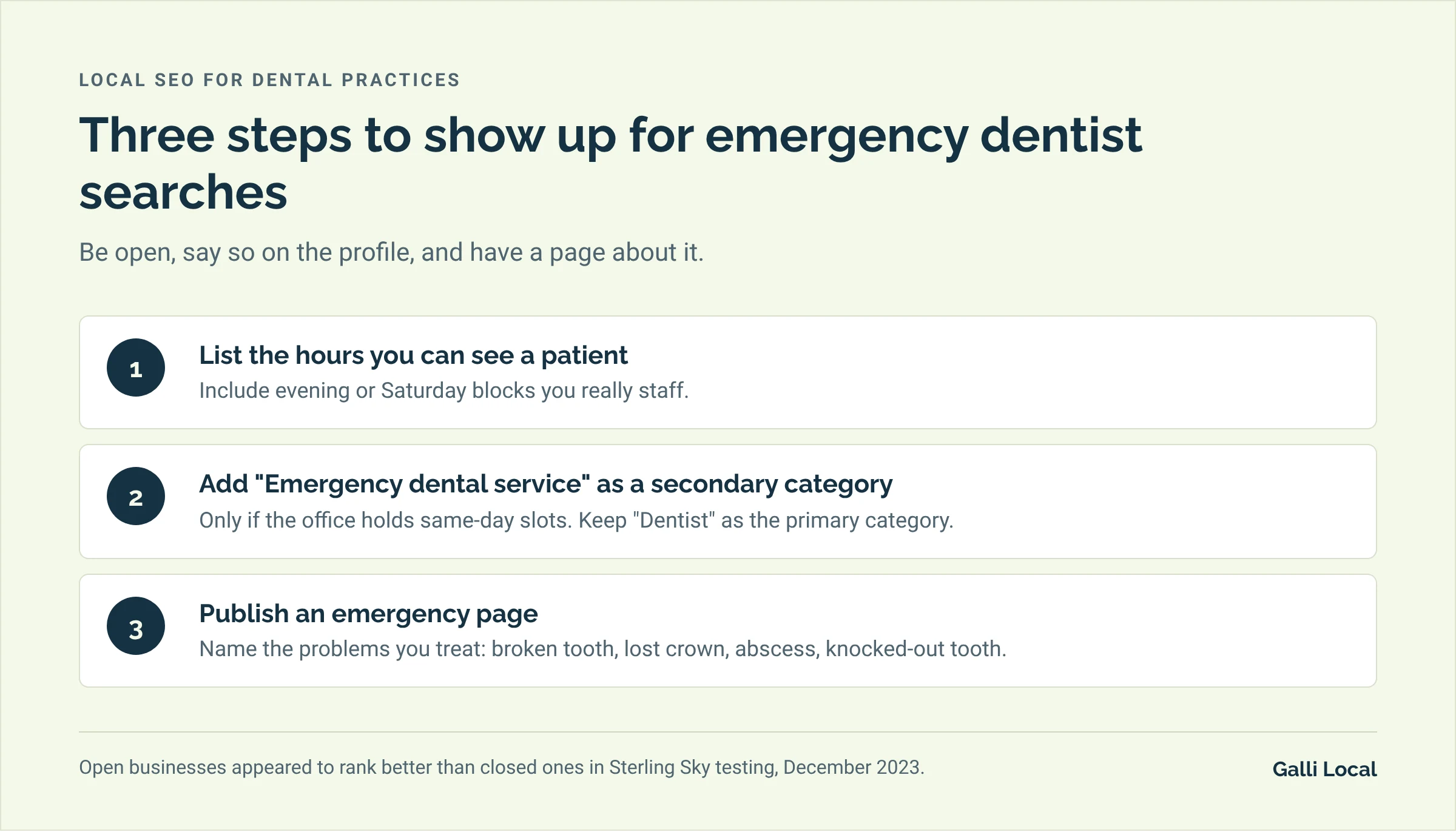
You rank for emergency searches by being open, saying so on the profile, and having a page about it. In late 2023 Joy Hawkins of Sterling Sky showed that businesses listed as open ranked better than closed ones on competitive searches, and Google's search liaison said it looked like a local ranking change (BrightLocal).
For a dental office that means:
- List the hours you can see a patient, including a Saturday block if you have one.
- Add "Emergency dental service" as a secondary category only if you hold same-day slots.
- Publish an emergency page that names the problems you treat: broken tooth, lost crown, abscess, knocked-out tooth.
What can a dental practice say in a review reply?
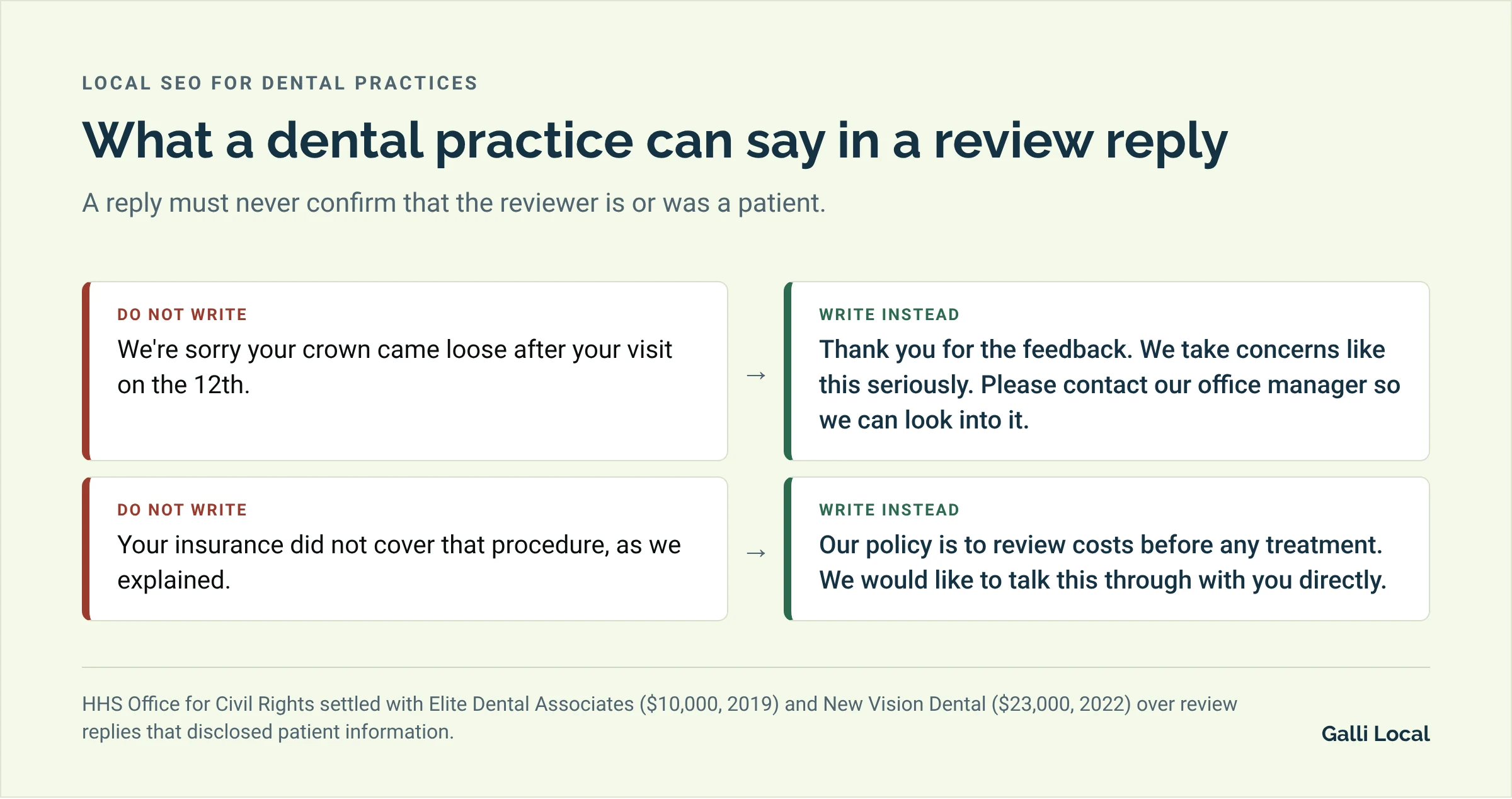
A review reply from a dental practice must never confirm that the reviewer is or was a patient. Naming a visit, a treatment, a bill or an insurance plan in a public reply is a disclosure of protected health information, even when the reviewer mentioned it first.
Federal regulators have fined dental offices for exactly this:
- Elite Dental Associates of Dallas paid $10,000 in 2019 after disclosing patient information in replies on a review site (HHS Office for Civil Rights).
- New Vision Dental in California paid $23,000 in 2022 over review replies that disclosed patient information (HHS Office for Civil Rights).
In BrightLocal's 2026 survey, 80% of consumers said they were likely to use a business that responds to all of its reviews, and 74% look for reviews written in the last three months (BrightLocal Local Consumer Review Survey).
The FTC's review rule, in effect since October 21, 2024, also bans offering anything in exchange for a review that must be positive (FTC). Ask every patient the same way, at checkout or by text after the visit. Our review response playbook has reply templates you can adapt.
When should a dental office ask for a review, and which reviews can be removed?
Ask on the day of the visit. The front desk can say it at checkout, and a text with the review link can go out that afternoon from your own patient messaging system. Keep the wording plain: "Would you be willing to share your experience on Google? Here is the link." Send the same request to every patient, not only the ones who left smiling.
We supply the request and reply templates and coach the front desk. Your staff sends the requests, so no patient list has to leave the practice. If a vendor ever handles patient contact details for you, HHS says a covered entity needs a written business associate agreement with that vendor first.
Only Google can remove a review. In the program, 1- and 2-star reviews are flagged for removal when they violate Google's policies: spam, off-topic rants, a review from a competitor or a former employee, or abusive language. An unhappy but honest review stays, and the reply rules above apply to it. Never send Google chart notes or appointment records to argue that a reviewer is wrong.
Which photos help a dental profile?
Photos of the real office help most, because a new patient is deciding whether to walk into a place they have never seen. Add the building from the street, the parking lot entrance, the waiting room, a treatment room and the team.
Patient photos, including before-and-after cases, need written permission.
Which directories matter for dentists?
After Google, these listings carry the most weight for a dental office because patients and insurance tools read them:
- ADA Find-a-Dentist, for American Dental Association members
- Healthgrades
- Zocdoc
- WebMD Care
- The provider directory of every insurance carrier you are in network with
The office name, address and provider names should match on all of them. Our guide to NAP consistency explains why a mismatch costs rankings, and the Google Maps cheat sheet for dental offices lists the full set on two pages.
What advertising rules apply to dental marketing?
Dental advertising is covered by the ADA's ethics code, your state dental board, and Google's own ad checks. The ADA code bars advertising that is false or misleading in a material respect, and section 5.H covers who may announce themselves as a specialist. A 2025 update added an advisory opinion on social media that requires paid influencers to disclose the partnership (ADA News).
For local search, three habits keep a practice out of trouble:
- Call yourself a specialist only in a specialty you are recognized in.
- Leave "best", "painless" and "number one" out of the business name and description.
- Check your state board's advertising rules before you publish prices or offers.
Dentists can also run Google Local Services Ads. Google lists a state practice license, a provider license, malpractice insurance and a National Provider Identifier check among its requirements (Google Local Services Help).
Dental local SEO by practice type
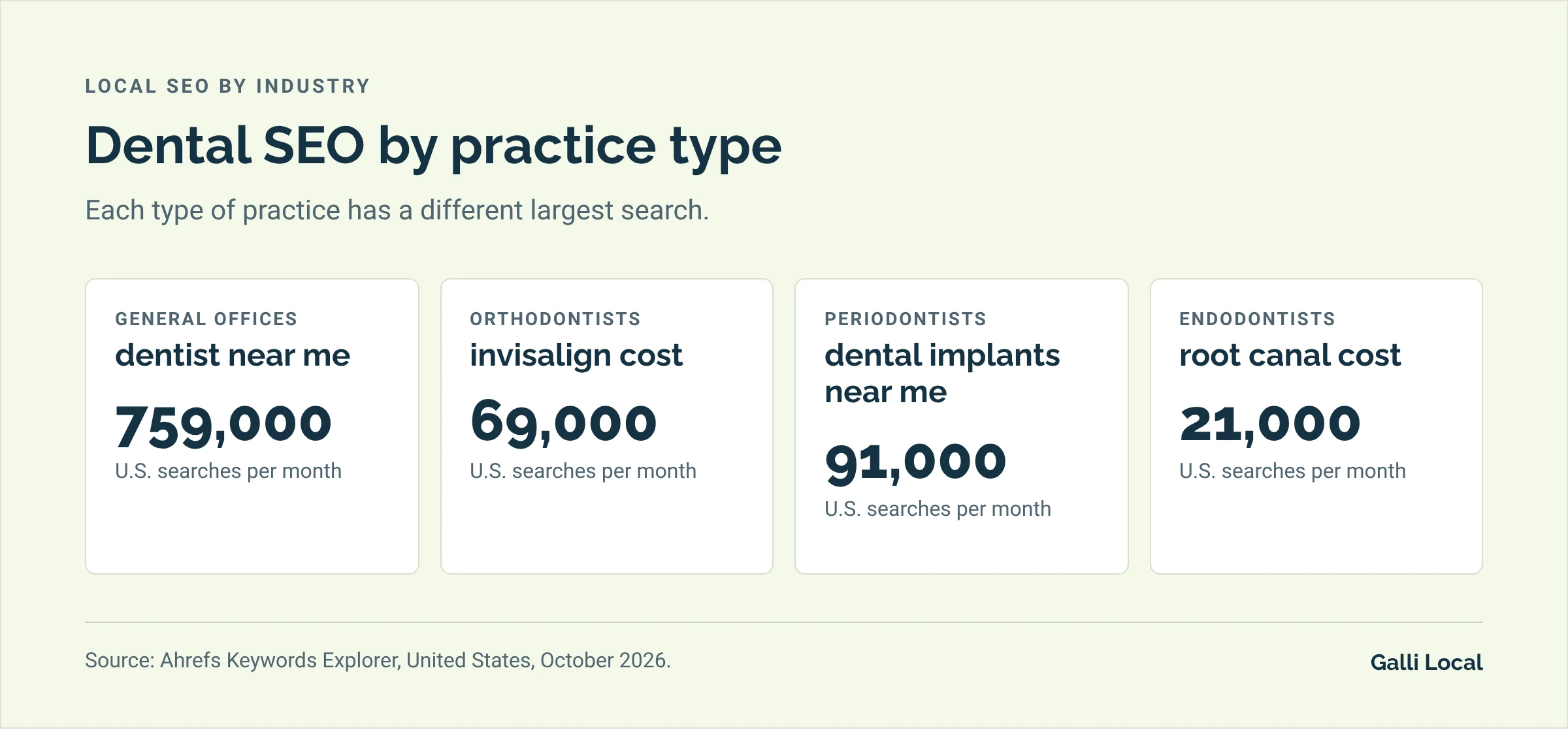
A general office and a specialty practice do not compete for the same searches. Each type has its own page:
- General dentists: winning "dentist near me" and ranking for services without specialist wording
- Orthodontists: cost pages, parents and adults, and part-time satellite offices
- Periodontists: implant searches, self-referring patients and referring dentists
- Endodontists: root canal searches, lost referrals and same-day review requests
What does the Local SEO program include for a dental practice?
The program starts at $850/mo per location. See the Local SEO services page for the full program, GBP management for monthly profile upkeep, and the Packages page for everything else.
How is the map grid tracked, and how do you read it?
The program tracks 10 keywords on a 5-mile community grid or 20 keywords on a 10-mile city grid. A single-office family practice in a small town usually fits the community grid. A practice in a metro area, or one with implant and cosmetic patients who drive farther, usually needs the city grid.
Each point on the grid is one search run from that spot, and the number on it is where your office ranked. A typical dental grid is strong in the blocks around the office and fades toward the next town, where another office sits closer to the searcher. Read it term by term. "Dentist near me" can hold the top 3 across most of the grid while "emergency dentist" does not, and that gap usually traces back to hours, a missing category or a missing page. The monthly report gives average rank, coverage, top 3 share, calls, website clicks and direction requests.
Are service and area pages part of the program?
Page recommendations are included. Writing the pages is not. Each recommendation names the page, the search it supports and what it should cover, and your team or your web vendor can write it. If you want the writing done for you, see SEO content for dental practices.
What is not included?
- Technical work on the website, such as speed, schema and booking page fixes. See SEO for dental practices and technical SEO.
- Content writing, including procedure pages and blog posts. See SEO content.
- Link building, such as local sponsorship and dental association links. See link building.
- Ads, including Google Ads and Local Services Ads for dentists. See PPC management.
Other services for dental practices
- Dental marketing overview: every service for dental offices on one page
- SEO for dental practices: the website work behind procedure and insurance searches
- AEO | GEO for dental practices: being named when a patient asks an AI tool for a dentist
- SEO content for dental practices: procedure, insurance and town pages written for you
Is Galli Local a good fit for your practice?
Galli Local is based in Bellefonte, Pennsylvania, and works with practices remotely. It is a new agency, so there are no dental case studies to show yet. Browse the other industries we work with, including auto repair shops and plumbers.
Dental local SEO by location
Dental local SEO FAQ
How long does local SEO take for a dental practice?
First movement on a map grid usually shows in 1 to 3 weeks, and reaching the top 3 on competitive terms usually takes 30 to 90 days. The timing depends on your reviews, your competitors and how far along your profile and website already are.
Can we reply to a negative review without breaking HIPAA?
Yes, if the reply never confirms the reviewer was a patient and shares no details about care, dates, costs or insurance. A safe reply thanks the person for the feedback, states a general office policy, and invites them to contact the office directly.
Should a general dentist use "Emergency dental service" as a category?
Only if the office holds same-day appointments for urgent cases. If it does, add it as a secondary category and keep "Dentist" as the primary one.
How do we show up for searches about our insurance plans?
Publish a page that names every plan you accept, and keep your listings in each carrier's provider directory accurate. Google has drawn insurance details for health care profiles from third-party data, so those outside listings need to be right.
Do you write the service pages?
Page recommendations are part of the Local SEO program. Page writing is not. Each recommendation names the page that is missing and the search it is meant to support. Writing comes with the AEO | GEO bundle or the full agency stack, or case by case once a strategy is in place.