
☰
All servicesLocal SEOGBP managementAEO | GEOSEO contentTechnical SEOLink buildingDesign & CROPPC managementIndustriesLaw firmsHome servicesPlumbersHVACElectriciansRoofersMedical practicesOrthopedicsPhysical therapyDental practicesGeneral dentistsOrthodontistsPeriodontistsEndodontistsRestaurants and coffee shopsTour operatorsAuto repair shopsLocationsPennsylvaniaState CollegeBellefonteAltoonaWilliamsportLock HavenLewistownPhiladelphiaPittsburghAllentownHarrisburgNew YorkNew York CityBuffaloRochesterAlbanyTexasHoustonDallasSan AntonioAustinUtahSalt Lake CityProvoSt. GeorgeConnecticutBridgeportNew HavenHartfordStamfordOhioColumbusClevelandCincinnatiWashingtonSeattleSpokaneTacomaNevadaLas VegasRenoHendersonPackagesAboutResourcesArticles
Home / Industries / Home services / Roofers / Local SEO
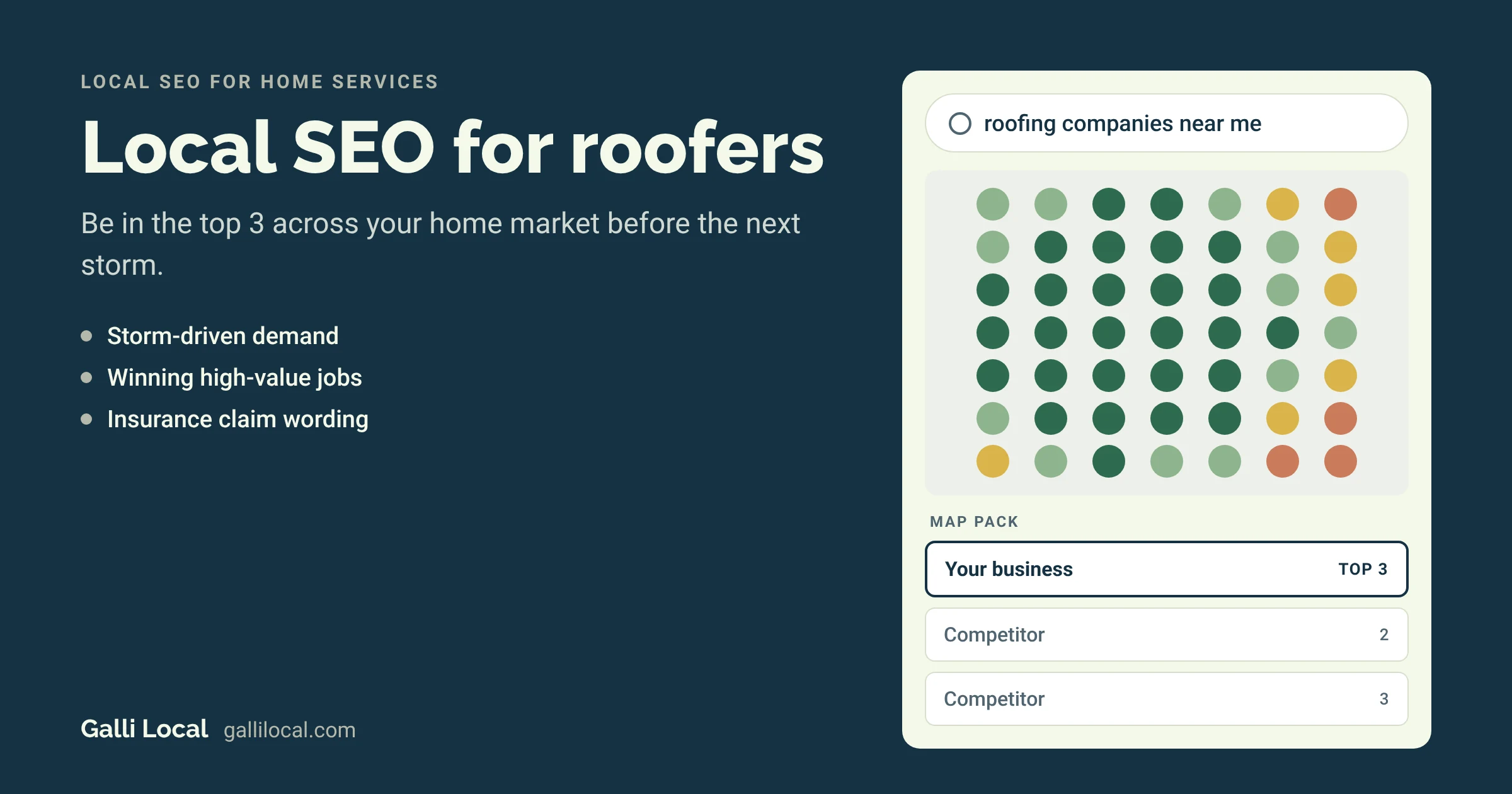
Local SEO for roofers
Quick summary: Local SEO for roofers is the work of getting a roofing company into the Google Maps top 3 across its home market, so it is already visible on the day a storm sends every homeowner in town to search. It is for established local roofing contractors with a verified Google Business Profile and a real office or yard address that want more inspection requests and replacement jobs.
This page covers local SEO for a roofing company from the profile to the monthly report. The parts shared by every trade are on the home services page.
How do homeowners search for a roofer?
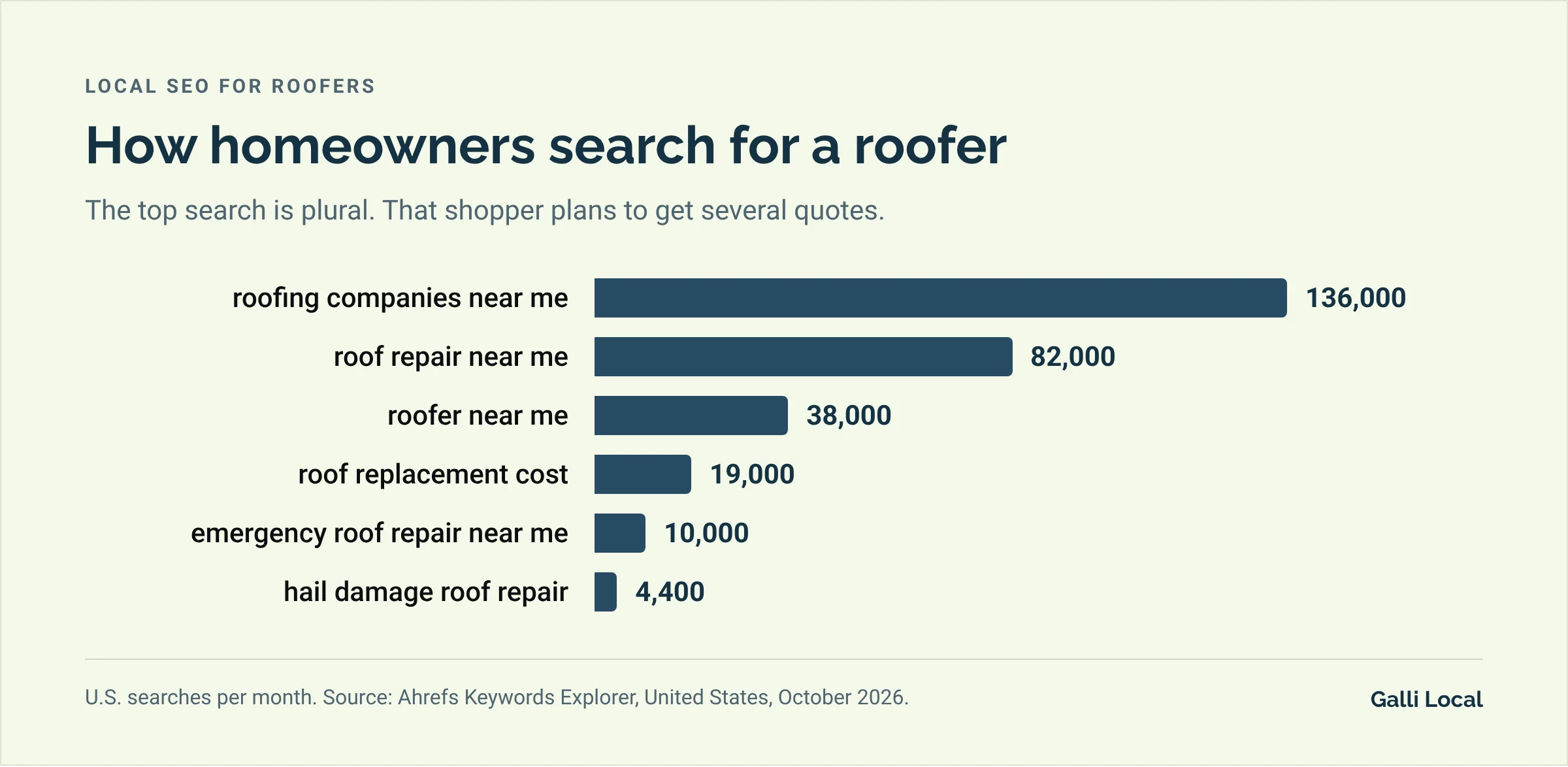
Homeowners search for roofers in two modes: slow comparison before a planned replacement, and a rush after wind or hail.
Source: Ahrefs Keywords Explorer, United States, checked October 5, 2026.
The top search is plural: "roofing companies". That is a shopper who plans to get several quotes.
Why does storm demand change the plan?
Storm demand arrives all at once and goes to whoever already ranks. Climate Central, which now maintains the billion-dollar disaster dataset that NOAA used to run, counted 14 billion-dollar weather disasters in the United States in the first half of 2025, with $101.4 billion in damage. The list included hail storms and several tornado outbreaks (Fox 5 New York, reporting Climate Central data).
A WebFX analysis of Ahrefs data found that "roof repair near me" peaks in September and that emergency and storm damage roof searches spike after seasonal storms (WebFX analysis, published by KRDO).
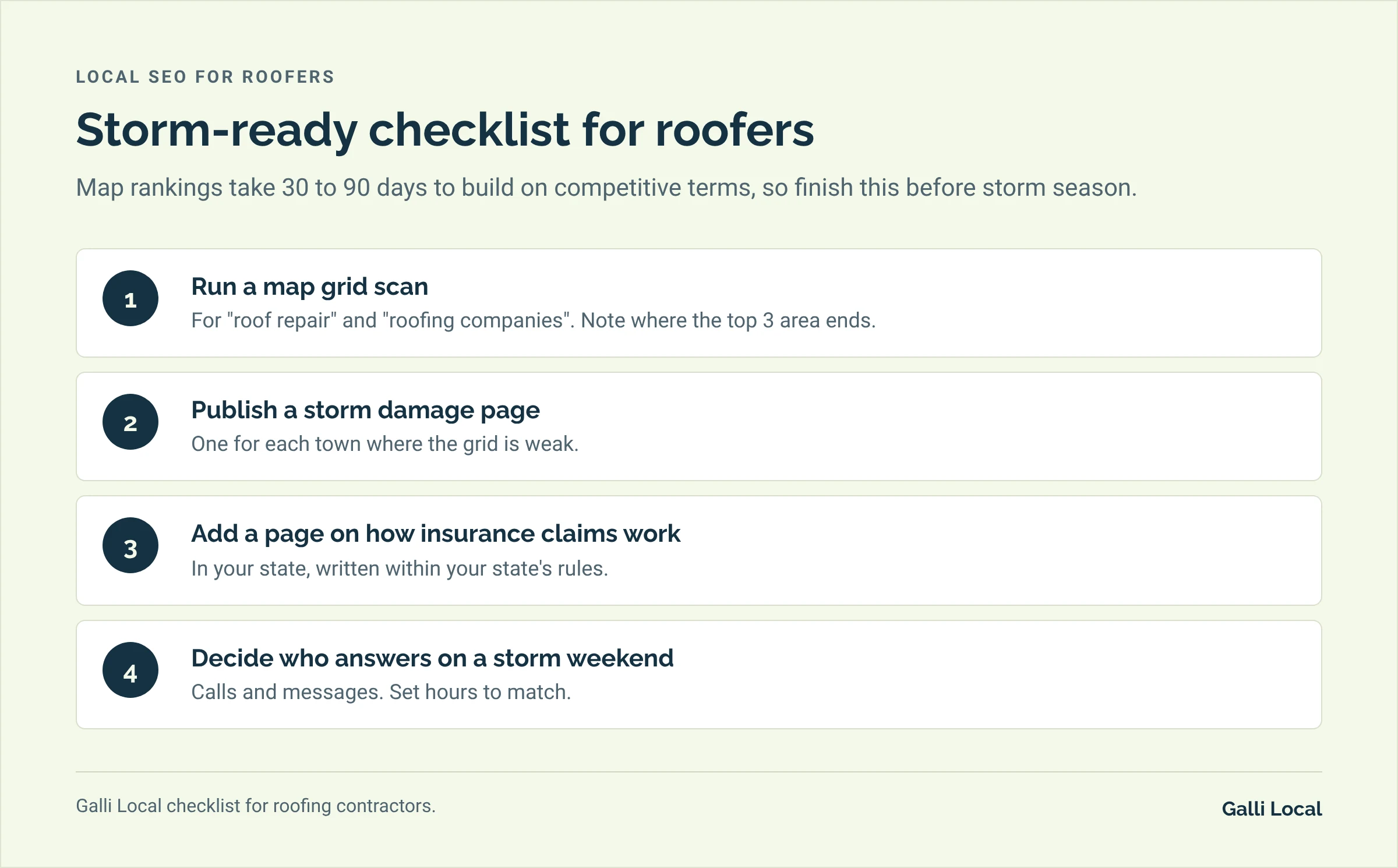
Map rankings take 30 to 90 days to build on competitive terms, so the plan has to be finished before storm season.
A storm-ready checklist
- Run a map grid scan for "roof repair" and "roofing companies" and note where the top 3 area ends.
- Publish a storm damage page for each town where the grid is weak.
- Add a page on how insurance claims work in your state, written within the rules below.
- Decide who answers calls and messages on a storm weekend, and set hours to match.
Can a roofer rank in a town where a storm just hit?
Not on the map, unless the company already has a real location near it. Google ties map rankings to the business address, and its guidelines say a service area should not extend farther than about two hours of driving from the base (Google Business Profile guidelines).
Out-of-town crews get around this with rented mailboxes and new listings. Those listings break Google's rules and get suspended. Our article on why a Business Profile gets suspended covers what triggers it.
A local roofer's edge after a storm is proof of being local: an address that has been on the profile for years, reviews that name nearby streets and towns, and photos of jobs in neighborhoods people recognize.
How do you win a high-value job from a search?
You win it by being the most convincing of the three or four companies the homeowner compares.
- Photos of whole roofs, not close-ups. Show the finished house from the street.
- Reviews that name the material and the town. They tell the next reader more than five stars alone.
- A cost page with real ranges. "Roof replacement cost" gets 19,000 searches a month. A page that gives ranges by roof size and material, and explains what changes the price, keeps that reader on your site.
What can a roofer say about insurance claims?
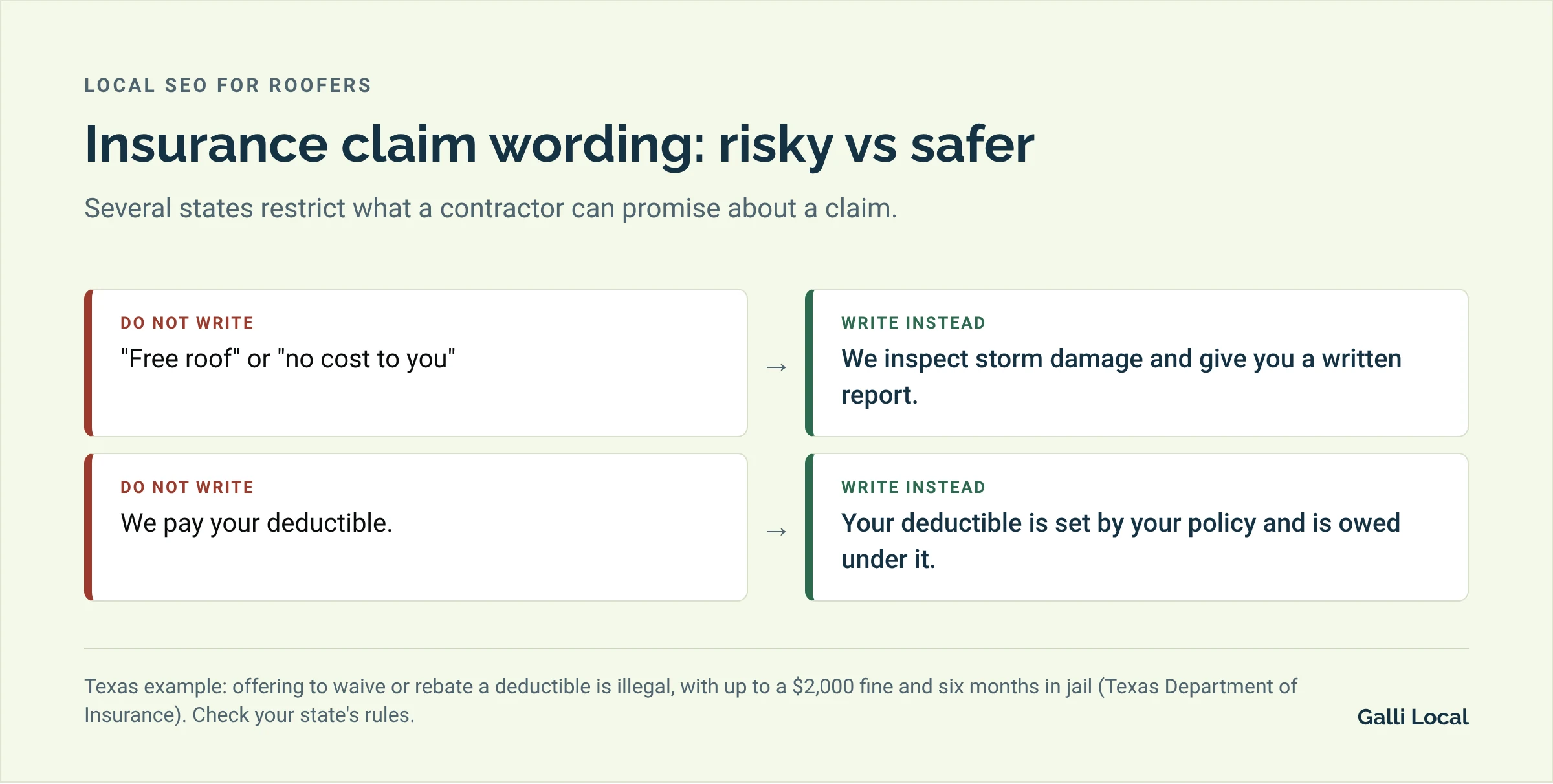
Less than many roofing websites say now. Several states restrict what a contractor can promise about a claim. Texas is a clear example: it is illegal there for a roofer to offer to waive a deductible or to promise a rebate for any part of it, with penalties of up to a $2,000 fine and six months in jail (Texas Department of Insurance).
Check your own state's rules before publishing a claims page.
What do licensing and Local Services Ads require from a roofer?
Roofing license rules vary by state. For roofers in the United States, Google's Local Services Ads requirements list a state-level business and owner license, general liability insurance and, for some advertisers, background checks (Google Local Services Help).
In Pennsylvania, roofers doing residential work must register with the Attorney General as home improvement contractors and show the registration number in all advertisements, contracts and estimates (PA Office of Attorney General). Put the number in the website footer and the profile description.
Which categories and directories matter for roofers?
"Roofing contractor" should be the primary category. Add "Gutter service", "Siding contractor" or "Skylight contractor" only for work you do regularly. Category names come from a published list of current Business Profile categories (Dalton Luka).
Directories worth keeping accurate:
- Contractor locators run by GAF, Owens Corning and CertainTeed, for contractors in each manufacturer's program
- National Roofing Contractors Association (NRCA) member directory
General listings matter as much as the manufacturer ones. Keep the company name, address and phone the same on Bing Places, Apple Business Connect, Yelp, the Better Business Bureau, Angi, Houzz and Nextdoor, and on your state contractor license or registration lookup.
What does managing a roofer's Business Profile involve?
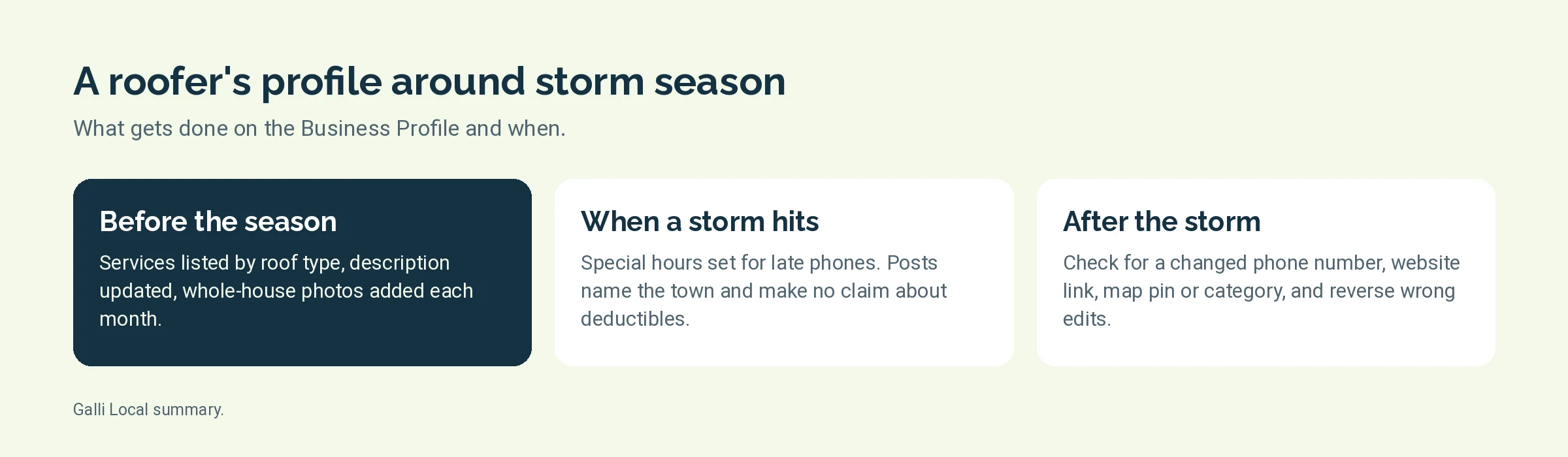
A roofing profile has to answer two questions fast: do you do my kind of roof, and are you from here?
Posts should carry no claim you could not put in a contract. A storm post can say you are inspecting roofs in a named town this week. It cannot say "free roof" or mention the deductible, for the reasons in the insurance section above.
Unwanted edits rise after a storm, when competitors and lead sellers are active. We check for a changed phone number, a changed website link, a moved map pin and a swapped category, and reverse the wrong ones. If you also hang gutters or siding, "Gutter service" and "Siding contractor" stay as secondary categories so "Roofing contractor" keeps the primary spot.
Ongoing posting and edit monitoring are part of GBP management, bundled with the Local SEO program.
How should a roofer ask for and answer reviews?
Ask at the final walkthrough, after the cleanup and the magnet sweep for nails, when the homeowner is looking at the finished roof. Do not wait for the insurance payment to clear.
A request that works: "Your roof is finished and the yard is clean. If you are happy with it, a Google review that mentions the material and your town helps your neighbors find us. Here is the link." Roofers finish fewer jobs a month than a plumber, so ask every customer.
In replies, do not discuss the claim, the insurer or the amount paid, and do not confirm an address. Thank the reviewer and name the town and the material. For a complaint about a leak after the job, say the warranty covers it and that the office will call that day, then make the call.
The Local SEO program monitors reviews and flags 1- and 2-star reviews for removal when they break Google's policies. After a storm, roofers see reviews from people who got a door knock from a different company with a similar name. Those are worth flagging. A real customer's complaint is not a policy violation, and only Google decides what is removed. Our guide on getting more Google reviews covers the review link and QR code.
How is a roofer's map ranking tracked?
A map grid puts points across your home market and records your Google Maps position from each. The Local SEO program tracks 10 keywords on a 5-mile community grid or 20 on a 10-mile city grid.
The keyword list mixes shopper terms ("roofing companies", "roofing contractor"), repair terms ("roof repair", "roof leak repair") and storm terms ("storm damage roof repair", "hail damage roof repair"). Each is qualified first.
The monthly report shows average rank, coverage and top 3 share, plus calls, website clicks and direction requests. Read coverage on the storm terms before the season. The edge of your top 3 area is the line the storm-ready checklist above asks you to find. Our article on how to read a map grid report has an example.
The program also includes local engagement signals on priority keywords, added in tiers as each set reaches the top 3.
Does the program include service and town pages?
It includes the recommendations: which storm damage, material or town page to add, and what it should cover. It does not include writing them. The cost page and claims page described above are content work, handled through SEO content for roofers, which comes with the AEO | GEO bundle and the full agency stack.
What is not included in the Local SEO program?
- Technical work. Speed, indexing and schema are under SEO for roofers and technical SEO.
- Content writing. Cost, material, claims and town pages.
- Links. Manufacturer, supplier and local links are link building.
- Ads. Google Ads and Local Services Ads are PPC management.
Is Galli Local a good fit for your roofing company?
The Local SEO program starts at $850/mo per location. See Local SEO services and Packages for what is included, and the roofer hub for our other services for roofing companies. Galli Local is based in Bellefonte, Pennsylvania, works with contractors remotely, and is new, so it has no roofing case studies yet. Related trades: HVAC companies and electricians.
Other services for roofers
- Marketing for roofers: the hub page
- SEO for roofers: organic rankings for cost and material searches
- AEO | GEO for roofers: being named when a homeowner asks an AI tool which roofer to trust
- SEO content for roofers: cost, storm and town pages written for you
Roofer local SEO FAQ
When should a roofer start local SEO?
Start at least three months before your storm season. Reaching the top 3 on competitive terms usually takes 30 to 90 days, so work that begins after a storm pays off after the claims are settled.
Can I rank in a nearby city after a hailstorm there?
Not in the map pack unless you have a real, staffed location near it. Area pages and ads aimed at that city are the ways to reach it without breaking Google's rules.
Can a roofer advertise paying the homeowner's deductible?
No, not where state law bans it. Texas, for example, makes it illegal to offer to waive or rebate a deductible. Check your state's rules and keep that wording off your site, posts and ads.
What photos work best on a roofing profile?
Photos of the finished house from the street work best. They show the whole job, and a caption with the town adds local proof.
Should a roofer run Local Services Ads?
They are worth testing if you hold the license and insurance Google asks for. The ads appear above the map and start once Google's screening is complete, which helps while map rankings build.