
☰
All servicesLocal SEOGBP managementAEO | GEOSEO contentTechnical SEOLink buildingDesign & CROPPC managementIndustriesLaw firmsHome servicesPlumbersHVACElectriciansRoofersMedical practicesOrthopedicsPhysical therapyDental practicesGeneral dentistsOrthodontistsPeriodontistsEndodontistsRestaurants and coffee shopsTour operatorsAuto repair shopsLocationsPennsylvaniaState CollegeBellefonteAltoonaWilliamsportLock HavenLewistownPhiladelphiaPittsburghAllentownHarrisburgNew YorkNew York CityBuffaloRochesterAlbanyTexasHoustonDallasSan AntonioAustinUtahSalt Lake CityProvoSt. GeorgeConnecticutBridgeportNew HavenHartfordStamfordOhioColumbusClevelandCincinnatiWashingtonSeattleSpokaneTacomaNevadaLas VegasRenoHendersonPackagesAboutResourcesArticles
Home / Industries / Law firms / Local SEO
Local SEO for law firms
Quick summary: Local SEO for law firms is the work of getting a firm into the Google map pack when someone nearby searches for a lawyer, while staying inside attorney advertising rules. Galli Local runs it for solo and two-partner firms. This page explains how clients search, what to fix and keep current on your Business Profile, which rules apply to reviews and ads, how the map grid is tracked, and what the program does not cover.
How do people search for a lawyer?
Most legal searches fall into three groups, and each one is answered by a different part of the results page.
The first group is where a small firm should start. Someone who types "near me" or a practice area plus a town wants to call a lawyer today, and they choose from the three firms on the map. The second group matters for firms that want to be named when people ask AI tools who to hire. That is the focus of AEO | GEO.
Practice area changes the pattern. Criminal defense and personal injury searches are often urgent. Estate planning and business law clients tend to take longer and read more before they call. A plan for a DUI firm leans on the map pack and call handling. A plan for an estate firm needs more content.
Which Business Profile categories and fields matter for a law firm?
Primary category
Google's guidance is to pick the fewest, most specific categories that describe what the business is. For a firm with one main practice area, that means a practice-area category such as "Personal injury attorney", "Criminal justice attorney", "Family law attorney", or "Estate planning attorney" instead of the general "Law firm". The primary category carries the most weight, so it should match the work you most want.
A general practice firm faces a real trade-off. "Law firm" matches broad searches but competes poorly on specific ones. We choose by scanning each option on the grid and checking which categories the top-ranked firms in your town use.
Firm profile and attorney profiles
Google allows individual practitioners, including lawyers, to have their own profiles when they are public-facing and can be reached directly at the verified location during stated hours. Two rules from Google's guidelines matter:
- Solo practitioner at a branded firm: one profile, named in the format "Firm name: Attorney name".
- Several attorneys at one firm: the firm has its own profile, and each attorney's profile uses only the attorney's name.
Attorney profiles are worth having when each lawyer has a different practice area, because each can carry its own primary category. They cause trouble when they are created and then ignored, because old attorney listings with a former firm's address confuse both Google and clients.
Name and address
The profile name must match your real-world name on your sign and letterhead. Adding a city or practice area to the name breaks Google's rules and can lead to suspension. The address must be a location where you meet clients, with permanent signage. Virtual offices and mailboxes are not allowed. If your profile has been suspended, read why your Google Business Profile was suspended.
Fields to complete
- Services, listed by practice area in the words clients use
- Hours, including whether calls are answered after hours
- Appointment link to your consultation form
- Description that states practice areas and the towns you serve
- Attributes that apply, such as online appointments or wheelchair access
Posts, hours and unwanted edits
A firm's profile needs upkeep after setup.
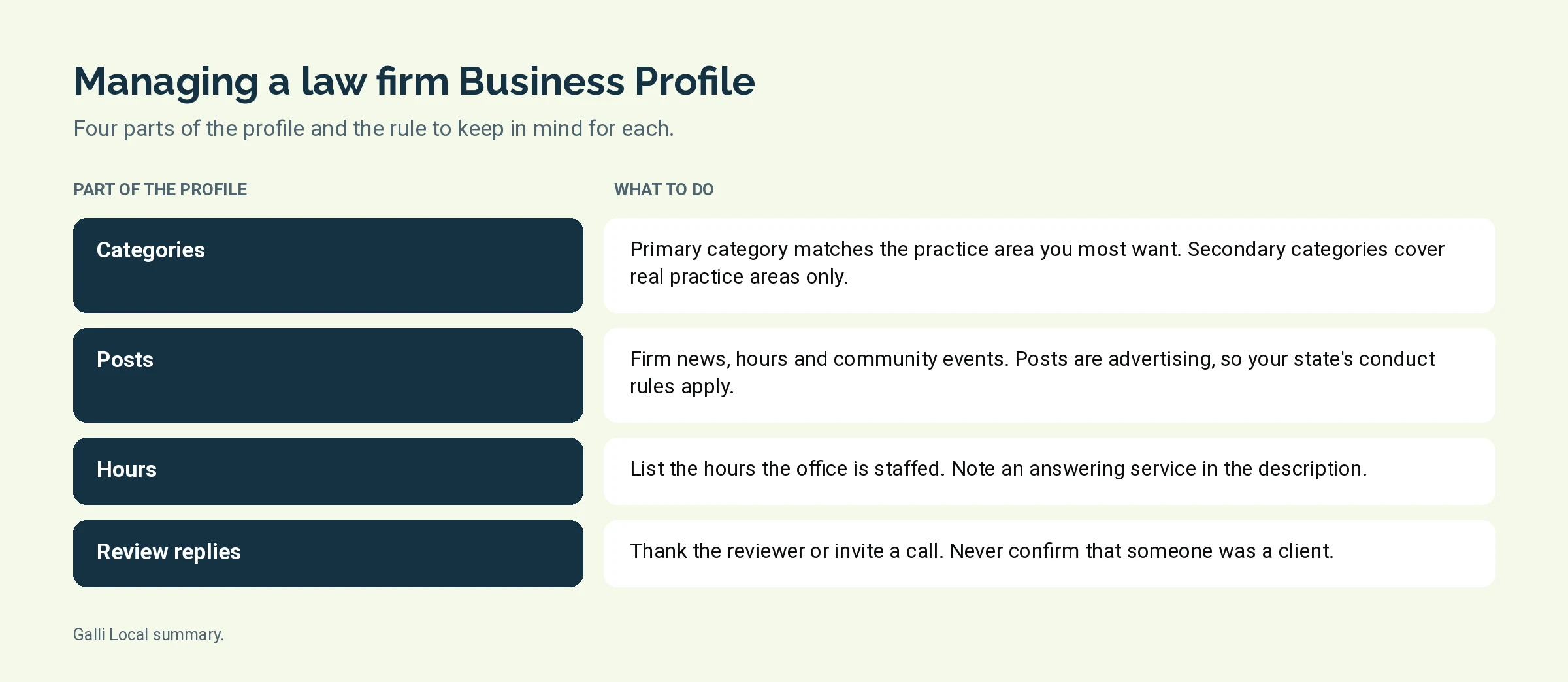
- Posts. A post is a communication about legal services, so the advertising rules lower on this page apply to it. Good subjects are a new attorney, new hours, or a community event. Skip case results unless your state allows them with the required context.
- Hours. List the hours the office is staffed. If an answering service takes calls at night, say so in the description instead of listing 24 hours.
- Unwanted edits. Anyone can suggest a change to a listing. On law firm profiles the usual ones are a practice-area category swapped for "Legal services" and a dropped suite number. Each is checked and corrected.
Secondary categories should cover real practice areas only. A firm with "Personal injury attorney" as the primary category might add "Trial attorney" and "Law firm". Ongoing posting and edit monitoring are part of GBP management, which is bundled with the Local SEO program.
How should a law firm handle reviews and photos?
Reviews
Three sets of rules apply at once.
- Google's policy. A business may not offer payment, discounts, or free services in exchange for a review, and may not ask only happy customers while steering unhappy ones away.
- The FTC's rule on reviews and testimonials. It bans fake reviews, bans incentives tied to a positive or negative sentiment, and requires insiders to disclose their connection.
- Attorney advertising rules. ABA Model Rule 7.2(b) bars a lawyer from paying a person to recommend the lawyer's services, with narrow exceptions. Most states have adopted a version of it.
Ask every client at the end of the matter, in the same words, with a direct link. Offer nothing in return. Do not ask staff or relatives to post.
Replies need more care than in other industries. ABA Formal Opinion 496 addresses how lawyers may respond to online criticism, and the duty of confidentiality still applies when a client has written about the case in public. A reply should not confirm that the reviewer was a client or share any detail of the matter. Thank the reviewer, or invite them to call the office. Our guide on responding to negative reviews has wording you can adapt.
When to ask, and what to do with a bad review
Ask when the matter closes, not while it is open. Send the request with the closing letter. Keep the wording neutral: "If you are willing to share your experience with our office, here is the link. Please leave out any details of your case you want kept private."
Use a reply that could sit under any review the firm has: "Thank you for the feedback. Please call our office so we can talk." It does not say whether the person was a client.
The Local SEO program monitors reviews and flags 1- and 2-star reviews for removal when they break Google's policies. Examples are a review aimed at the wrong firm or one written by a competitor. A real client's complaint about a result does not break policy, and only Google decides what is removed.
Photos
Clients want to see who they will meet and where. Useful photos for a firm are the building exterior with signage, the entrance and parking, the reception area, a conference room, and a current headshot of each attorney.
Which legal directories are worth claiming?
AI tools and Google both check legal directories to confirm who you are. Start with the ones clients and AI tools see most often.
- Your state bar's directory. The official record of your license. Make sure the address and firm name match your profile.
- Avvo, Justia, FindLaw, and Martindale-Hubbell. The large legal directories. Claim the free profile on each before paying for an upgrade.
- Super Lawyers and Lawyers.com. Claim them if a listing already exists.
- General directories. Bing, Apple Business Connect, Yelp, and the Better Business Bureau.
What matters is that the firm name, address, and phone number match everywhere. An attorney who has changed firms often has old listings at the last address. Finding and fixing those is the first job in any citation cleanup. See what is NAP consistency for how to audit your own.
How is a law firm's map ranking tracked?
A map grid lays points across the area around the firm and records your position in Google Maps from each one.
For a firm, the keywords are practice-area searches such as "divorce lawyer", "DUI attorney" and "estate planning attorney near me". Each term is qualified first. The monthly report gives average rank, coverage, and top 3 share, next to calls, website clicks and direction requests. Read coverage first: it is how much of the grid shows your firm at all. Top 3 share is where a searcher sees you without scrolling. Our article on how to read a map grid report walks through an example.
The program also includes local engagement signals on priority keywords, added in tiers as each set of terms reaches the top 3.
What about practice-area and town pages?
When part of the grid stalls, the cause is often a missing page, such as one for DUI defense in the next town. The program tells you which pages to add or change and what each should cover. It does not write them. Writing is handled through SEO content for law firms, which comes with the AEO | GEO bundle and the full agency stack.
What is not included in the Local SEO program?
- Technical work. Site speed, indexing and schema fixes are part of SEO for law firms and technical SEO.
- Content writing. Practice-area pages, attorney bios and articles.
- Links. Outreach to local and legal sites is link building.
- Ads. Google Ads and Local Services Ads run under PPC management.
What advertising rules apply to law firm SEO?
Your website, Business Profile, and ads are all communications about legal services, so your state's Rules of Professional Conduct apply to them. These points from the ABA Model Rules are common to most:
- No false or misleading statements (Rule 7.1). That covers "best lawyer in town" claims you cannot support and results stated without context.
- Name and contact information (Rule 7.2(d)). Each communication must include the name and contact information of at least one responsible lawyer or firm.
- Specialist claims (Rule 7.2(c)). You may not say you are certified as a specialist unless an approved organization certified you and you name it.
Some states go further. Pennsylvania, for example, requires an ad to state the city or town of the office where the work will be done. Our Pennsylvania page summarizes that rule. This page is a summary and not legal advice, so check your state's current rules or call your bar's ethics line.
Local Services Ads have their own screening. Google checks the state bar license of each lawyer in the firm before the ads run, and it requires a verified Business Profile.
Which package fits a law firm?
Most small firms start with the Local SEO program, which starts at $850/mo per location. It covers Business Profile optimization, citation cleanup, map grid tracking, and recommendations for practice-area and area pages. The Local SEO services page has the full list.
Firms in practice areas that clients research heavily, such as estate planning, family law, and business law, often add the bundle with GBP management and AEO | GEO. It includes a legal directory audit and two content pieces a month. Firms that need cases now can run PPC alongside either one. Current rates are on the packages page.
Is this a good fit for your firm?
Before you hire any agency, read hiring an SEO company for your law firm. Other industries are on the industries page, the law firm hub lists every service we offer firms, and our home market pages for State College and Bellefonte cover two Pennsylvania towns in detail.
By location: Pennsylvania, State College, PA, Philadelphia, PA, Pittsburgh, PA, New York, Texas, Connecticut, Ohio, Utah, Washington State, Nevada.
Other services for law firms
- Marketing for law firms: the hub, with every service in one place
- SEO for law firms: organic rankings for practice-area and research searches
- AEO | GEO for law firms: being named when someone asks an AI tool which lawyer to hire
- SEO content for law firms: practice-area pages and articles written for you
Common questions about local SEO for law firms
How long does local SEO take for a law firm?
First map grid movement usually shows in 1 to 3 weeks. Reaching the top 3 on competitive terms takes 30 to 90 days, depending on your reviews, your practice area, and how many firms are nearby.
Can a law firm ask clients for Google reviews?
Yes. A firm can ask clients for honest reviews. It cannot pay for them, offer anything in exchange, or ask only the clients it expects to be happy.
Should each attorney have a separate Google Business Profile?
Separate attorney profiles help when each lawyer has a different practice area and will keep the profile current. A solo practitioner should have one profile.
Can I use a virtual office to rank in another city?
No. Google's guidelines do not allow virtual offices, and profiles that use them can be suspended. Area pages, ads, or a staffed second office are the options.
Which Business Profile category should a law firm choose?
Choose the most specific category that matches the work you most want. A firm that mainly handles injury cases should use a personal injury category as its primary one, not the general "Law firm".