
☰
All servicesLocal SEOGBP managementAEO | GEOSEO contentTechnical SEOLink buildingDesign & CROPPC managementIndustriesLaw firmsHome servicesPlumbersHVACElectriciansRoofersMedical practicesOrthopedicsPhysical therapyDental practicesGeneral dentistsOrthodontistsPeriodontistsEndodontistsRestaurants and coffee shopsTour operatorsAuto repair shopsLocationsPennsylvaniaState CollegeBellefonteAltoonaWilliamsportLock HavenLewistownPhiladelphiaPittsburghAllentownHarrisburgNew YorkNew York CityBuffaloRochesterAlbanyTexasHoustonDallasSan AntonioAustinUtahSalt Lake CityProvoSt. GeorgeConnecticutBridgeportNew HavenHartfordStamfordOhioColumbusClevelandCincinnatiWashingtonSeattleSpokaneTacomaNevadaLas VegasRenoHendersonPackagesAboutResourcesArticles
Home / Industries / Home services / HVAC / Local SEO
Local SEO for HVAC companies
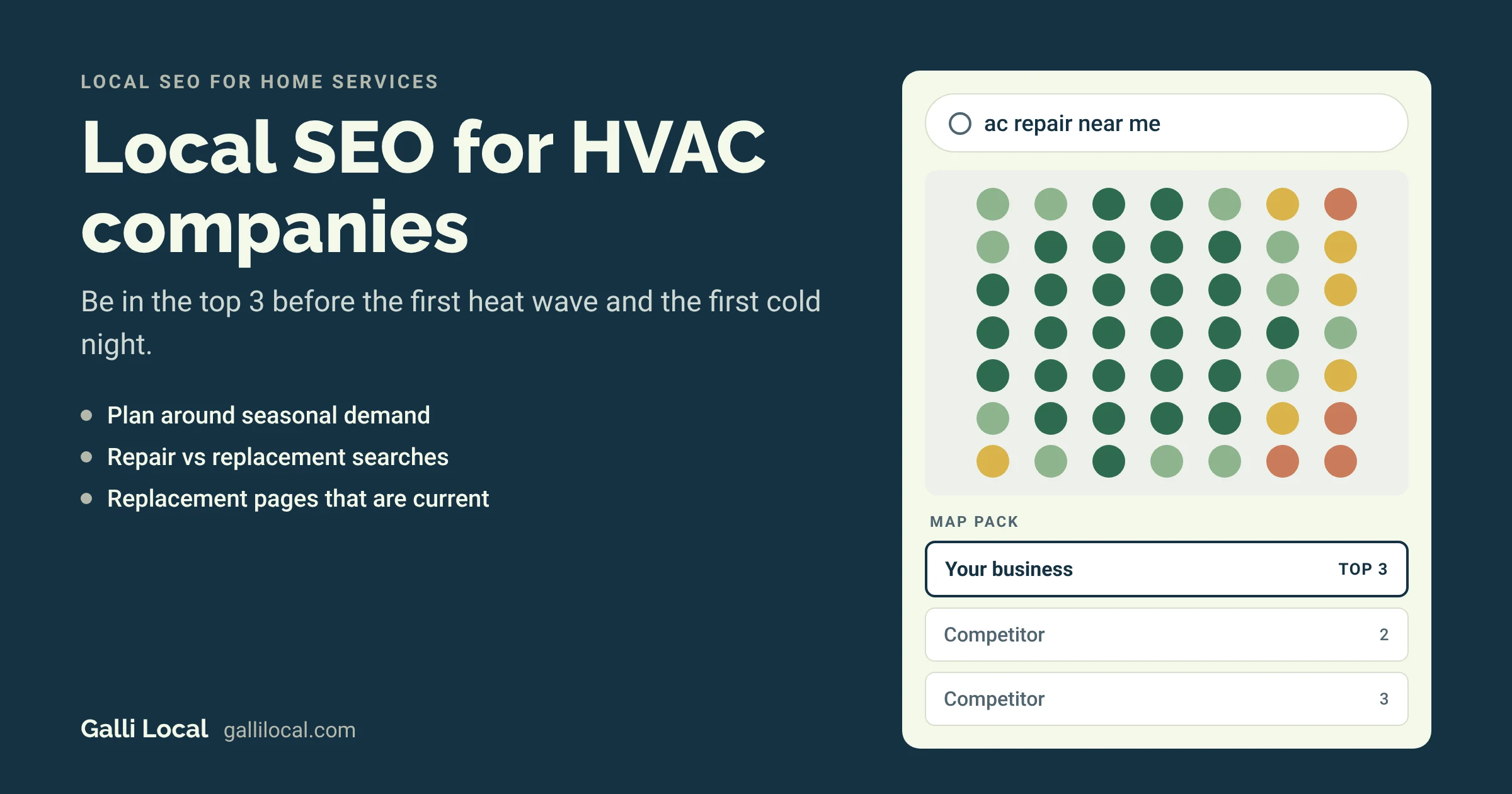
Quick summary: Local SEO for HVAC companies is the work of ranking a heating and cooling contractor in the Google Maps top 3 before the first heat wave and the first cold night, when most of the year's calls come in. It is for HVAC contractors with a verified Google Business Profile and a real shop address that want steadier calls for repair, maintenance and system replacement.
This page covers local SEO for a heating and cooling company from the profile to the monthly report. The parts shared by every trade are on the home services page.
When do people search for HVAC service?
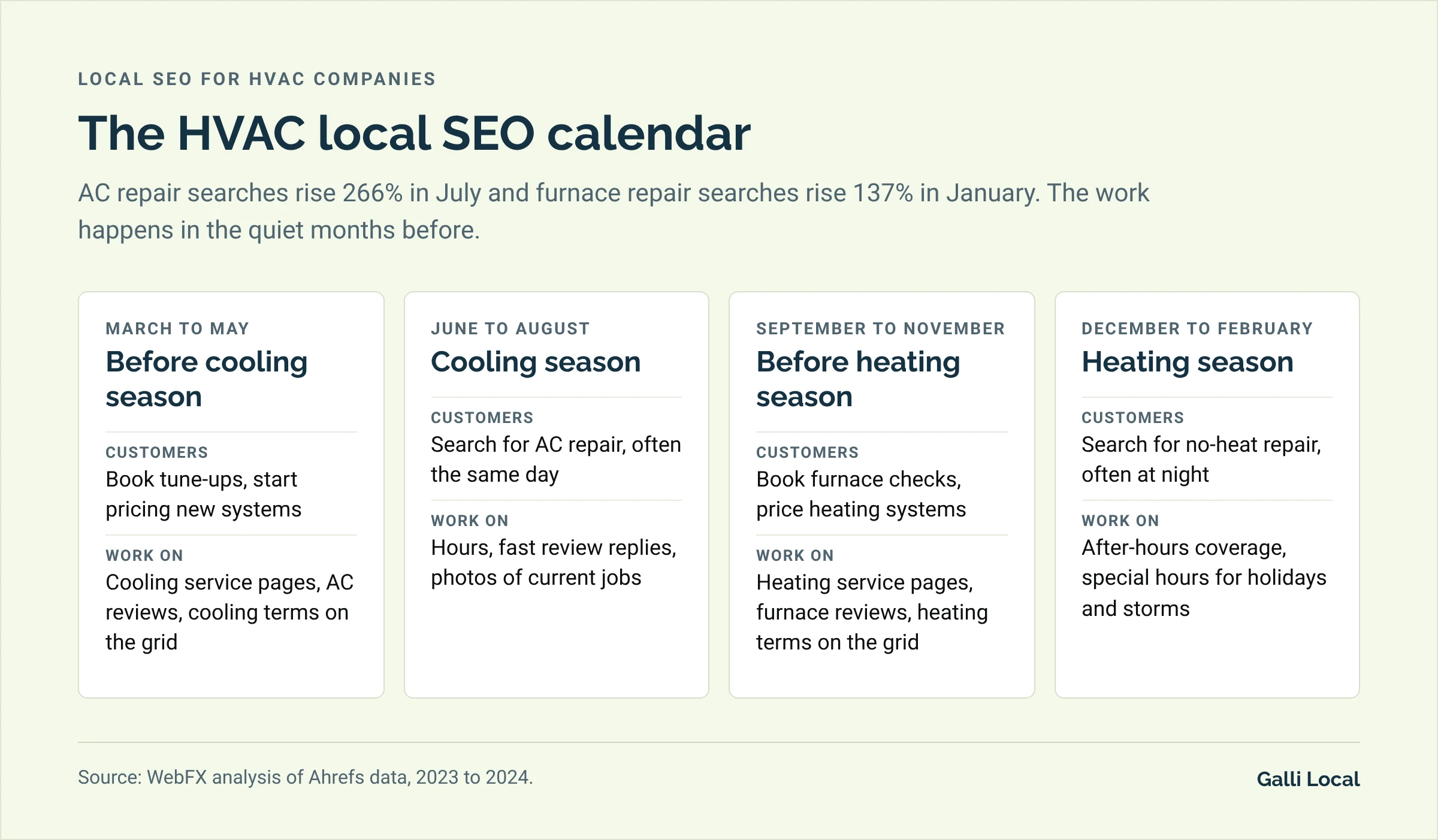
HVAC searches follow the weather more than any other home service. A WebFX analysis of Ahrefs data from 2023 and 2024 found that AC repair searches rise 266% in July and that furnace repair searches rise 137% in January (WebFX analysis, published by KRDO).
Map rankings take weeks to build, so the work has to happen in the months when the phones are quiet.
How do repair searches differ from replacement searches?
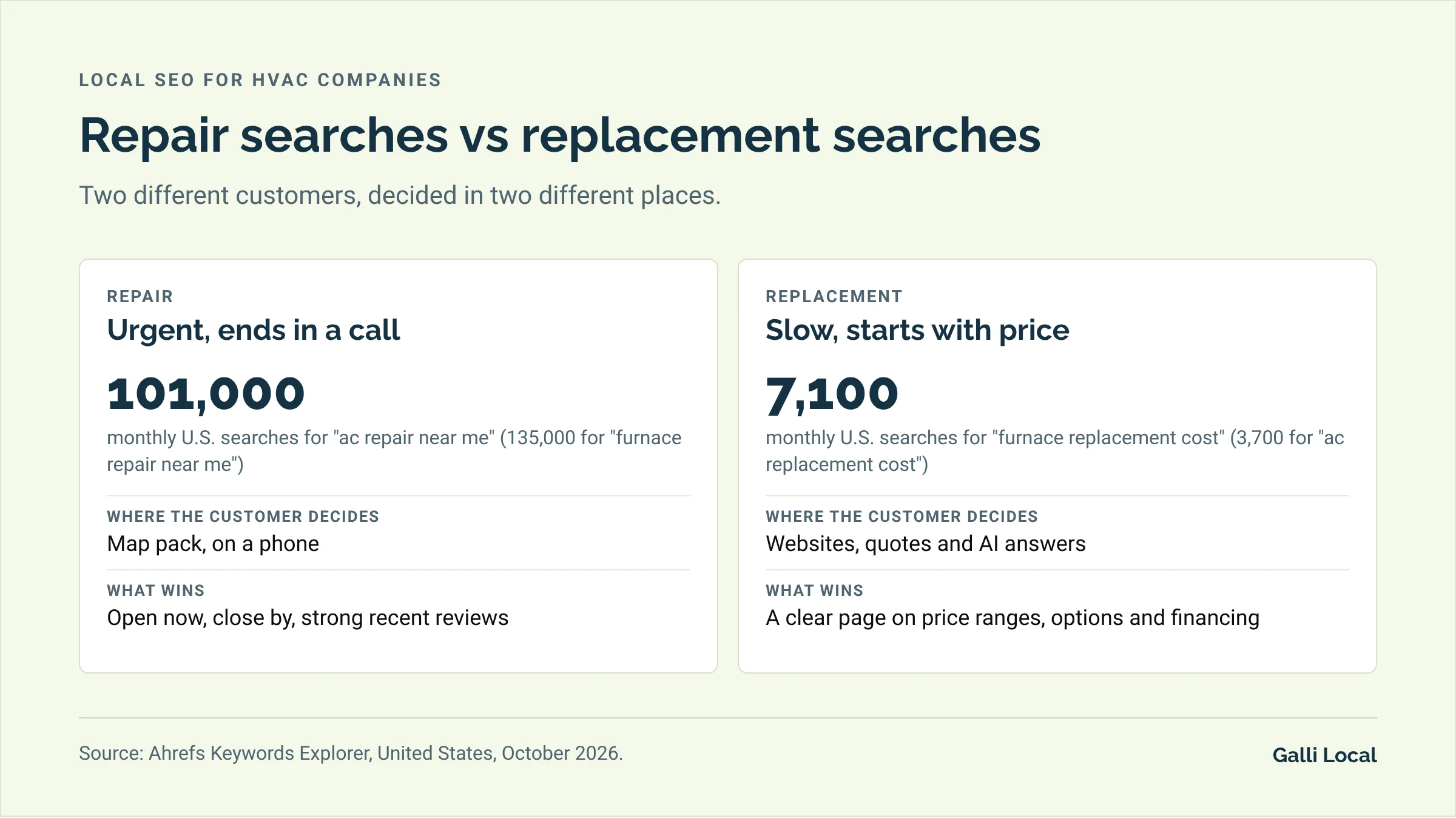
Repair searches are urgent and end in a call from the map. Replacement searches are slow, start with a price question, and often end on a website after the homeowner has compared several companies.
Source: Ahrefs Keywords Explorer, United States, checked October 5, 2026.
Cost questions are also the kind of search where an AI answer shows first. A replacement page that gives real price ranges for your market, explains what changes the price, and names the brands you install can be the source that answer cites. That is the work our AEO | GEO service covers.
What should a replacement page say now?
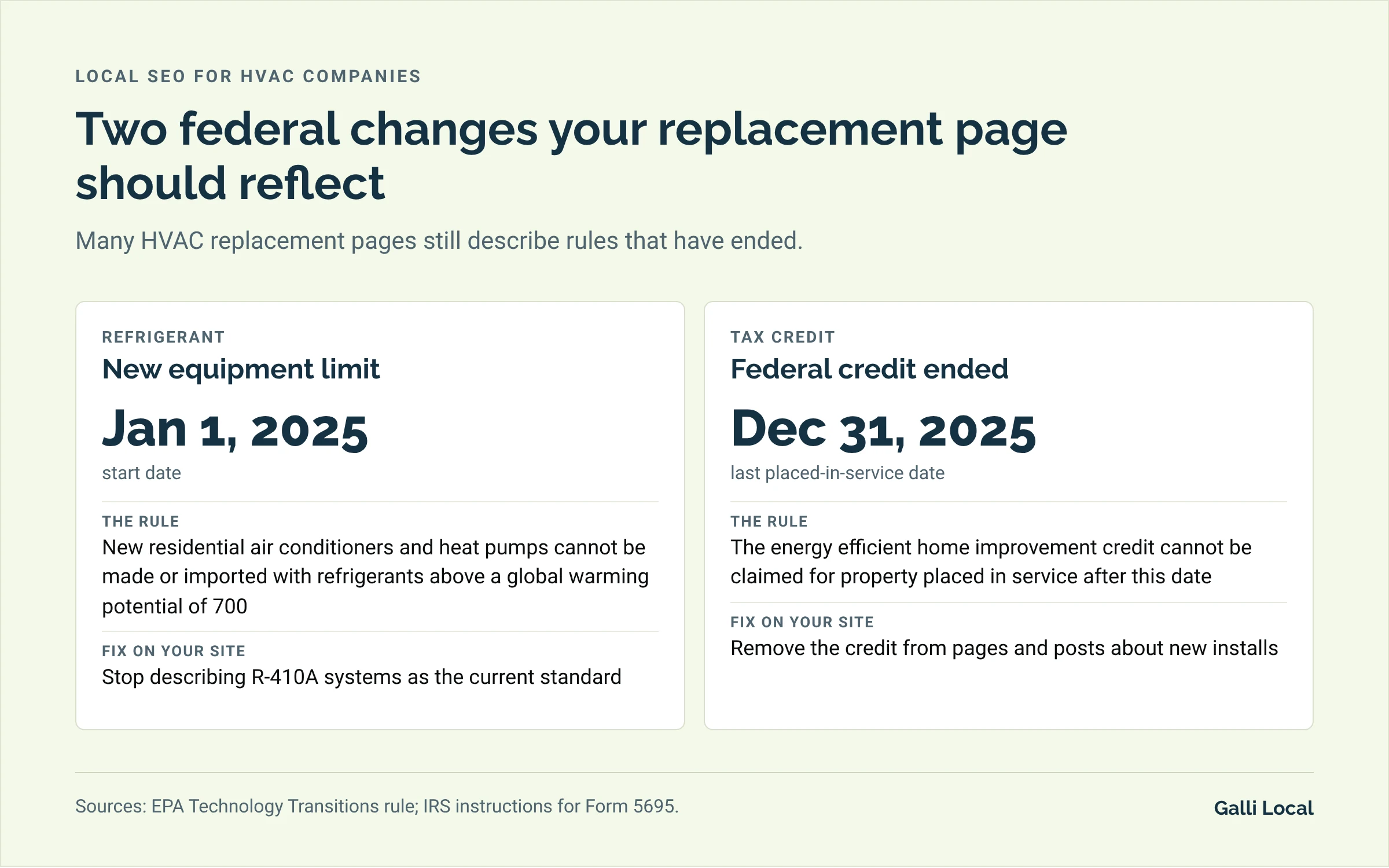
Two federal changes have made many HVAC replacement pages out of date.
Refrigerant. Since January 1, 2025, new residential air conditioners and heat pumps cannot be made or imported with refrigerants above a global warming potential of 700 (EPA). That rule ended new R-410A equipment. A page that still describes R-410A systems as the current standard reads as old to a homeowner who has done any research.
Tax credits. The federal energy efficient home improvement credit cannot be claimed for property placed in service after December 31, 2025 (IRS instructions for Form 5695). Pages and Business Profile posts that still promote that credit for new installs should be corrected.
Which categories should an HVAC company use?
"HVAC contractor" is the right primary category for most full-service companies. Secondary categories should cover both seasons.
- Air conditioning repair service
- Air conditioning contractor
- Heating contractor
- Furnace repair service
- Air duct cleaning service, if you offer it
Category names come from a published list of current Business Profile categories (Dalton Luka).
Some companies switch the primary category by season. It can help the in-season terms, but any primary category change can also shake rankings for a week or two. We test a switch on the map grid before the season starts, not during the first heat wave.
What does managing an HVAC Business Profile involve?
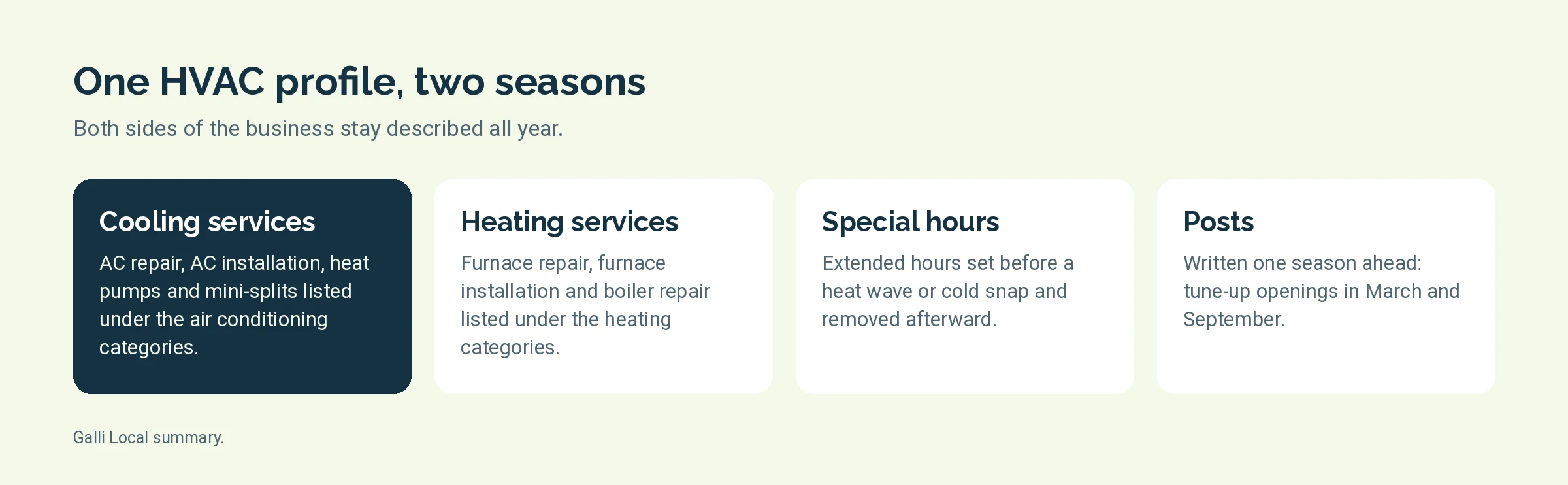
An HVAC profile describes two businesses that share one truck: a cooling company in summer and a heating company in winter. Both have to be fully described all year.
- Services, both seasons. List cooling jobs under the air conditioning categories and heating jobs under the heating ones: AC repair, AC installation, heat pump installation, ductless mini-split installation, furnace repair, furnace installation, boiler repair, thermostat installation, maintenance plans.
- Description. Name the systems you service, the brands you install, the towns you cover, and whether a tech is on call overnight.
- Attributes. Fill in what Google offers, such as online estimates. Mention financing in the description.
- Special hours. Extended hours for a heat wave or cold snap are set before it arrives and removed afterward.
- Posts. Two a month, written one season ahead: tune-up openings in March and September, filter reminders in between, and a correction post if an older post still promotes the expired federal credit described above.
- Unwanted edits. We check for changed hours, a primary category switched by a suggested edit, and brand names added to your business name by a third party.
Posting and edit monitoring are part of GBP management, bundled with the Local SEO program.
Which credentials should show on your profile and site?
Show the credentials a homeowner or Google can check:
- EPA Section 608 certification. Anyone who adds or removes refrigerant must hold it, and it does not expire (EPA).
- State or local contractor license number, where one is required.
- NATE certification for technicians who hold it.
Google checks some of this itself for Local Services Ads. For HVAC in the United States, its requirements list a state-level business and owner license, general liability insurance, and background checks on the business, the owner and the service professionals (Google Local Services Help).
Which directories matter for HVAC companies?
- Manufacturer dealer locators, such as those run by Carrier, Trane and Lennox
- Air Conditioning Contractors of America (ACCA) member directory
- NATE's contractor locator
Dealer locators are often filled in once and then forgotten after a move, so check them first.
Those are the industry listings. Under them sits the general set every HVAC company needs to be right on: Bing Places, Apple Business Connect, Yelp, the Better Business Bureau, Angi and Nextdoor. If your gas or electric utility publishes a list of participating contractors for its rebate programs, get on it too.
How is an HVAC company's map ranking tracked?
A map grid places points across your service area and records your Google Maps position from each one, keyword by keyword. The Local SEO program tracks 10 keywords on a 5-mile community grid or 20 on a 10-mile city grid. For HVAC, the keyword list is split so neither season goes unwatched.
The monthly report shows average rank, coverage and top 3 share, with calls, website clicks and direction requests beside them. Read the off-season group as your early warning. If heating terms are weak in August, there is still time to fix them. The map grid report explainer shows how to read each number.
The program also includes local engagement signals on priority keywords, added in tiers as each set reaches the top 3.
Does the program include service and town pages?
It includes recommendations. If "furnace repair" lags behind "ac repair" on the grid, the heating pages are usually thinner than the cooling ones, and we say which page to build and what it should cover. The same goes for a town where every term is weak. The writing is not part of the program. It is handled through SEO content for HVAC companies, which comes with the AEO | GEO bundle and the full agency stack.
What is not included in the Local SEO program?
- Technical work. Speed, indexing and schema sit under SEO for HVAC companies and technical SEO.
- Content writing. Repair pages, replacement cost pages and town pages.
- Links. Manufacturer, association and local links are link building.
- Ads. Google Ads and Local Services Ads are PPC management.
What review and photo habits work for HVAC?
Ask for a review twice a year from maintenance plan customers, after the spring and fall visits. That keeps reviews coming in during the slow months, when most companies get none.
After an install, ask the homeowner once the system has run for a few days and the house is comfortable. Photos of finished installs are the most useful ones on an HVAC profile: the outdoor unit set level on its pad, the furnace with clean ductwork.
Request wording, replies and removal requests
For a maintenance visit, the request can ride on the visit summary: "Your fall tune-up is done and the notes are attached. If you have a minute, a Google review of the visit helps us. Here is the link." For an install, wait the few days described above and ask the homeowner to mention the system type.
In replies, thank the reviewer and name the job. On a no-cooling or no-heat complaint, the common grievance is the wait. Do not explain the schedule in public. Say you are sorry for the wait and ask them to call the office.
The program monitors reviews and flags 1- and 2-star reviews for removal when they break Google's policies. Examples are a review meant for another contractor, one from a person with no service record, or one posted by a competitor. A real customer's complaint about a wait or a quote stays up, and Google alone decides on removals.
Is Galli Local a good fit for your HVAC company?
The Local SEO program starts at $850/mo per location. See the Local SEO services and Packages pages for what is included, and the HVAC hub for our other services for heating and cooling companies. Galli Local is based in Bellefonte, Pennsylvania, works with contractors remotely, and is new, so it has no HVAC case studies yet. Related trades: plumbers and roofers.
Other services for HVAC companies
- Marketing for HVAC companies: the hub page
- SEO for HVAC companies: organic rankings for replacement and cost searches
- AEO | GEO for HVAC companies: being the source an AI answer cites on price and system questions
- SEO content for HVAC companies: repair, replacement and town pages written for you
HVAC local SEO FAQ
When should an HVAC company start local SEO?
Start two to three months before your busy season. Reaching the top 3 on competitive terms usually takes 30 to 90 days, so work that begins in the first heat wave pays off after it ends.
Should we change our primary category each season?
It can help, but it carries risk. A primary category change can unsettle rankings for a week or two, so test it on a map grid before the season starts.
Do we need separate pages for repair and replacement?
Yes. Repair pages serve urgent searches and should lead with hours and how to reach you. Replacement pages serve slower research and should cover price ranges, options and financing.
Can we still advertise the federal tax credit for new systems?
No, not for new installs. The IRS states the energy efficient home improvement credit cannot be claimed for property placed in service after December 31, 2025. Check for utility and state rebates in your area instead.
How do we keep reviews coming in during slow months?
Ask maintenance plan customers after each spring and fall visit. Those visits happen in the shoulder seasons, so they fill the gap between busy periods.