
☰
All servicesLocal SEOGBP managementAEO | GEOSEO contentTechnical SEOLink buildingDesign & CROPPC managementIndustriesLaw firmsHome servicesPlumbersHVACElectriciansRoofersMedical practicesOrthopedicsPhysical therapyDental practicesGeneral dentistsOrthodontistsPeriodontistsEndodontistsRestaurants and coffee shopsTour operatorsAuto repair shopsLocationsPennsylvaniaState CollegeBellefonteAltoonaWilliamsportLock HavenLewistownPhiladelphiaPittsburghAllentownHarrisburgNew YorkNew York CityBuffaloRochesterAlbanyTexasHoustonDallasSan AntonioAustinUtahSalt Lake CityProvoSt. GeorgeConnecticutBridgeportNew HavenHartfordStamfordOhioColumbusClevelandCincinnatiWashingtonSeattleSpokaneTacomaNevadaLas VegasRenoHendersonPackagesAboutResourcesArticles
Home / Locations / Pennsylvania / Law firms / Local SEO
Local SEO for law firms in Pennsylvania
Quick summary: Law firm SEO in Pennsylvania follows the same method as anywhere, with one state-specific layer: Rule 7.2 of the Rules of Professional Conduct, which governs what a firm's website, Business Profile, and ads may say. Galli Local is based in Bellefonte and works with Pennsylvania firms remotely. This page covers that rule and how the state's three main legal markets differ. The general method is on our law firm SEO page.
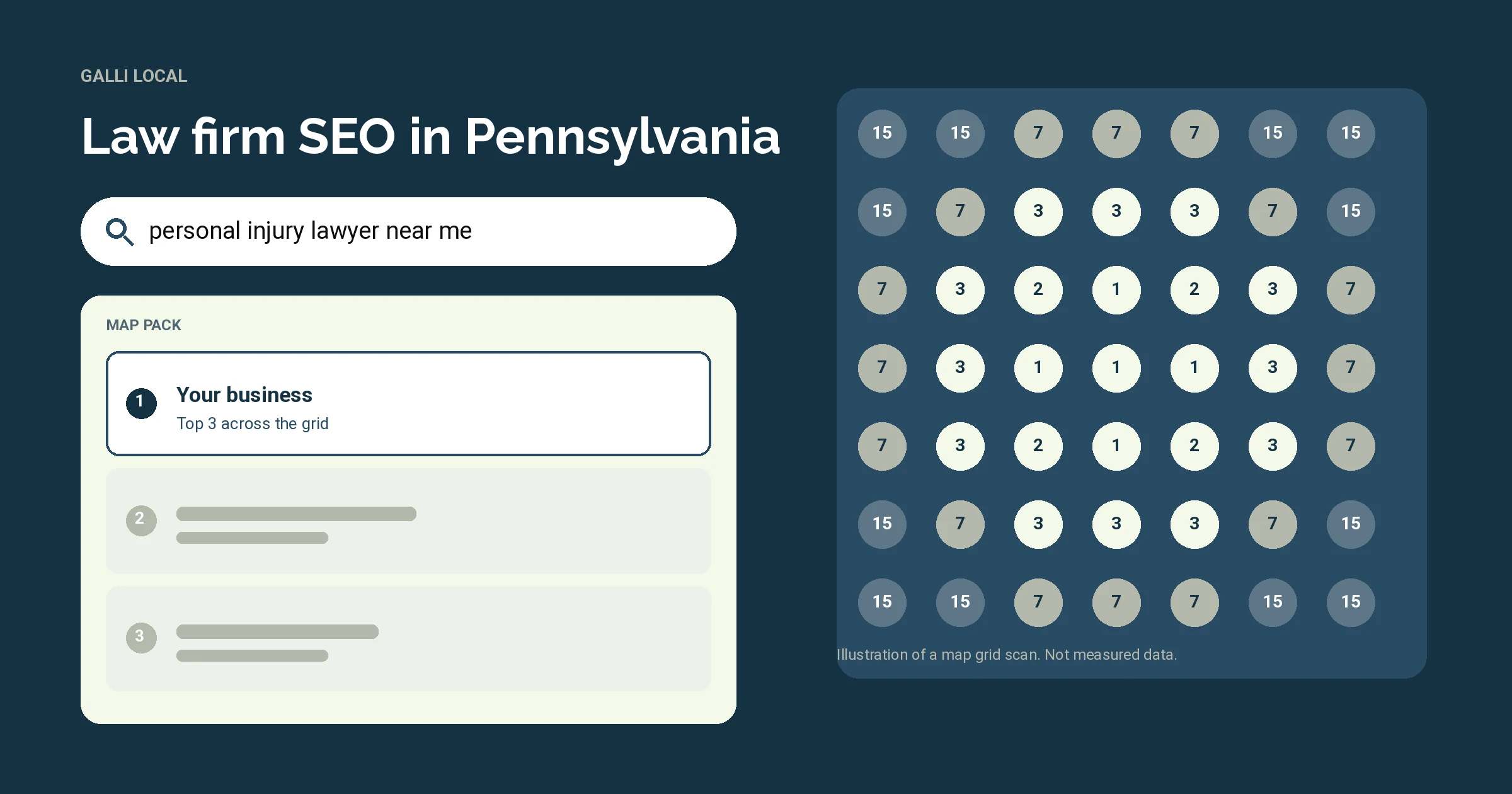
What local SEO covers for law firms in Pennsylvania
Local SEO for law firms in Pennsylvania is four jobs done every month: managing the Google Business Profile, earning and answering reviews, cleaning up citations and directory listings, and tracking rank on a map grid. In Pennsylvania, this page adds the local detail: what Rule 7.2 requires on a firm website and a Business Profile, and how Philadelphia, Pittsburgh, and State College differ. The method itself, including categories, review rules and the directories that matter, is on our local SEO for law firms page. The Local SEO program starts at $850/mo per location and needs a verified profile at a real address, at least 10 reviews and a 3.5-star or better rating.
What does Pennsylvania's Rule 7.2 require of a law firm's marketing?
Rule 7.2 treats a website, a Business Profile, and a paid ad the same way: as communications about legal services. Six parts of it come up in SEO work.
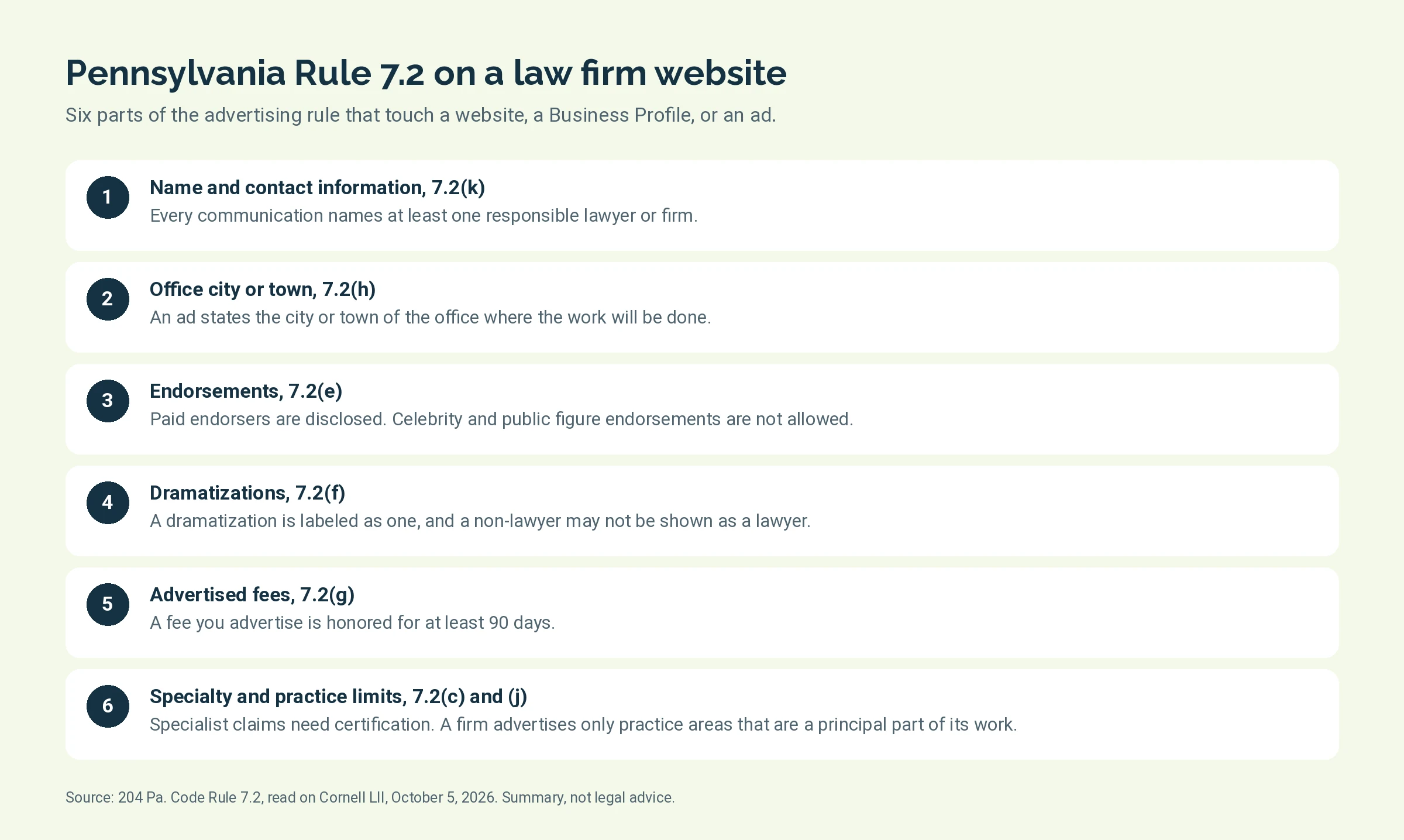
Three of these change how local SEO is done here.
The office rule and location pages. Many firms build a page for every town they would like clients from. Under 7.2(h), a page that implies an office in a town where the firm has none is a problem. Write location pages as "we serve clients in [town] from our office in [city]", and name the office.
The practice-limit rule and categories. Rule 7.2(j) says a firm may not advertise a limited practice area unless it is a principal part of the practice. That lines up with good SEO. A firm that lists eight Business Profile categories for work it rarely does is weak on relevance and exposed under the rule.
The endorsement rule and reviews. A Google review a client leaves freely is not a paid endorsement. A testimonial you paid for, or gave something for, has to be disclosed, and Rule 7.2(b) bars paying for a recommendation at all. Ask every client the same way and offer nothing.
This is a summary, not legal advice. Read the current rule before you publish.
How do Pennsylvania's legal markets differ?
Pennsylvania's trial courts are organized into 60 judicial districts. Three of them cover the markets we have written about in detail.
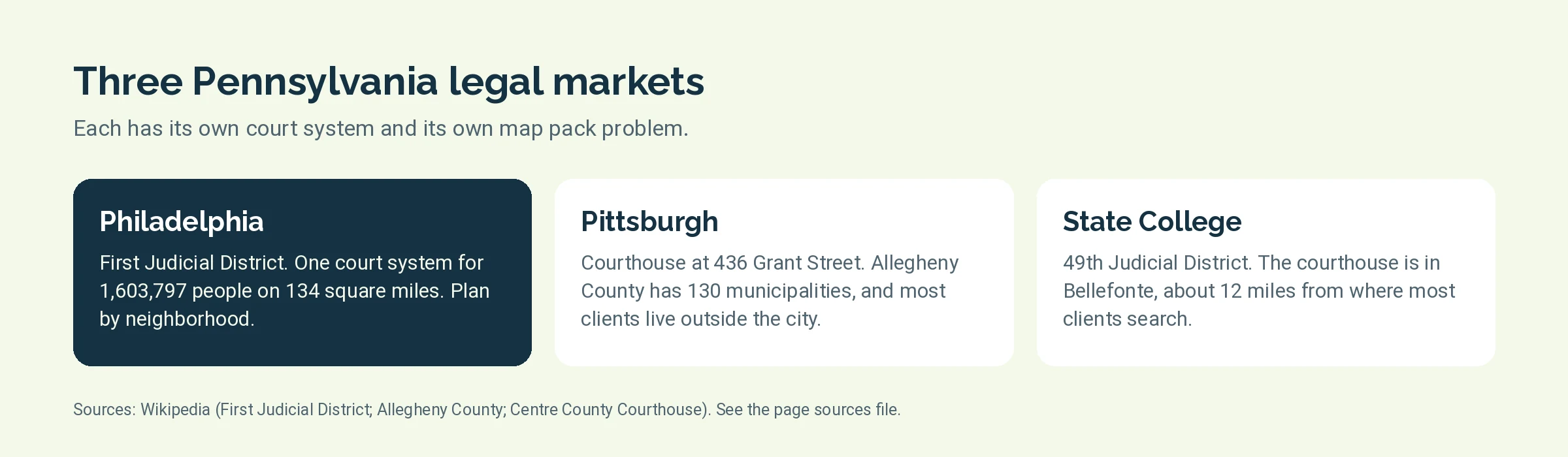
- Philadelphia. One judicial district serves a city of 1.6 million. Clients search from their own neighborhoods, so the office that ranks is the one near them. See law firm SEO in Philadelphia.
- Pittsburgh. The courthouse is downtown, and Allegheny County's 130 municipalities hold most of the clients. See law firm SEO in Pittsburgh.
- State College. The county's courthouse is in Bellefonte, about 12 miles from where most of the county's residents and students search. See law firm SEO in State College.
In smaller county seats, a firm near the courthouse shares almost the same map position as every other firm on those blocks. Reviews, categories, and practice-area pages decide the order.
What does this mean for Local Services Ads?
Google checks the state bar license of each lawyer in the firm before Local Services Ads run. The ad itself is still a communication under Rule 7.2, so the firm name on it must be real and the office location true.
What should a Pennsylvania firm check this month?
- Does every page and ad carry a lawyer's or firm's name and contact information?
- Does each location page name the real office city or town?
- Is any advertised fee still being honored?
- Does any page call a lawyer a specialist without a certification behind it?
- Do your Business Profile categories match the work that is a principal part of your practice?
The Local SEO program starts at $850/mo per location. It needs a verified Google Business Profile at a real physical address, at least 10 reviews, and a rating of 3.5 stars or better. See the Local SEO services page and the packages page. For the state as a whole, see local SEO in Pennsylvania.
Other search services for law firms
- Digital marketing for law firms: the hub for every service
- SEO for law firms: content, technical work and links beyond the map
- AEO | GEO for law firms: being named in AI answers
- SEO content for law firms: service, area and FAQ pages
These three are national pages. For the wider picture in this market, see SEO services in Pennsylvania.
Common questions about law firm SEO in Pennsylvania
Does Pennsylvania require law firms to file their ads with the bar?
Rule 7.2 as we read it contains no filing step. It does set content rules, including the office location and the responsible lawyer's name. Confirm against the current rule.
Can a Pennsylvania firm build pages for towns where it has no office?
Yes, if the page is honest about where the office is. Rule 7.2(h) requires an ad to state the city or town of the office where the work will be done.
Can a Pennsylvania lawyer say "specialist"?
Only with a certification the rule recognizes, or within the limits Rule 7.2(c) sets. Check the rule before using the word.
Can a firm use client testimonials on its site?
Yes. A paid endorsement must be disclosed, and endorsements by celebrities or public figures are not allowed.
Which Pennsylvania cities do you have law firm pages for?
Philadelphia, Pittsburgh, and State College. Each covers that city's courts and how its map packs behave.