
☰
Services
Industries
Law firmsHome servicesPlumbersHVACElectriciansRoofersMedical practicesOrthopedicsPhysical therapyDental practicesGeneral dentistsOrthodontistsPeriodontistsEndodontistsRestaurants and coffee shopsTour operatorsAuto repair shopsCar dealershipsView all industriesLocations
Pennsylvania
All PennsylvaniaState CollegeBellefonteAltoonaWilliamsportLock HavenLewistownPhiladelphiaPittsburghAllentownHarrisburgNo contracts. No card.
Home / Locations / New York / Law firms / Local SEO
Local SEO for law firms in New York
Quick summary: Law firm SEO in New York uses the same method as anywhere, with one layer on top: the New York Rules of Professional Conduct. Since June 1, 2026, Rule 7.1 bars false or misleading statements about a lawyer's services and asks for the name and contact information of a responsible lawyer or firm. There is no longer a rule on how long copies must be kept. Galli Local is based in Bellefonte, Pennsylvania, and works with New York businesses remotely. The general method is on our law firm SEO page.
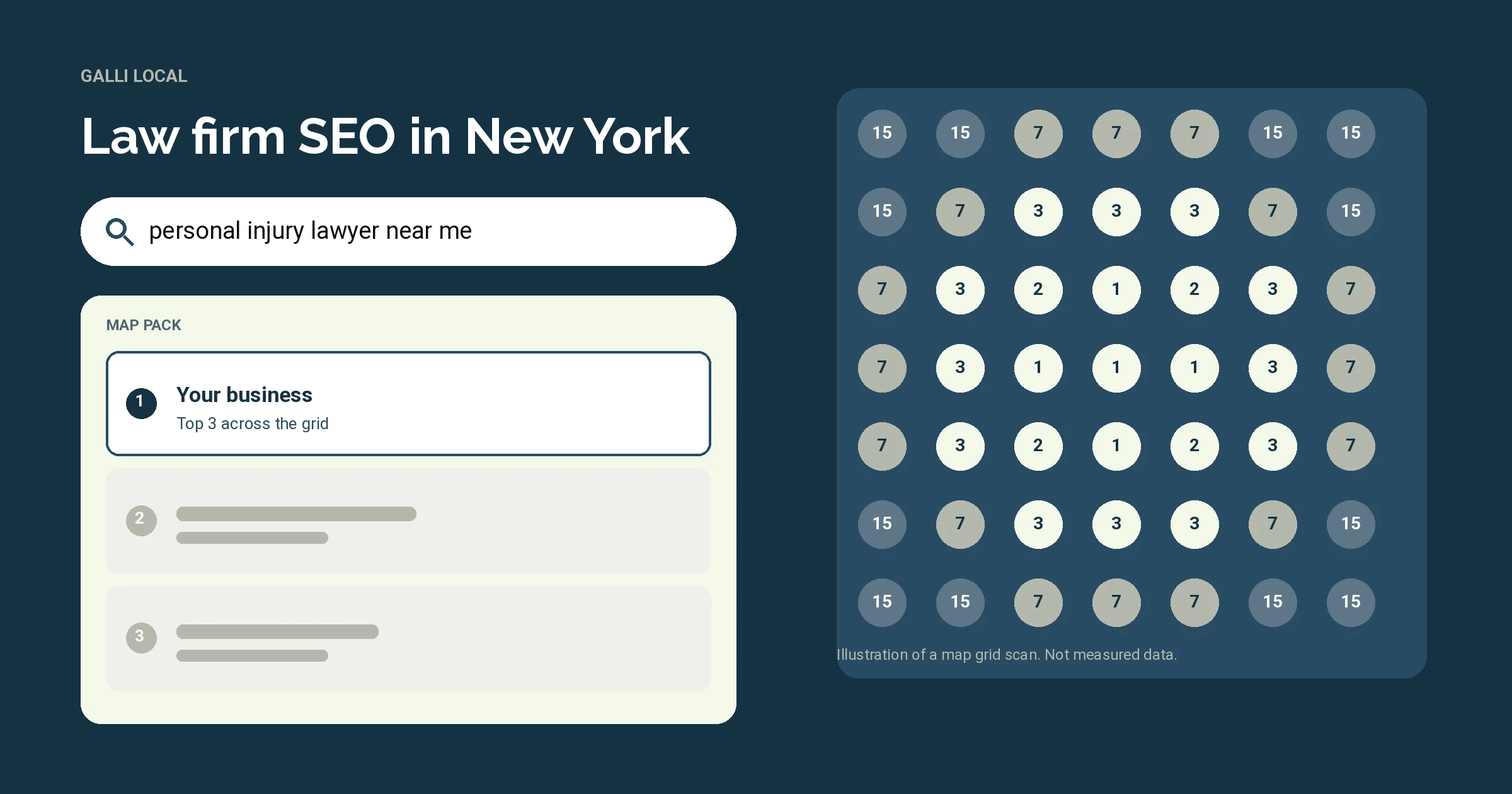
What local SEO covers for law firms in New York
Local SEO for law firms in New York is four jobs done every month: managing the Google Business Profile, earning and answering reviews, cleaning up citations and directory listings, and tracking rank on a map grid. In New York, this page adds the local detail: the attorney advertising rules in effect since June 1, 2026, what a firm can now take off its site, and how the markets differ. The method itself, including categories, review rules and the directories that matter, is on our local SEO for law firms page. The Local SEO program starts at $850/mo per location and needs a verified profile at a real address, at least 10 reviews and a 3.5-star or better rating.
What do New York's attorney advertising rules require of a firm website?
Since June 1, 2026, Rule 7.1 reaches any communication about a lawyer's services, in any media. A firm's website, Business Profile and ads all fall under it. These parts of the rules shape SEO work here.
What changed on June 1, 2026. New York replaced Rules 7.1 and 7.3 with the ABA's 2018 model rules and removed Rule 7.4. Gone are the "Attorney Advertising" label, the principal office address in every ad, the required prior results disclaimer and testimonial conditions, the meta tag rule, and the filing and copy-keeping rules, including saved website copies. Three points still matter for SEO.
Metadata is still copy. There is no separate meta tag rule now, but title tags, schema and alt text show up in search results and AI answers. A title tag that says "best injury lawyer in Brooklyn" is a claim the firm has to stand behind. Write metadata to the same standard as visible copy.
Copies are now for your own records. No rule requires saved website copies. A dated export before each redesign still gives you a record of what a page said and when.
Specialist claims follow Rule 7.1(c). A lawyer may claim to be a certified specialist only with certification from an approved or ABA-accredited body, and the page must name that body. The old "not granted by any governmental authority" disclaimer is gone. The New York State Bar Association reads the adopted comments as generally allowing a firm to say it concentrates in an area, as long as the claim is not false or misleading.
Rule 7.5, which New York kept, still covers firm names, letterheads and professional notices. Check its current text before using a domain name that leaves out the firm's name.
What a New York firm can drop from its site, and what to keep
If they are on the site only because the old rules required them, a New York firm can now remove the "Attorney Advertising" label, the prior results disclaimer on results and testimonial pages, and the principal office address in every ad. It can also stop the 90-day website copies.
Keep the firm's name and contact information for at least one responsible lawyer or firm on every page. The state bar reads the rule's comments as calling for a phone number or a physical office address. Keep the same name, address and phone on the Business Profile and in directories too, since local search depends on that match.
The false-or-misleading test still covers everything else. A results page that leaves out facts a reader would need can still mislead, which is why the state bar suggests a disclaimer may still help.
Solicitation changed as well. The 30-day ban on plaintiff-side solicitation in old Rule 7.3(e) is gone. Rule 4.5, the 30-day bar on defense-side contact with injury victims, was not amended, and Judiciary Law § 480 still applies.
about 170 words)
ources: [Order] pp. 1-7 (amends Rules 1.0, 7.1, 7.3 and 7.4 only; old 7.3 30-day paragraph struck); [NYSBA] pp. 2-3 and footnote 3 (§ 480 not overridden); Rule 4.5 text in [Part 1200]; § 480: https://www.nysenate.gov/legislation/laws/JUD/480
# Recheck list
Current consolidated rule text: the nycourts.gov Part 1200 PDF is dated 2018 and still shows the old rules, and the nycourts.gov rules index could not be reached. The new 7.1 and 7.3 text above comes from the order itself. Confirm against a current consolidated copy when one is posted.
Rule 7.5: NYSBA says it was amended in June 2020; the nycourts.gov copy predates that. Confirm the current domain name wording before publishing change 9.
Comment [10] (phone number or physical office address): this comes from NYSBA's reading of the adopted ABA comments. The comments are not in the order. Confirm where New York published them.
Order date: the scanned order reads "May 47, 2026" (OCR); the file name and the brief say May 27, 2026.
Rule 4.5(b) still points to old Rule 7.3(e), which no longer exists. Check whether the courts fix that cross-reference.
FTC Endorsement Guides and the consumer review rule: check current federal text if the page names them.
After pasting: update the meta description, og:description, twitter:description, Service schema description, FAQPage schema, rule graphic and its alt text, and dateModified.
Timing FAQ: see change 16 below (softened per Steven, Nov 9).
Rules can change. Re-read the official text on nycourts.gov before each update to this page.
## 16. FAQ: How long does local SEO take for a New York firm? (added Nov 9)
*Current text**
First map grid movement usually shows in 1 to 3 weeks. Reaching the top 3 on competitive terms takes 30 to 90 days, depending on reviews and nearby competition.
*Revised text**
First map grid movement usually shows in 1 to 3 weeks. When a profile starts with an average rank position of about 12 or better and already appears in at least 70% of a 25-square-mile grid, reaching the top 3 on competitive terms typically takes 30 to 90 days. Profiles that start further back take longer, and results depend on reviews and nearby competition.
*Why:** the old answer read as a promise. Steven (Nov 9): 30 to 90 days is typical when the starting average rank position is 12 and the profile covers at least 70% of a 25-square-mile grid. Update the FAQPage schema answer to match.
This is a summary, not legal advice, last checked in November 2026. Rules can change, so read the official text on nycourts.gov or ask your ethics counsel before you publish.
How do New York's legal markets differ?
New York has 62 counties and 13 judicial districts. The Supreme Court is the statewide trial court, which surprises out-of-state marketers who assume it is the top court. Each of New York City's five boroughs is its own county with its own courthouse.
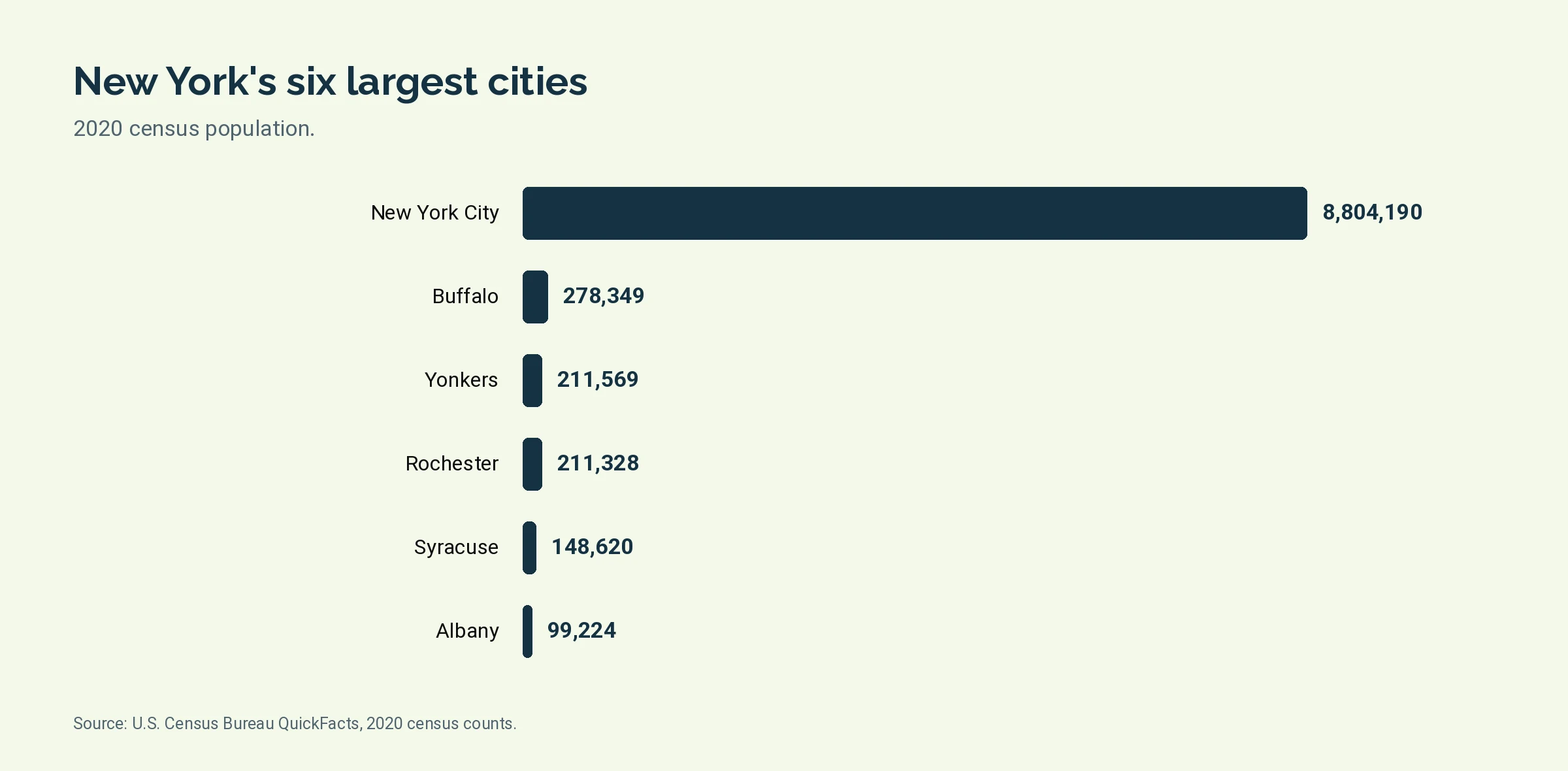
- New York City. 8,804,190 residents in 2020. "Personal injury lawyer nyc" gets about 2,400 searches a month in the United States. A firm ranks in a few neighborhoods around its office, and clients think in boroughs. Build pages by borough and by court.
- Buffalo, Rochester, Syracuse, Albany. Each is under 300,000 people and anchors its own county. One office can cover the city, and county-seat pages for nearby towns are worth writing.
- Yonkers and the suburbs. Yonkers is the state's third-largest city at 211,569. Westchester and Long Island firms compete with city firms that advertise outward.
What should a New York firm check this month?
- Does every page name the firm and give a phone number or office address for a lawyer or firm responsible for it?
- Does any page, title tag or schema field say something false or misleading, or leave out a fact a reader would need?
- Do results and testimonial pages give enough context that a reader would not expect the same outcome?
- Does any bio, badge or schema field say "certified specialist"? If so, is the certifying body approved or ABA-accredited, and named on the page?
- Do pay-per-lead or referral deals fit Rule 7.2?
The Local SEO program starts at $850/mo per location. It needs a verified Google Business Profile at a real physical address, at least 10 reviews, and a rating of 3.5 stars or better. See the Local SEO services page and the packages page. For the state as a whole, see local SEO in New York.
Other search services for law firms
- Digital marketing for law firms: the hub for every service
- SEO for law firms: content, technical work and links beyond the map
- AEO | GEO for law firms: being named in AI answers
- SEO content for law firms: service, area and FAQ pages
These three are national pages. For the wider picture in this market, see SEO services in New York.
Common questions about law firm SEO in New York
What does a New York law firm website have to show under the 2026 rules?
The name and contact information of at least one lawyer or firm that answers for the content, under Rule 7.1(d). The "Attorney Advertising" label in old Rule 7.1(f) stopped being required on June 1, 2026, and the principal office address requirement went with it. Every page is still held to the false-or-misleading test in Rule 7.1(a). Rules can change, so check the current text or ask your ethics counsel.
Can a New York firm publish client testimonials?
Yes. Since June 1, 2026, the old conditions are gone, including the required prior results disclaimer, the paid-testimonial disclosure and the written consent rule for pending matters. The test is now Rule 7.1(a): a testimonial cannot be false or misleading. The state bar suggests a results disclaimer may still help, and federal rules on endorsements and reviews also apply. Confirm against the current rule or your ethics counsel.
Does a New York firm still have to save copies of its website?
No. The filing and copy-keeping rules, including the 90-day website copies under old Rule 7.1(k), ended on June 1, 2026. A dated copy before each redesign is still a useful record of what the site said.
Is the Supreme Court the highest court in New York?
No. The Supreme Court is the statewide trial court. That matters when you write pages about where a client's case will be heard.
How long does local SEO take for a New York firm?
First map grid movement usually shows in 1 to 3 weeks. When a profile starts with an average rank position of about 12 or better and already appears in at least 70% of a 25-square-mile grid, reaching the top 3 on competitive terms typically takes 30 to 90 days. Profiles that start further back take longer, and results depend on reviews and nearby competition.