
Quick summary: The Google local 3-pack is the block of three map listings shown above the regular results for searches with local intent. Google ranks it on relevance, distance, and prominence. To rank, choose the correct primary category, keep your hours accurate, earn recent reviews, and support your profile with a strong, locally focused website.
When someone searches "emergency plumber" or "divorce lawyer near me," Google shows a map and three businesses before any website link. Those three spots get the calls.
This guide explains how the local map pack works, how it differs from traditional SEO, and the steps that move a business into the top three.
What is the Google local 3-pack?
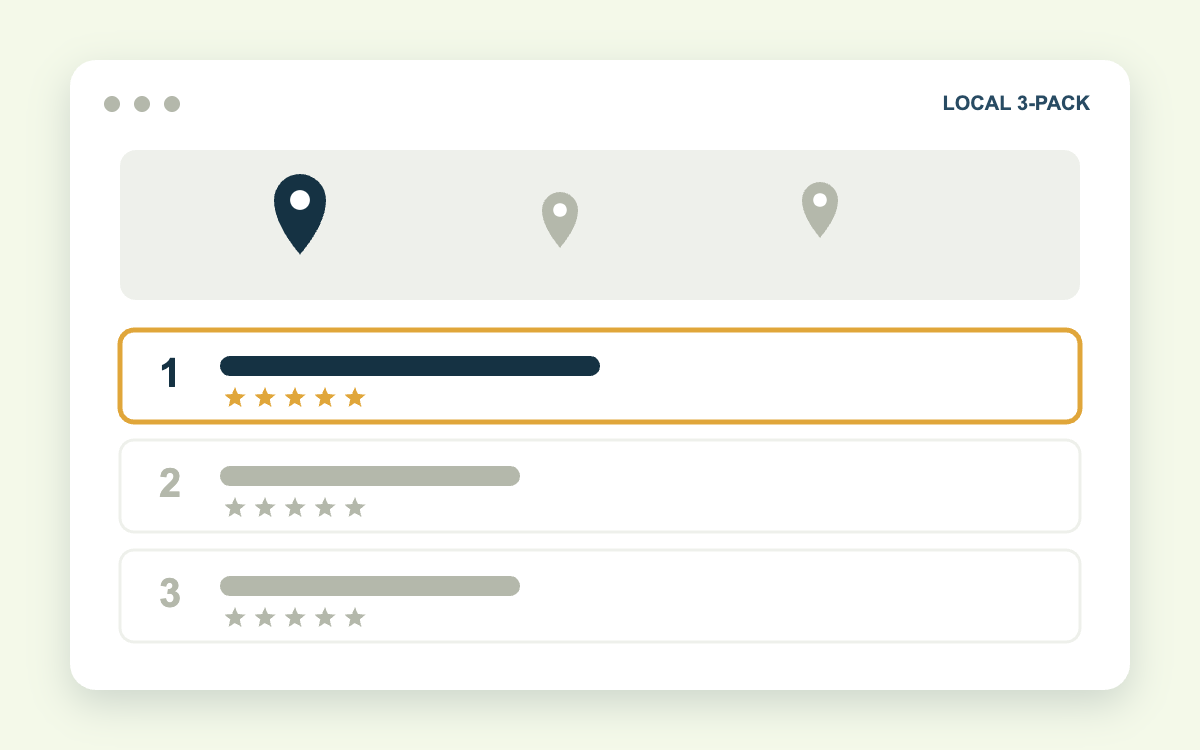
The local 3-pack, also called the local map pack, is a search feature that displays three Google Business Profiles with a map. It appears when Google detects that the searcher wants a nearby business.
Each listing shows the business name, star rating, review count, hours, and buttons to call or get directions. A searcher can phone you without ever visiting your website.
How does Google decide who ranks in the map pack?
Google's documentation names three factors.
- Relevance: how well your profile matches the search. Categories, services, and website content drive this.
- Distance: how far your business is from the searcher or from the place named in the search.
- Prominence: how well known the business is. Google measures this through reviews, links, mentions, and your website's organic rankings.
What the 2026 ranking factor data shows
Whitespark's 2026 survey of local SEO practitioners ranks the top local pack factors in this order: primary category, proximity, keywords in the business name, a physical address in the searched city, and being open at the time of the search.
High star ratings and review count follow closely. The report also found that review and behavioral signals gained weight this year, while on-page and link signals lost some.
How is local SEO different from traditional SEO?
Traditional SEO ranks web pages. Local SEO ranks a business entity at a physical location. The two overlap, but the inputs differ.
| Local map pack | Traditional organic results | |
|---|---|---|
| What ranks | Google Business Profile | Web pages |
| Biggest factor | Category and proximity | Content relevance and links |
| Changes by searcher location | Yes, street by street | Mostly by city or region |
| Role of reviews | Direct ranking factor | Indirect |
| Main conversion | Call or directions | Website visit |
The practical difference is proximity. Your website can rank across a whole metro area. Your map listing ranks strongest near your address and fades with distance.
How to rank in the local 3-pack in 7 steps
1. Fix your primary category
Search your main keyword in Google Maps. Note the category under each of the top three results. If yours differs, change it. This is the fastest ranking change available to most businesses.
2. Make sure you are open when customers search
A listing marked closed ranks lower for that search. If you answer calls until 7 p.m., your hours should say 7 p.m. Add holiday hours ahead of time.
3. Build a steady stream of recent reviews
Ask every customer, every week. Ten reviews a month for a year beats 120 reviews in one burst, because Google and customers both weigh recency.
BrightLocal's 2026 consumer survey found that 74% of people look for reviews written in the last three months.
4. Match your profile to a strong landing page
Link your profile to the page that best matches your primary category. For a single-location business that is usually the homepage. For multi-location businesses, link each profile to its own location page.
That page should name your city, list your services, and show the same name, address, and phone number as the profile.
5. Clean up citations
Your business details should match across Apple Maps, Bing, Yelp, and the main data aggregators. Conflicting addresses make Google less confident about where you are.
6. Earn local links and mentions
Sponsorships, chamber of commerce memberships, local news coverage, and supplier pages all count toward prominence. One link from a local newspaper is worth more than dozens from generic directories.
7. Track rankings on a grid, not from your desk
A single rank check from your office shows the best case. A geo-grid scan checks your position from dozens of points across your service area and shows where you fall out of the top three.
Why can't I rank in the 3-pack in the next city over?
Distance is the reason. Google favors businesses close to the searcher, and a profile's reach usually shrinks as competition grows.
Here is a common scenario. A roofing company based in a suburb ranks in the top three within about two miles of its office. Ten miles away in the main city, it ranks fifteenth, behind roofers with addresses inside city limits.
You have three options that stay within Google's rules: open a real, staffed location in that city, build city landing pages to rank in the organic results below the map, or run ads there. Virtual offices and fake addresses violate Google's guidelines and lead to suspensions.
How long does it take to rank in the map pack?
In low-competition markets, a corrected category and a few weeks of new reviews can move a listing into the top three within a month. In competitive metro areas, plan for three to six months of consistent work.
Measure progress every 30 days with the same grid, the same keywords, and the call and direction counts in your profile's Performance report.
Frequently asked questions
What is the difference between the local pack and Google Maps?
The local pack is the three-listing preview inside regular Google search. Google Maps shows the full list. Both use the same ranking system, so improving one improves the other.
Do I need a website to rank in the local 3-pack?
No, but it helps. Google uses your website to confirm what you do and where. Businesses with a relevant, well-linked site usually outrank those with a profile alone.
Does adding keywords to my business name help?
Keywords in the name do correlate with higher rankings, but only your real, legally used business name is allowed. Adding extra keywords is a guideline violation that competitors can report.
Can I pay Google to appear in the 3-pack?
You can run Local Services Ads or Google Ads with location assets, which appear above or within map results and are labeled as sponsored. Organic 3-pack positions cannot be bought.
See where you rank across your service area
Our local SEO services start with a grid scan and a profile audit, so the first month of work targets the gaps that cost you calls. If your listing needs hands-on upkeep, GBP management covers categories, posts, photos, and review monitoring.
For a closer look at the reports themselves, read how to read a map grid report. When you are ready, contact Galli Local and ask for a grid scan of your top three keywords.
Sources: Google: how local results are ranked, Whitespark Local Search Ranking Factors