
☰
All servicesLocal SEOGBP managementAEO | GEOSEO contentTechnical SEOLink buildingDesign & CROPPC managementIndustriesLaw firmsHome servicesPlumbersHVACElectriciansRoofersMedical practicesOrthopedicsPhysical therapyDental practicesGeneral dentistsOrthodontistsPeriodontistsEndodontistsRestaurants and coffee shopsTour operatorsAuto repair shopsLocationsPennsylvaniaState CollegeBellefonteAltoonaWilliamsportLock HavenLewistownPhiladelphiaPittsburghAllentownHarrisburgNew YorkNew York CityBuffaloRochesterAlbanyTexasHoustonDallasSan AntonioAustinUtahSalt Lake CityProvoSt. GeorgeConnecticutBridgeportNew HavenHartfordStamfordOhioColumbusClevelandCincinnatiWashingtonSeattleSpokaneTacomaNevadaLas VegasRenoHendersonPackagesAboutResourcesArticles
Home / Locations / Ohio / Dental practices / Local SEO
Local SEO for dental practices in Ohio
Quick summary: Dental SEO in Ohio works inside a short, specific set of State Dental Board advertising rules. They say whose name goes in an ad, who may give a testimonial, and what a general dentist must write beside a list of services. Galli Local is based in Bellefonte, Pennsylvania, and works with Ohio businesses remotely. The general method is on our dental SEO page.
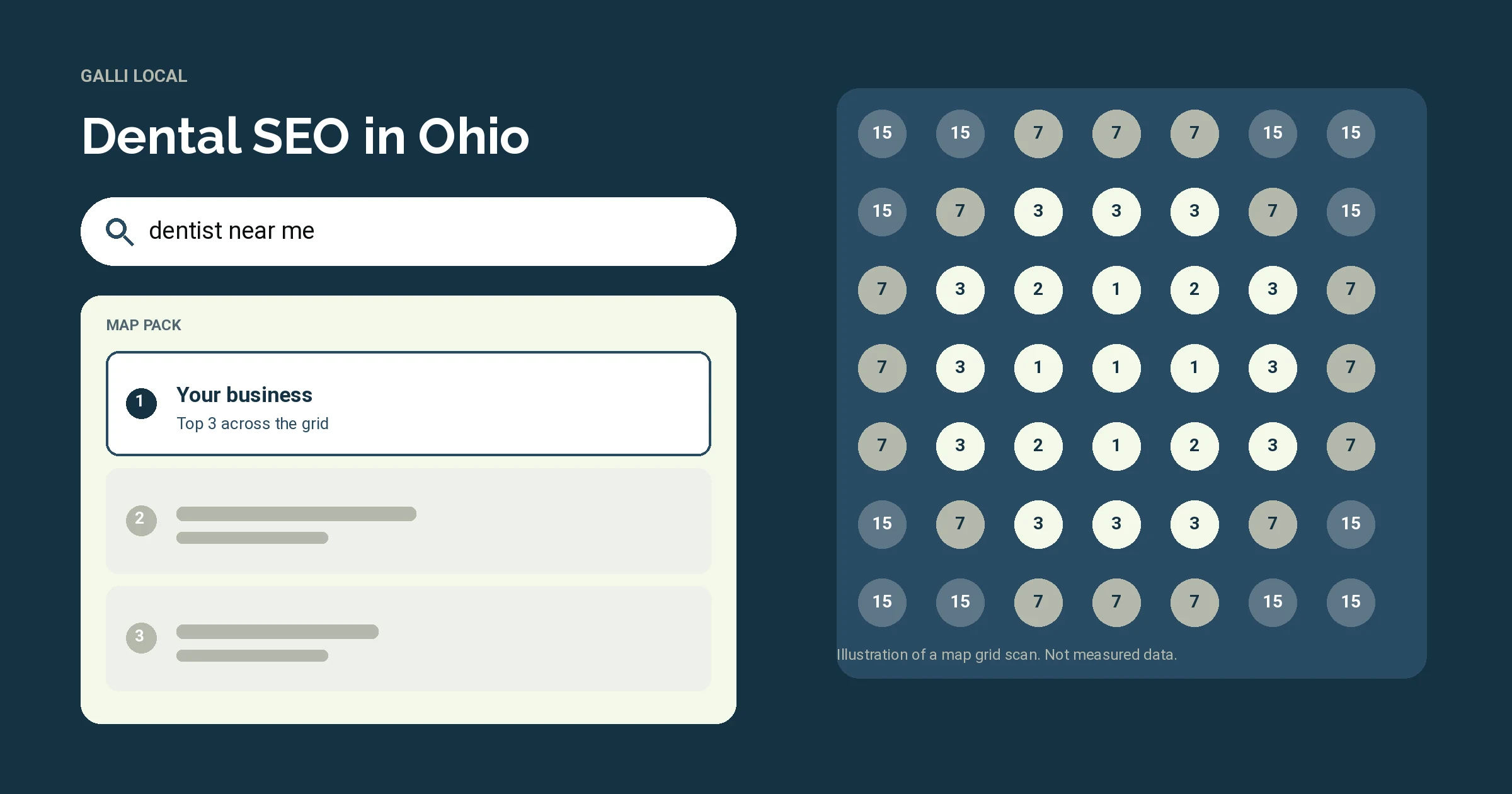
What local SEO covers for dental practices in Ohio
Local SEO for dental practices in Ohio is four jobs done every month: managing the Google Business Profile, earning and answering reviews, cleaning up citations and directory listings, and tracking rank on a map grid. In Ohio, this page adds the local detail: the rule that every ad names the owner or dentist, the General dentist wording, testimonials from patients of record, and markets. The method itself, including categories, review rules and the directories that matter, is on our local SEO for dental practices page. The Local SEO program starts at $850/mo per location and needs a verified profile at a real address, at least 10 reviews and a 3.5-star or better rating.
What do Ohio's dental advertising rules require?
The rules are in chapter 4715-13 of the Ohio Administrative Code. Five points apply to a website, a Business Profile, and paid ads.
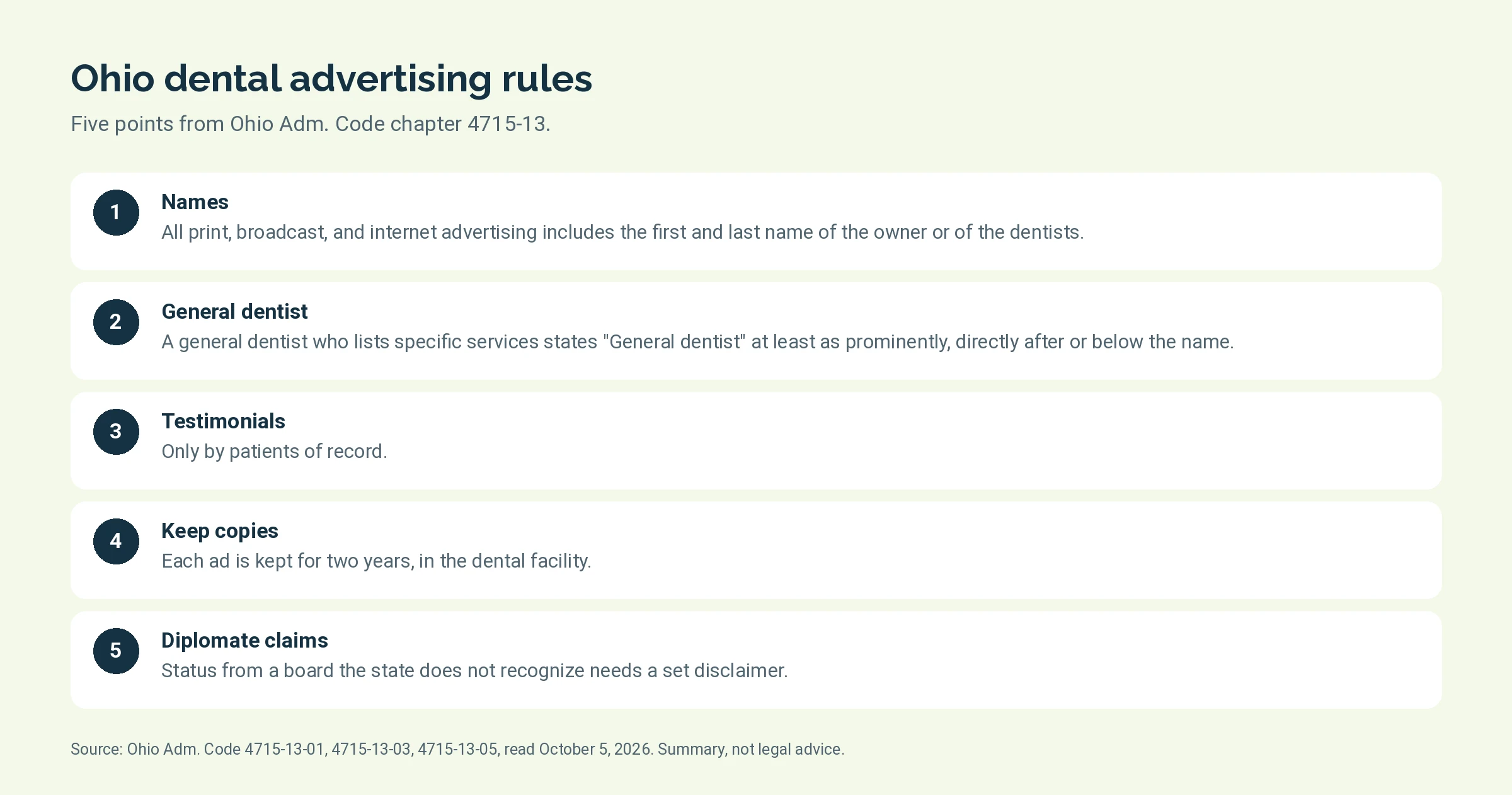
A brand name is not enough. A practice trading under a brand name must also show the owner's or dentists' first and last names in its internet advertising. Put them in the header or footer so every page complies, and in the Business Profile description.
"General dentist" has a position and a size. If a page lists implants, Invisalign, and sedation under a dentist's name, the words "General dentist" go directly after or below the name and at least as prominently as the list. Fix the page template once.
Testimonials must come from patients of record. That rules out staff, friends, and actors. It also means you should be able to show, if asked, that each person quoted is a patient.
Review replies. Federal privacy law applies. In December 2022 the federal Office for Civil Rights announced a $23,000 settlement with a California dental practice over patient details in replies to Yelp reviews. A reply must never confirm that the reviewer is a patient.
This is a summary, not legal advice. Read the current rule before you publish.
How do Ohio's dental markets differ?
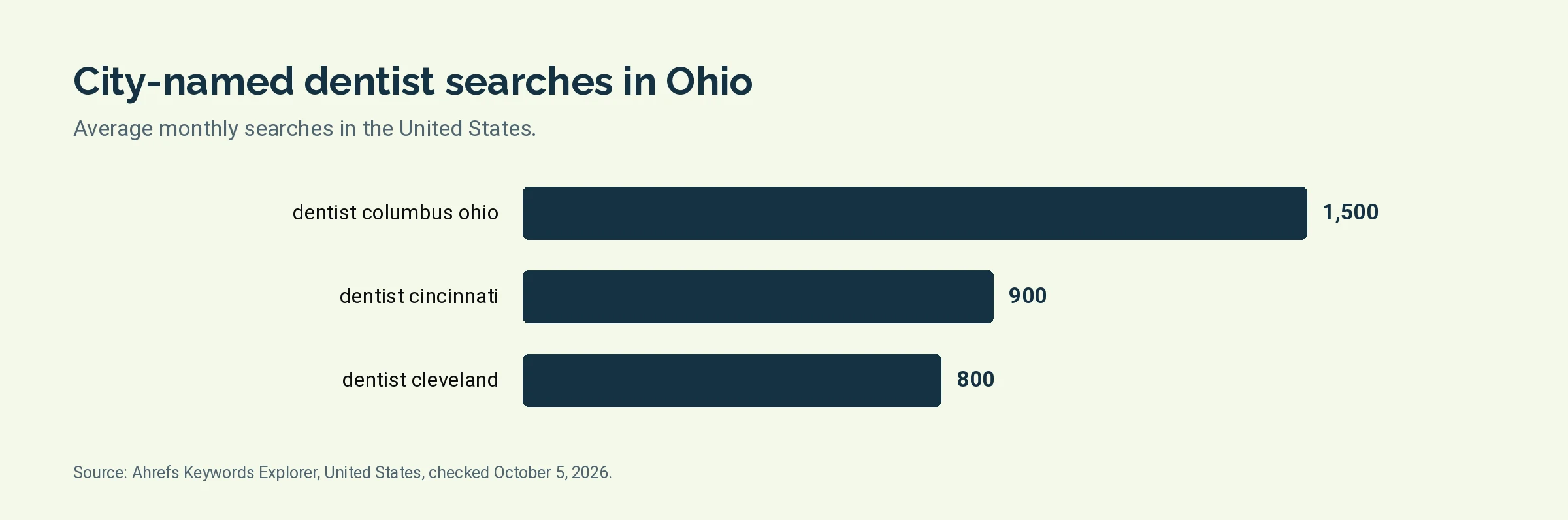
"Dentist columbus ohio" gets about 1,500 searches a month in the United States, "dentist cincinnati" about 900, and "dentist cleveland" about 800. Ahrefs rates their difficulty 58, 56, and 48 out of 100.
- Columbus. The largest term and a city of 220 square miles. Ohio State's more than 60,000 students make the campus area its own market each August.
- Cincinnati. 52 neighborhoods on hills. Patients pick a practice in their own neighborhood.
- Cleveland. The easiest of the three terms. East Side and West Side practices rarely compete.
See our pages for Columbus, Cleveland, and Cincinnati.
What should a Ohio practice check this month?
- Does every page show the owner's or dentists' first and last names?
- Does "General dentist" appear where and how the rule says?
- Is every testimonial from a patient of record?
- Are you keeping two years of ads at the office?
- Do review replies avoid confirming anyone is a patient?
The Local SEO program starts at $850/mo per location. It needs a verified Google Business Profile at a real physical address, at least 10 reviews, and a rating of 3.5 stars or better. See the Local SEO services page and the packages page. For the state as a whole, see local SEO in Ohio.
Other search services for dental practices
- Digital marketing for dental practices: the hub for every service
- SEO for dental practices: content, technical work and links beyond the map
- AEO | GEO for dental practices: being named in AI answers
- SEO content for dental practices: service, area and FAQ pages
These three are national pages. For the wider picture in this market, see SEO services in Ohio.
Common questions about dental SEO in Ohio
Does an Ohio dental ad have to name a dentist?
Yes. All print, broadcast, and internet advertising must include the first and last name of the practice owner or owners, or of the dentist or dentists. Check the current rule.
Who can give a testimonial for an Ohio dental practice?
Only patients of record, under Ohio Administrative Code 4715-13-01.
How long must an Ohio practice keep its ads?
Two years, kept in the dental facility.
Can a general dentist in Ohio advertise implants?
Yes, with the words "General dentist" at least as prominently as the list of services, directly after or below the dentist's name.
How long does local SEO take for a Ohio practice?
First map grid movement usually shows in 1 to 3 weeks. Reaching the top 3 on competitive terms takes 30 to 90 days, depending on reviews and nearby competition.