
☰
All servicesLocal SEOGBP managementAEO | GEOSEO contentTechnical SEOLink buildingDesign & CROPPC managementIndustriesLaw firmsHome servicesPlumbersHVACElectriciansRoofersMedical practicesOrthopedicsPhysical therapyDental practicesGeneral dentistsOrthodontistsPeriodontistsEndodontistsRestaurants and coffee shopsTour operatorsAuto repair shopsLocationsPennsylvaniaState CollegeBellefonteAltoonaWilliamsportLock HavenLewistownPhiladelphiaPittsburghAllentownHarrisburgNew YorkNew York CityBuffaloRochesterAlbanyTexasHoustonDallasSan AntonioAustinUtahSalt Lake CityProvoSt. GeorgeConnecticutBridgeportNew HavenHartfordStamfordOhioColumbusClevelandCincinnatiWashingtonSeattleSpokaneTacomaNevadaLas VegasRenoHendersonPackagesAboutResourcesArticles
Home / Industries / Dental practices / SEO content
SEO content for dental practices
Quick summary: SEO content for dental practices means procedure pages, area pages, FAQs and rewrites built around the searches patients make before they book. Each page starts as an AI-assisted draft, gets a human edit and fact-check, and is approved by a dentist at your office before it goes live. Content is not sold on its own: it comes with the AEO | GEO bundle or the full agency stack.
Which pages does a dental practice need written?
A dental site needs four kinds of page. The descriptions match our national SEO content service; the examples are dental.
Which topics are worth a page?
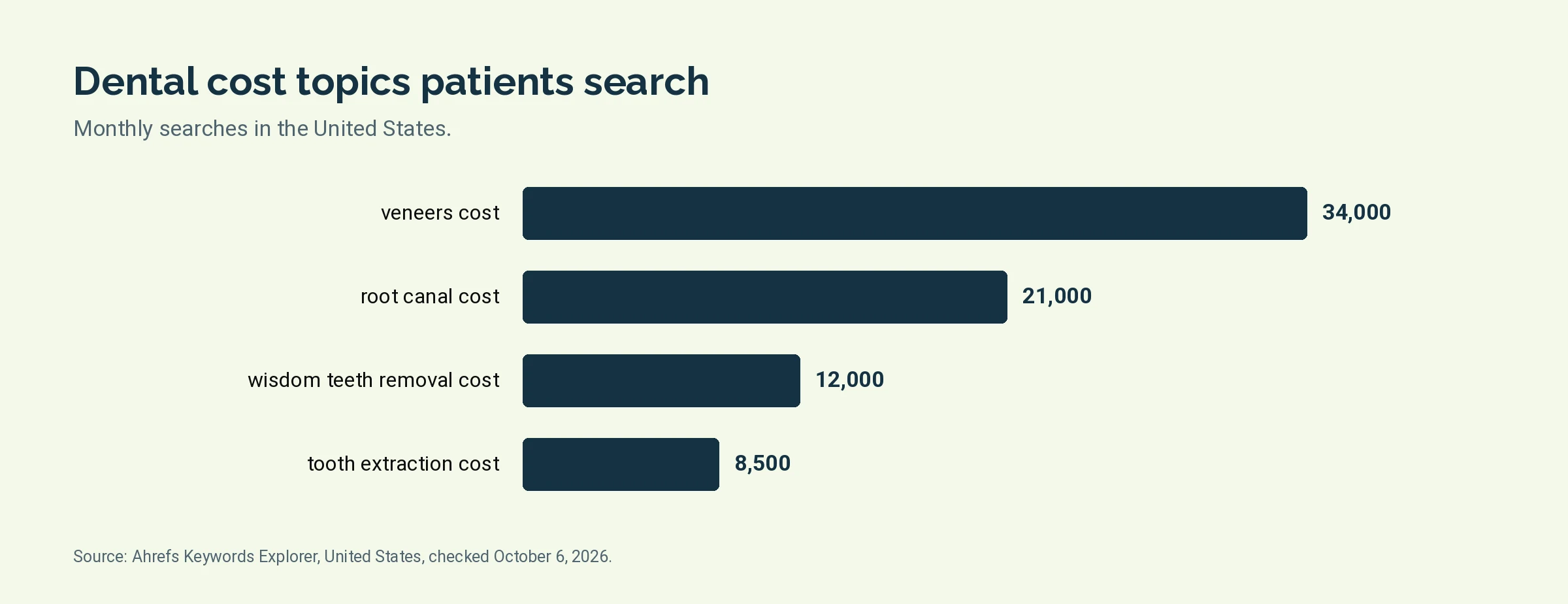
A topic is worth a page when patients search it and your office has something specific to say. These ideas come from Ahrefs Keywords Explorer, United States.
Cost topics lead the list, and many offices avoid them. That is a mistake. A patient who cannot find any price information on your site gets it from someone else's. A page that gives a range, explains what moves it, and says how your office quotes a case answers the search without committing to a fee. Check your state dental board's rules on advertising fees first.
What does your office need to supply?
Your office supplies the details no other dental site has. It takes about 10 minutes per page.
- How you do the procedure. Materials, equipment, number of visits, who on the team does which part.
- The questions the front desk hears. The five things callers ask about this procedure, in their words.
- Credentials. Each dentist's degree, license, training and memberships, stated exactly. A general dentist's page should describe orthodontic or implant services without calling the dentist a specialist.
- Fees and plans. A range if you publish one, the plans you are in network with, and any membership plan.
- Photos. The real office and team. Patient photos only with a signed authorization on file.
- Cases, with identities removed. "A patient with a cracked molar" is enough. We never need a chart, a name or a date.
Do not send us patient records. Nothing we write requires them.
How is a dental page reviewed and approved?
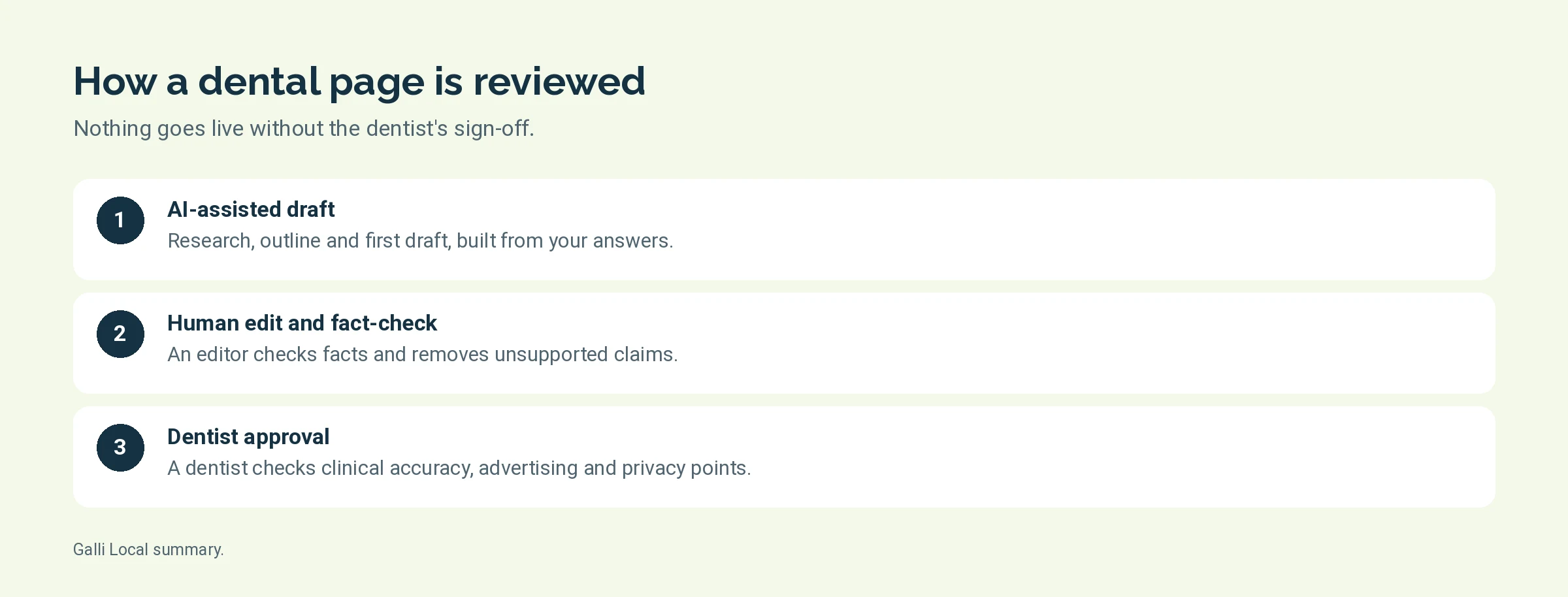
Every page goes through three checks before it is published, and the last one belongs to your dentist.
- AI-assisted draft. Research, outline and first draft, built from your answers.
- Human edit and fact-check. An editor checks facts, removes unsupported claims, and adds the title tag, meta description, internal links and schema.
- Dentist approval. A dentist at your office reads the page for clinical accuracy and for the advertising and privacy points below. Nothing goes live without that sign-off.
What the approval step checks:
We are not a law firm. Your state board's rules decide, and the dentist's approval is the final check.
What gets a dental page ignored?
Google and AI tools pass over dental pages for three reasons.
- Town-swapped pages. "Dentist in [town]" copied 20 times with the name changed. Google treats near-identical pages as one and ignores the rest.
- Thin procedure pages. Two sentences on implants under a stock photo. The patient learns nothing and neither does Google.
- Unsupported claims. "The most advanced care in the region" with nothing behind it. Google's guidance for site owners treats health as a topic where trust matters most, so claims need a named dentist, a credential or a source.
A fourth problem is specific to dental sites: copy supplied by a website vendor. The same procedure text appears on hundreds of other offices' sites. If your pages came with the template, they are candidates for a rewrite.
How is content sold?
Content is not sold as a standalone service. It comes three ways:
- With the Local SEO + GBP management + AEO | GEO bundle, which includes 2 content pieces per month
- With the full agency stack
- Case by case, once a strategy is in place
The Local SEO program on its own includes service and area page recommendations, not page writing. Details are on the packages page. SEO content takes 3 to 6 months to show steady gains.
For the map pack, see local SEO for dental practices. For the full site, see SEO for dental practices. For AI answers, see AEO | GEO for dental practices. The dental hub compares them, and the service area page template shows how an area page is laid out.
Questions dental practices ask about SEO content
Do you use AI to write dental content?
Yes, for research and first drafts. A person edits and fact-checks every page, and a dentist at your office approves it before it publishes.
Who checks that the clinical information is right?
Your dentist does, at the approval step. Our editor checks facts against your answers and public sources, but the clinical sign-off has to come from a licensed dentist at the practice.
Can we buy a few pages without a monthly program?
Not as a first step. Content comes with the AEO | GEO bundle or the full stack, or case by case after a strategy is set, so each page has a reason to exist.
How long should a dental procedure page be?
About 800 to 1,000 words for a core procedure. Area pages and FAQ blocks are shorter. Length matters less than answering the patient's question in the first lines.
Can you use our before-and-after photos?
Yes, when your office has a signed authorization from the patient for marketing use. Without one, the photos stay off the page.
Should a dental practice have a blog?
Only if the posts answer real patient questions. Fourteen strong procedure, cost and comparison pages do more than a hundred short posts about dental holidays.