
☰
All servicesLocal SEOGBP managementAEO | GEOSEO contentTechnical SEOLink buildingDesign & CROPPC managementIndustriesLaw firmsHome servicesPlumbersHVACElectriciansRoofersMedical practicesOrthopedicsPhysical therapyDental practicesGeneral dentistsOrthodontistsPeriodontistsEndodontistsRestaurants and coffee shopsTour operatorsAuto repair shopsLocationsPennsylvaniaState CollegeBellefonteAltoonaWilliamsportLock HavenLewistownPhiladelphiaPittsburghAllentownHarrisburgNew YorkNew York CityBuffaloRochesterAlbanyTexasHoustonDallasSan AntonioAustinUtahSalt Lake CityProvoSt. GeorgeConnecticutBridgeportNew HavenHartfordStamfordOhioColumbusClevelandCincinnatiWashingtonSeattleSpokaneTacomaNevadaLas VegasRenoHendersonPackagesAboutResourcesArticles
Home / Industries / HVAC / SEO content
SEO content for HVAC companies
Quick summary: SEO content for an HVAC company means service pages, area pages, troubleshooting answers and rewrites, each built from your own jobs, equipment and climate so it cannot be mistaken for anyone else's. We draft with AI help, a person edits and fact-checks, and you approve before anything goes live. Content comes with the AEO | GEO bundle or the full agency stack, or case by case once a strategy is in place. It is not sold on its own.
Which page types does an HVAC site need?
Troubleshooting pages are where HVAC differs from most trades. A homeowner will check a filter, a breaker or a thermostat setting before paying for a visit. A page that walks through the safe checks, and says clearly where the safe part ends, earns the call when the checks fail.
Which topics are worth writing first?
Source: Ahrefs Keywords Explorer, United States, checked October 6, 2026.
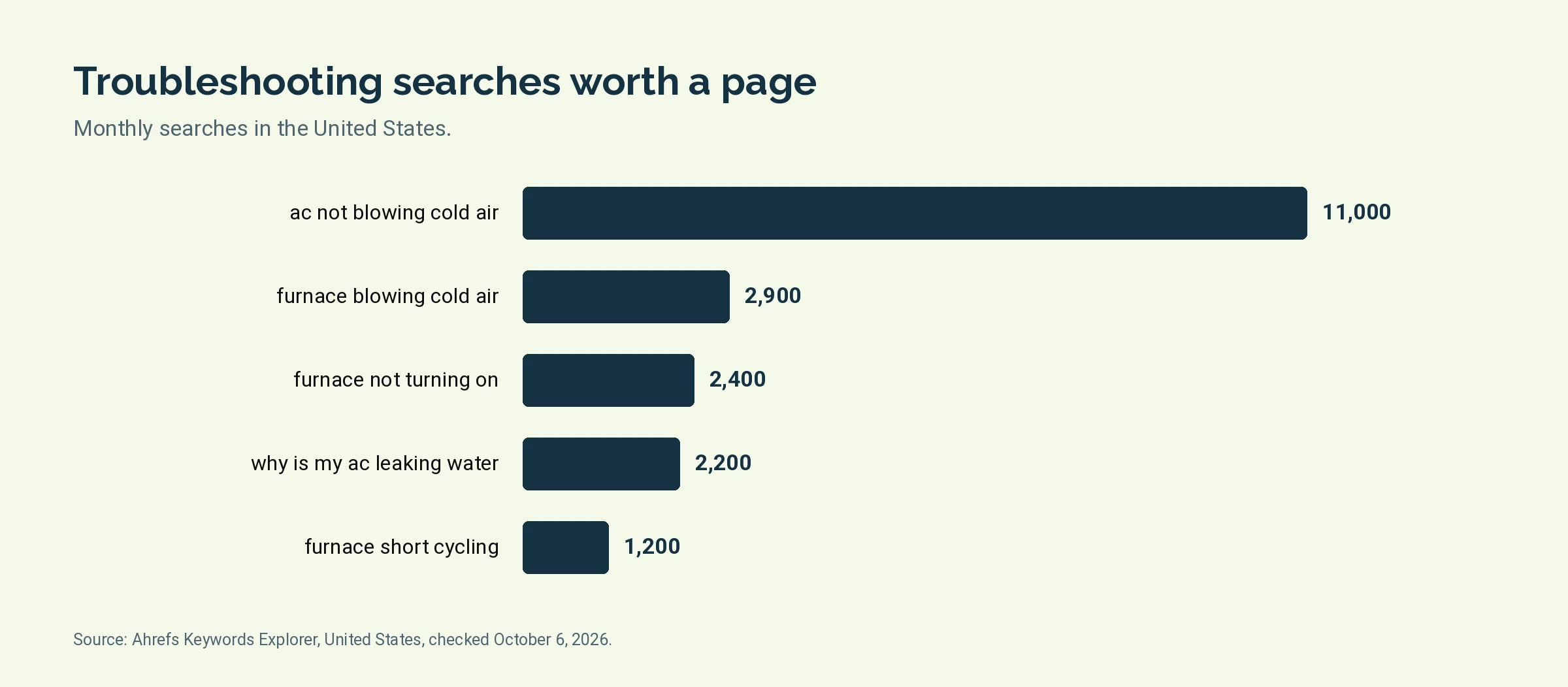
These are national volumes. We check each topic against your service area and your current rankings before it goes on the plan, and we order the plan by season: cooling topics get written in winter and early spring, heating topics in summer. The buying, cost and comparison keywords are covered on the SEO page, and question formats for AI tools on the AEO | GEO page.
What do you need to supply?
Every HVAC site says "fast, friendly, certified". What makes a page yours is what only you know. For each page we ask for:
- Recent jobs: town, system type and age, what failed, what you did. A few short job notes beat a page of general copy.
- Customer questions: what your dispatcher hears every day. "Do you charge to come out?" "Can you fix it today?" "Do you work on oil boilers?"
- Credentials: license or registration numbers, EPA Section 608 certification, NATE certifications, manufacturer dealer status and insurance.
- Equipment and brands: what you install, what you service and what you will not touch.
- Plan and policy details: what the maintenance plan includes, after-hours rules, warranty terms and financing partners.
- Photos: your trucks, your techs and real installs.
- Climate notes: what local winters and summers do to equipment, and what you recommend because of it.
You answer a few questions for each page. It takes about 10 minutes.
How does review and approval work?
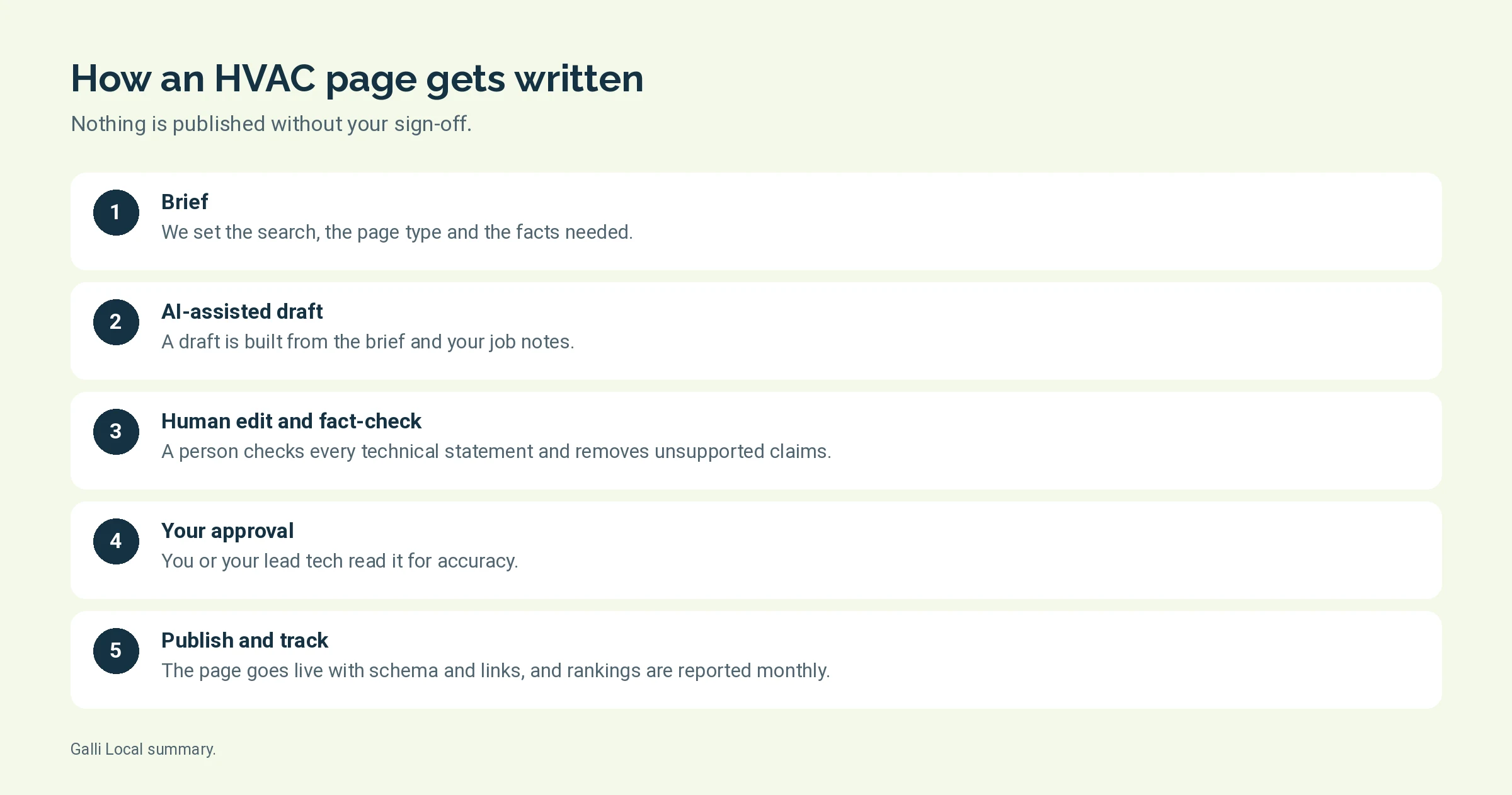
- Brief. We set the search, the page type and the facts needed, and collect them from you.
- AI-assisted draft. A draft is built from the brief and your notes.
- Human edit and fact-check. A person rewrites, checks every technical statement and removes any claim we cannot support.
- Your approval. You or your lead tech read it for accuracy. Nothing is published without sign-off.
- Publish and track. The page goes live with schema and internal links, and its rankings go into the monthly report.
Three things get extra care on HVAC pages:
- Safety. Troubleshooting pages stop at filters, breakers, thermostats and vents. Gas, refrigerant and electrical work inside the unit is always "call a technician". The EPA requires Section 608 certification for technicians who service equipment that could release refrigerants, so no page tells a homeowner to add refrigerant.
- Incentives. Federal tax credits and utility rebates change often. We only state an amount with a current official source and a date on the page, and otherwise point readers to the program.
- Savings claims. The Federal Trade Commission says advertisers must have evidence to back up their claims. "Cuts your bill by 40%" does not go on a page without it.
What gets an HVAC page ignored?
- Town-swapped pages. Thirty area pages that differ only by the town name. Google keeps one version and ignores the rest. The service area page template shows what a real one contains.
- Thin pages. A single "Heating" page that lists furnaces, boilers and heat pumps in three bullets cannot rank for any of them.
- Unsupported claims. "Best HVAC company in the state" and "lowest prices" with nothing behind them.
- Manufacturer copy. Brand brochure text pasted onto your site is on hundreds of other dealer sites too.
- Out-of-date offers. A coupon that expired two summers ago, or a rebate page with no date.
- No next step. A helpful troubleshooting page with no phone link or booking option at the point where the homeowner gives up.
How is content sold?
Content is not sold on its own. It comes three ways:
- With the AEO | GEO bundle, which includes 2 content pieces per month
- With the full agency stack, where content is planned alongside SEO, development and ads
- Case by case once a strategy is in place, for example a set of cooling pages before summer
The Local SEO program includes service and area page recommendations, but not the writing. What each option includes is on the packages page. SEO content usually takes 3 to 6 months to produce steady gains. The national service is described on the SEO content page.
Related: the HVAC hub, local SEO for HVAC companies and SEO content for home services.
Questions HVAC owners ask about content
Who checks the technical details on an HVAC page?
Two people. Our editor checks every technical statement against your notes and official sources, and you or your lead tech approve the page before it is published. AI helps with research and the first draft only.
Should we write troubleshooting articles if they help people avoid calling us?
Yes. When the safe checks rule out the easy causes, the homeowner still needs a technician. The company that wrote the helpful page is the one the homeowner already has open.
Can you write a page for every town we serve?
We write area pages for towns where you can supply real jobs, photos or local detail. We do not produce town-swapped pages.
Who owns the content?
You do. The client owns the accounts and the content, including after the agreement ends.
How often should HVAC pages be updated?
Check them before each cooling and heating season. Update price ranges, plan details, brands, refrigerant information and any incentive, and remove offers that have expired.