
☰
All servicesLocal SEOGBP managementAEO | GEOSEO contentTechnical SEOLink buildingDesign & CROPPC managementIndustriesLaw firmsHome servicesPlumbersHVACElectriciansRoofersMedical practicesOrthopedicsPhysical therapyDental practicesGeneral dentistsOrthodontistsPeriodontistsEndodontistsRestaurants and coffee shopsTour operatorsAuto repair shopsLocationsPennsylvaniaState CollegeBellefonteAltoonaWilliamsportLock HavenLewistownPhiladelphiaPittsburghAllentownHarrisburgNew YorkNew York CityBuffaloRochesterAlbanyTexasHoustonDallasSan AntonioAustinUtahSalt Lake CityProvoSt. GeorgeConnecticutBridgeportNew HavenHartfordStamfordOhioColumbusClevelandCincinnatiWashingtonSeattleSpokaneTacomaNevadaLas VegasRenoHendersonPackagesAboutResourcesArticles
Home / Industries / Restaurants and coffee shops / SEO content
SEO content for restaurants
Quick summary: SEO content for restaurants means a short list of pages that bring in bookings: a menu in text, a catering page, a private dining page, and a few occasion and FAQ pages. It does not mean a blog. Most restaurants need only a short list of pages, and the ones that pay are about catering and events. Galli Local writes them from your menus, rooms and policies, and you approve each one.
Which pages does a restaurant need written?
A restaurant site needs four kinds of written page. Here is a restaurant example of each.
- Service pages. For a restaurant, a "service" is a way to buy from you other than walking in. Example: a breakfast catering page with three packages, the per-person range, the towns you deliver to and how much notice you need.
- Area pages. These fit caterers and multi-location groups only. Example: a page for office catering in a nearby business park, naming the buildings you deliver to and the drop-off window. A single dining room does not need area pages.
- FAQ blocks. Short answers on pages guests already visit. Example: on the private dining page, "Is there a room fee?", "What is the food and drink minimum?", "Can we bring a cake?"
- Rewrites. Example: a menu page that is one PDF link, rebuilt as typed sections with dish names, descriptions and prices.
Which pages a site needs in the first place, and the schema behind them, is on the SEO for restaurants page.
Which topics are worth a page?
Volumes are from Ahrefs Keywords Explorer for the United States. A national number is only a guide to demand. Your share is whatever part of it comes from your town.
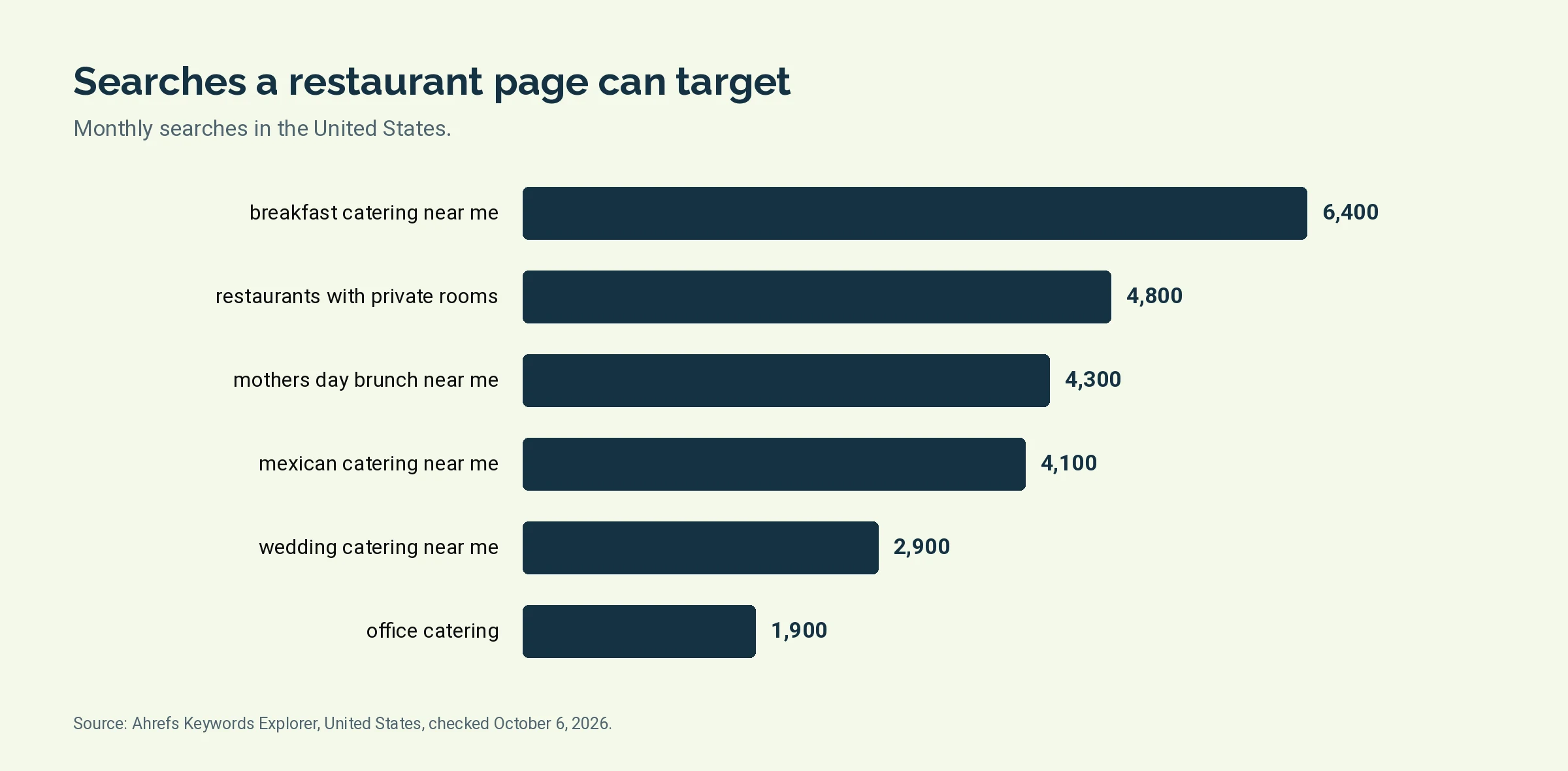
Pick only the rows that match something you sell. A page about gluten free options is worth writing if the kitchen has a real process for it, and harmful if it does not.
Seasonal pages need lead time. A Thanksgiving or Mother's Day page should be live weeks ahead and kept at the same URL every year, updated with the new menu, so it does not start from zero each time.
One kind of topic to skip: glossary posts. Ahrefs shows about 28,000 searches a month for "what is a cortado". Nearly all of those people are nowhere near your cafe, and national coffee sites own the result. A cafe gains more from a typed drink menu than from a post defining its drinks.
What does the restaurant have to supply?
The details below are what stop a catering page from reading like every other caterer's. Most of it already exists in a binder, an inbox or the event manager's head.
- Current menus with prices, including catering and event menus, as documents and not photos
- Room facts: seated and standing capacity, minimum spend, what audio and video gear is in the room, whether it has a door
- Policies: deposit, cancellation, outside desserts, corkage, lead time, delivery radius
- Recent events: three or four you can describe without naming the client, such as "a 60-person retirement lunch with a carving station"
- The questions people ask by phone and email before they book
- Photos of the room set for an event and of catering as it arrives, not only plated dinner dishes
- People and sourcing: the chef, the owner, the roaster, the farms, any awards you can document
Allergen and dietary statements come from the kitchen, in the kitchen's words. We do not write "nut free" or "celiac safe" on a page unless you tell us it is true and how you keep it true.
How is a page reviewed and approved?
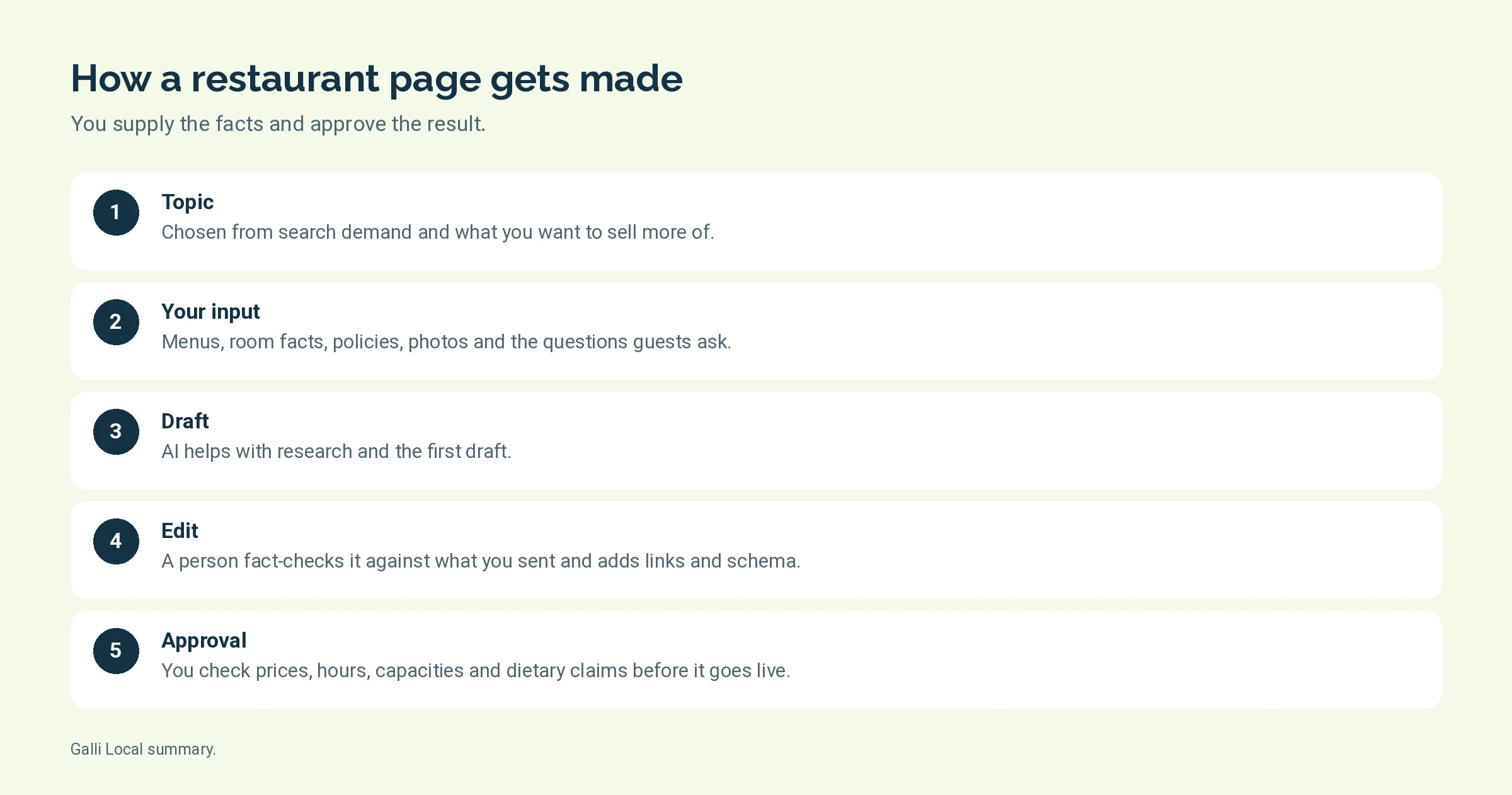
Every page goes through the same steps as on the main SEO content page:
- We choose the topic from search demand and your priorities.
- You answer a short set of questions and send menus and photos.
- AI helps with research and the first draft.
- A person edits and fact-checks it against what you sent, then adds the title tag, meta description, internal links and schema.
- You approve it. Nothing goes live without your sign-off.
For a restaurant, approval is mostly a check on prices, hours, capacities and dietary claims. These go stale fast. A catering page with last year's per-person price starts every inquiry with a correction, so set a reminder to review event and catering pages whenever the menu changes.
What gets a restaurant page ignored?
- Town-swapped pages. "Catering in" followed by fifteen town names over the same text. Google treats near-identical pages as one and ignores the rest. The service area page template shows what a real area page needs.
- Thin pages. A private dining page that says "contact us for details" and nothing else. The details are the page.
- Unsupported claims. "Best brunch in town" with nothing behind it. A named award, a press mention or a review count you can point to is fine.
- Menus as images. Covered above, and the most common cause of a restaurant page drawing no searches.
- Stock photos. Guests can tell, and a photo of food you do not serve is a promise you will not keep.
- Stale seasonal pages. A holiday menu from two years ago that still ranks sends people to a meal that no longer exists.
How is content sold?
Content is not sold on its own. It comes with the AEO | GEO bundle, which includes two content pieces a month, and with the full agency stack. It can also be added case by case once a strategy is in place. Details are on the packages page.
That order matters for a restaurant. Pages about catering do little if the Business Profile shows the wrong hours, so the map comes first. See local SEO for restaurants for that work, AEO | GEO for restaurants for how these pages feed AI answers, and the restaurant hub for the overview.
Common questions about SEO content for restaurants
Does a restaurant need a blog?
No, most restaurants do not. A menu in text, a catering page, a private dining page and a few occasion pages do more than a year of blog posts.
How many pages does a restaurant website need?
A short list for most single-location restaurants. Home, menu, about, reservations or ordering, and one page for each thing you sell beyond the dining room, such as catering or private events.
Should we publish prices on catering and private dining pages?
Yes, at least a range. Buyers search for cost before they call, and a per-person range or a room minimum screens out bookings that were never going to fit.
How long does a new page take to work?
SEO content takes 3 to 6 months to produce steady gains. Seasonal pages should go live well ahead of the date and stay at the same URL each year.
Do you write our menu descriptions?
No. Your menu is your voice and your kitchen's facts. We move it from a PDF or image into text on the page and structure it so search engines can read it.
Can we use AI to write our own pages?
Yes, for a first draft. Someone who knows the menu still has to check every price, capacity and dietary claim, because a draft will state wrong ones with confidence.