
☰
All servicesLocal SEOGBP managementAEO | GEOSEO contentTechnical SEOLink buildingDesign & CROPPC managementIndustriesLaw firmsHome servicesPlumbersHVACElectriciansRoofersMedical practicesOrthopedicsPhysical therapyDental practicesGeneral dentistsOrthodontistsPeriodontistsEndodontistsRestaurants and coffee shopsTour operatorsAuto repair shopsLocationsPennsylvaniaState CollegeBellefonteAltoonaWilliamsportLock HavenLewistownPhiladelphiaPittsburghAllentownHarrisburgNew YorkNew York CityBuffaloRochesterAlbanyTexasHoustonDallasSan AntonioAustinUtahSalt Lake CityProvoSt. GeorgeConnecticutBridgeportNew HavenHartfordStamfordOhioColumbusClevelandCincinnatiWashingtonSeattleSpokaneTacomaNevadaLas VegasRenoHendersonPackagesAboutResourcesArticles
Home / Industries / Restaurants and coffee shops / SEO
SEO for restaurants
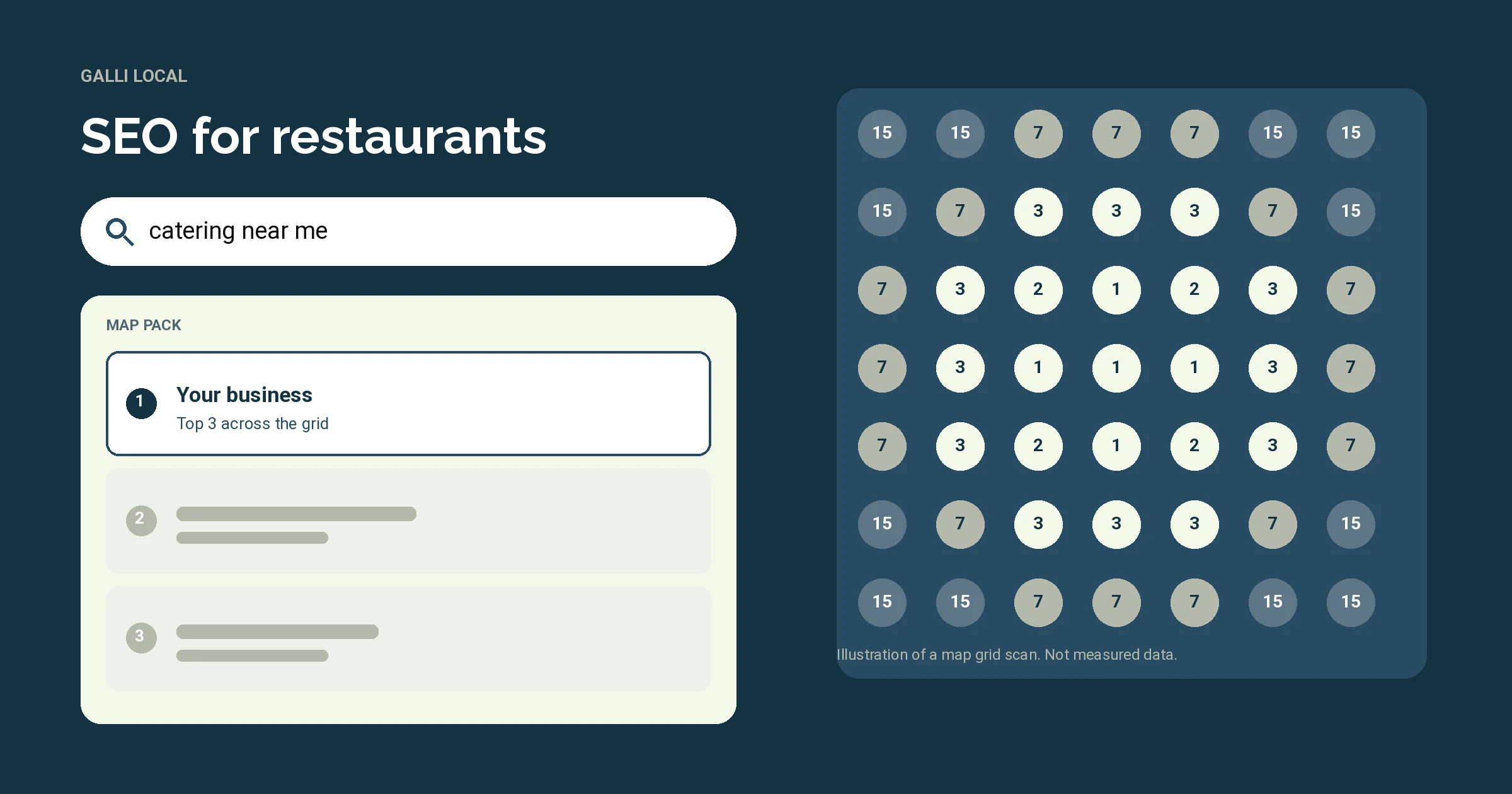
Quick summary: SEO for restaurants is the work of ranking your website, and not only your map listing, for searches where people compare options before they book: catering, private dining, rehearsal dinners, holiday parties. It differs from local SEO, which wins "near me" searches through the Business Profile. For most restaurants the map pack does most of the work, and a full SEO program fits fewer of them. This page says which ones.
Does a restaurant need SEO beyond the map pack?
Often it does not. Someone who types "tacos near me" picks from the map and walks over. No web page changes that choice, so a taqueria with one room and no catering should put its money into the profile and stop there.
SEO starts to pay when the sale is bigger and slower. An office manager ordering lunch for 40, a couple booking a rehearsal dinner, and a family planning a graduation party all open several websites, read menus and look for a price range. Those searches land on pages, and a restaurant with no page for them is not in the running.
You are a candidate for full SEO if at least one of these is true:
- You cater, and want more of it
- You have a private room, a patio or a full space you rent for events
- You run several locations and need each one to rank in its own area
- You are a destination restaurant that visitors plan a trip around
- You sell something online: beans, gift cards, classes, a bottled sauce
What does SEO cover for a restaurant?
The general version of this, for any small business, is on the SEO services page.
How do people search for catering and private dining?
These are the searches that web pages win. Volumes are from Ahrefs Keywords Explorer for the United States.
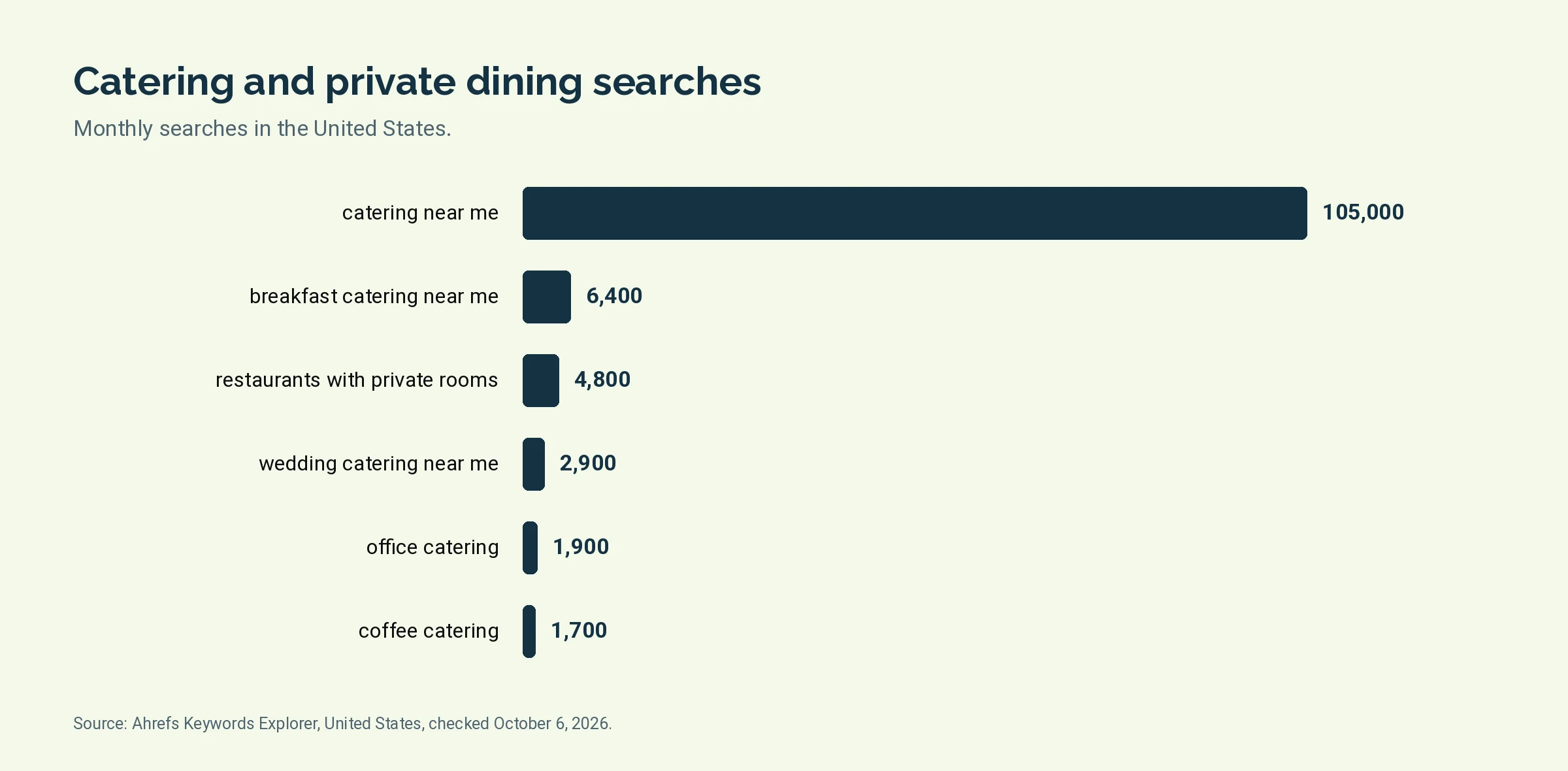
Two things stand out. First, the numbers are small next to "restaurants near me", which Ahrefs puts at about 6,060,000 a month. Second, one catering order can equal a full night of covers. Low volume and high ticket is the pattern that makes SEO worth it for a restaurant.
Cost searches are tiny and still worth a page. A buyer who finds your per-person range before calling arrives with the right budget, and one who does not find it calls the caterer who published theirs.
Which pages does a restaurant website need?
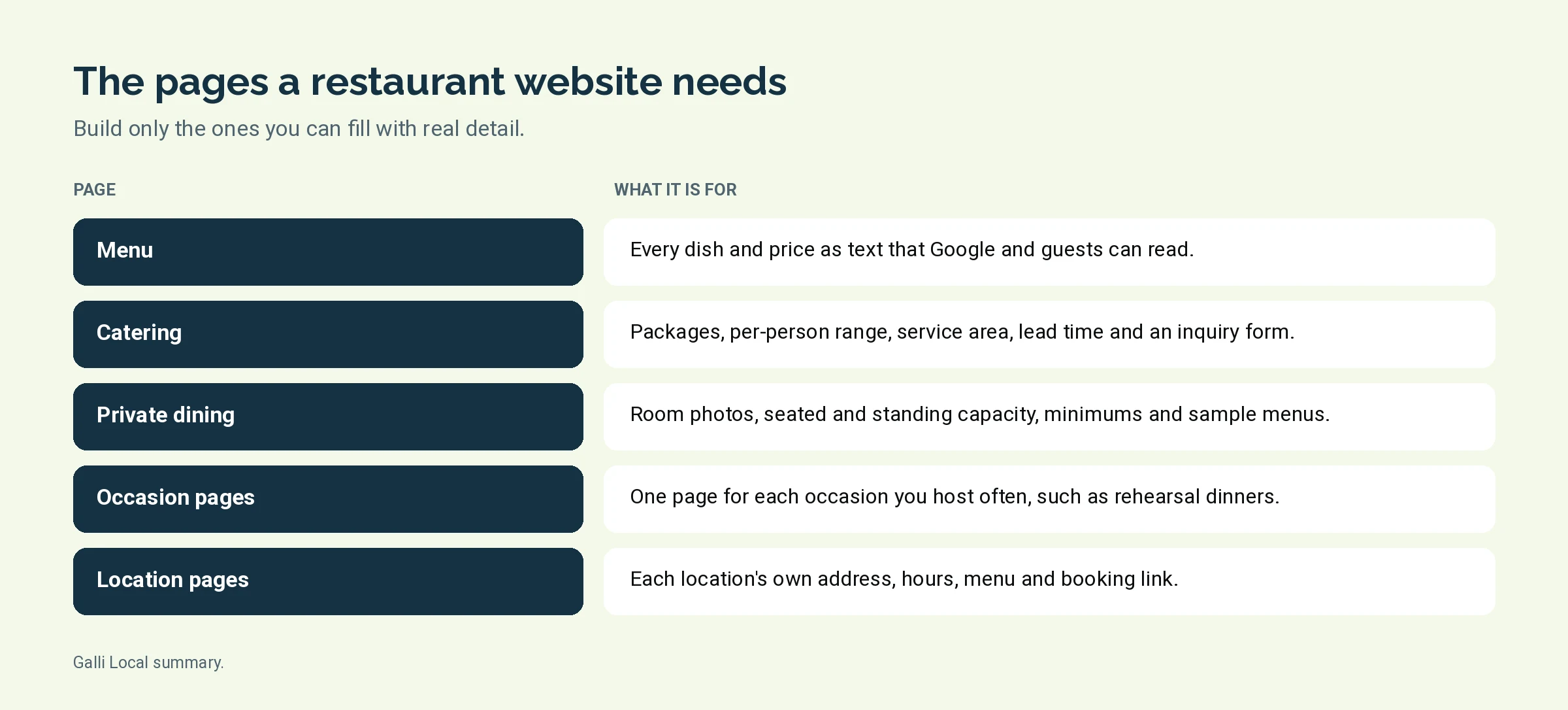
Do not build pages you cannot fill. A private dining page with no capacity, no photos and no menu ranks for nothing and books nothing. How these pages get written is on the SEO content page.
What technical work is specific to restaurants?
The menu has to be text
This is the most common problem on restaurant sites. A menu posted only as a PDF or a photo is hard to read on a phone and cannot be marked up dish by dish. A menu posted as an image has no text for a search engine to match to "short rib" or "oat milk latte". Put the menu on the page as HTML text, with dish names, descriptions and prices.
The same rule covers accessibility. The Department of Justice's guidance on web accessibility and the ADA lists food and drink establishments among the businesses covered, and names images with no text alternative as a barrier for blind users.
Schema types that fit
Schema.org has a Restaurant type and a CafeOrCoffeeShop type. Both sit under FoodEstablishment, which adds the properties servesCuisine, acceptsReservations and hasMenu. Schema.org also defines Menu, MenuSection and MenuItem, so a menu can be marked up down to the dish, its price and whether it suits a diet. Google's structured data documentation for local businesses says to use the most specific type that fits, and gives Restaurant as an example. Our LocalBusiness schema starter pack has the base markup.
Booking and ordering tools
Reservation widgets from OpenTable and Resy, and ordering pages from your point-of-sale system, often load from another company's servers. What matters is that the buttons on your site point to the path you prefer, that they work on a phone, and that a slow widget does not hold up the rest of the page.
Speed on a phone
Restaurant sites carry large food photos and, too often, a video that plays on load. Most visitors are on a phone and want hours, the menu or a booking link. Compress photos, skip the autoplay video, and put those three things at the top.
Where do links come from for a restaurant?
Restaurants earn links more easily than most small businesses, because people write about food.
- Tourism and downtown groups. The visitors bureau, the chamber of commerce and the downtown association usually list member restaurants.
- Dining guides and local press. City magazines, alt-weeklies, campus papers, and national food sites that cover your city.
- Associations. State restaurant associations, such as the Pennsylvania Restaurant and Lodging Association, which has a member directory, and coffee trade groups for cafes and roasters.
- Suppliers. Roasters, breweries, bakeries and farms often publish a "where to find us" page.
- Wedding directories. The large wedding sites carry vendor listings for caterers and venues.
- Events. Restaurant weeks, food festivals and charity dinners post participant lists.
Listings on Yelp, Tripadvisor, OpenTable, Resy, DoorDash and Uber Eats count more as places diners and AI tools read than as links. They are covered on the local SEO and AEO | GEO pages.
Which rules apply to restaurant websites?
Two more deserve care. Allergen and diet claims such as "gluten free" or "nut free" are promises a guest may rely on, so the kitchen should confirm each one before it goes on a page. Rules for advertising alcohol can differ by state, so check your state's rules before a page advertises drink specials.
Is full SEO a fit for your restaurant?
Back to the restaurant hub.
Common questions about SEO for restaurants
Is SEO worth it for a restaurant?
It is worth it for restaurants that sell catering, private dining or events, or that run several locations. A single dining room that lives on walk-ins gets more from its Business Profile than from a full SEO program.
Why does my menu PDF hurt my search results?
A PDF or image menu is hard to read on a phone and gives search engines less to work with than text on a page. Typed dish names and prices in HTML let Google match your site to dish searches and let you add Menu and MenuItem schema.
What schema should a restaurant website use?
Use the Restaurant type, or CafeOrCoffeeShop for a cafe. Add servesCuisine, acceptsReservations and hasMenu, and mark up the menu with Menu, MenuSection and MenuItem where your site allows it.
How long does restaurant SEO take?
SEO content takes 3 to 6 months to produce steady gains. Map grid movement from the local SEO side shows sooner, usually in 1 to 3 weeks.
Should each location have its own page?
Yes. Each location needs a page with its own address, hours, menu, photos and booking link, matched to its own Business Profile.
Can you write our catering page on its own?
No, content is not sold by itself. It comes with the AEO | GEO bundle and the full agency stack, or is added case by case once a strategy is in place.