
☰
All servicesLocal SEOGBP managementAEO | GEOSEO contentTechnical SEOLink buildingDesign & CROPPC managementIndustriesLaw firmsHome servicesPlumbersHVACElectriciansRoofersMedical practicesOrthopedicsPhysical therapyDental practicesGeneral dentistsOrthodontistsPeriodontistsEndodontistsRestaurants and coffee shopsTour operatorsAuto repair shopsLocationsPennsylvaniaState CollegeBellefonteAltoonaWilliamsportLock HavenLewistownPhiladelphiaPittsburghAllentownHarrisburgNew YorkNew York CityBuffaloRochesterAlbanyTexasHoustonDallasSan AntonioAustinUtahSalt Lake CityProvoSt. GeorgeConnecticutBridgeportNew HavenHartfordStamfordOhioColumbusClevelandCincinnatiWashingtonSeattleSpokaneTacomaNevadaLas VegasRenoHendersonPackagesAboutResourcesArticles
Home / Industries / Plumbers / SEO content
SEO content for plumbers
Quick summary: SEO content for plumbers means service pages, area pages, FAQ answers and rewrites that rank for the jobs you want and sound like your shop wrote them. Each page starts from a real search, uses details from your own jobs, and is approved by you before it goes live.
Which page types does a plumbing company need?
Four, and each does a different job.
Rewrites come first more often than owners expect. A page already ranking in positions 5 to 15 often gains more from a rewrite than a new page would from a standing start, so we review existing pages before proposing new ones.
What should a plumber write about first?
Start where a real search meets a job you want more of. These ideas use volumes from Ahrefs Keywords Explorer, United States, checked October 6, 2026. Your local numbers will be a small fraction of these.
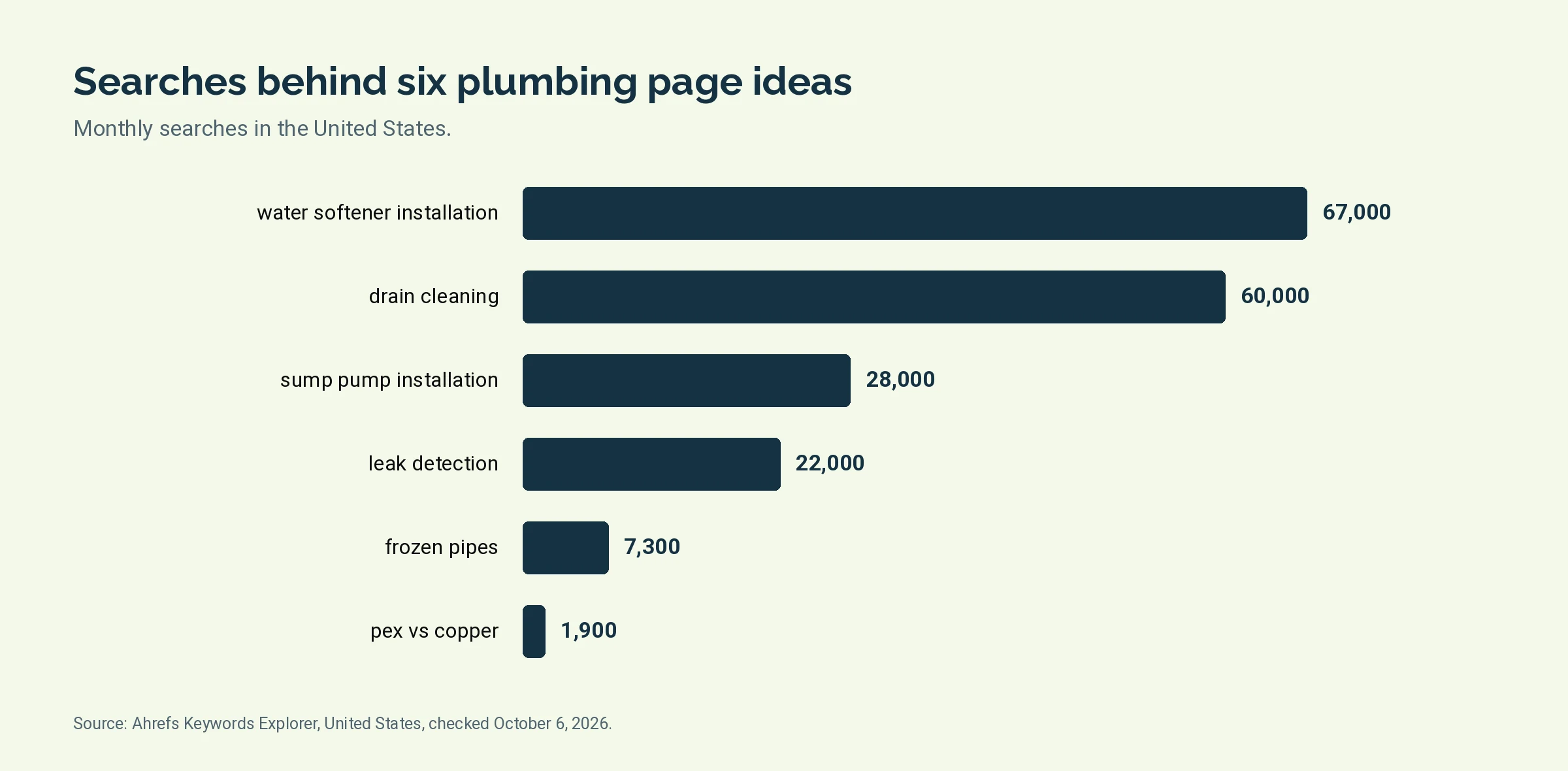
Two notes on choosing. Pick by margin, not by volume. A page for a high-margin job with modest search volume can be worth more than a clog page with many times the searches. And match the season: frozen pipe and sump pump pages should be live before the weather that sends people looking for them.
How these pages fit into the wider site plan, with cost and method pages, is on SEO for plumbers.
What do we need from you so the page is not generic?
Any writer or AI tool can produce 800 words on drain cleaning. What makes your page different can only come from you.
- Recent jobs. A few per service: the town, the house age, what you found, what you did, how long it took. No customer names or street addresses.
- The questions customers ask on the phone. Your dispatcher hears the same ones every week. Those are the FAQ.
- Your equipment and methods. Jetter pressure, camera brand, whether you pipe-burst or dig, which water heater lines you stock on the truck.
- Local conditions. Hard water, clay or cast iron sewer laterals, slab foundations, freeze depth, well and septic areas. These change what a job involves in your area, and no national article mentions them.
- Credentials. License and registration numbers, insurance, the master plumber's name, manufacturer training.
- Photos. Real ones, from a phone, of real work: the old tank, the corroded fitting, the finished install.
- How you price. Flat rate or hourly, trip charge, after-hours rate, what a quote includes.
We send a short form for each page. Ten minutes of your answers shapes the whole draft.
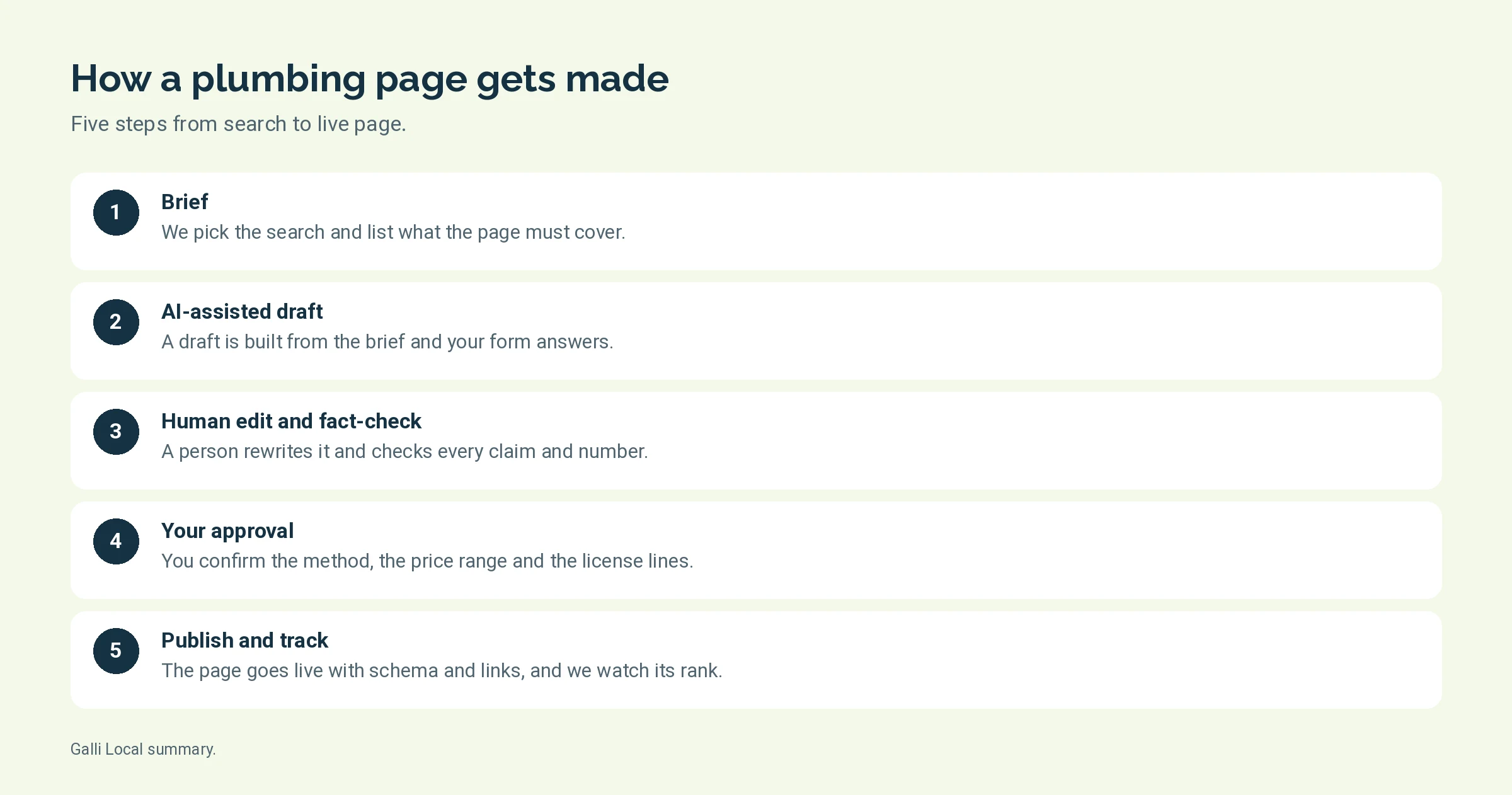
How is a page reviewed and approved?
- Brief. We pick the search, check what already ranks for it and list what your page must cover to be better.
- AI-assisted draft. A draft is built from the brief and your form answers.
- Human edit and fact-check. A person rewrites it, checks every claim and number, and removes anything that sounds like every other plumbing site.
- Your approval. You read it for accuracy. Is that how you do the job? Is the price range right? Does anything promise more than you would on the phone?
- Publish and track. The page goes live with schema and internal links, and we watch where it ranks.
Your approval step also covers licensing. Rules on what a plumber may advertise, and what license details must appear, are set by state and local boards. You know your board's rules, so nothing goes live until you have signed off on those lines.
What gets a plumbing page ignored?
- Town-swapped pages. Forty area pages that differ only in the town name. Google treats near-identical pages as one, picks a version and ignores the rest.
- Thin pages. Two paragraphs and a phone number under the heading "Repiping".
- Claims with nothing behind them. "Fastest response in the county" or "lowest prices" with no proof. Customers discount them.
- Advice that stops short. A frozen pipe page that never says where the shutoff valve usually is.
- DIY steps a homeowner should not take. Gas, water heater relief valves and sewer work carry real risk. A good page says what is safe to check and when to stop and call.
The service area page template shows what a town page should contain.
How is content sold?
Content is not sold on its own. It comes with the AEO | GEO bundle, which includes two content pieces a month, and with the full agency stack. Outside those, we take it case by case once a strategy is in place, so every page has a search and a reason behind it.
If you are on the Local SEO program alone, you get service and area page recommendations and can write them in-house. Programs are on the packages page, and the national description of this service is on the SEO content page.
Related pages: the plumber hub, SEO content for home services, local SEO for plumbers and AEO | GEO for plumbers.
Questions plumbers ask about content
Should an emergency plumbing page be long?
No. An emergency page needs the phone number, the area you cover, your hours and what to shut off first. The longer explanation belongs on the service page for that job.
Can I write the pages myself?
Yes. Many owners write well about their own trade, and nobody knows the work better. What usually goes missing is the search research, the structure and the time, which is why the Local SEO program gives you recommendations to write from.
Do you use AI to write?
Yes, for the first draft only. A person then edits and fact-checks it, and you approve it. The job details, photos and pricing notes come from you, which is what keeps the page from reading like every other one.
How long before a new page ranks?
Plan on 3 to 6 months for steady gains. Pages are usually indexed within days, and low-competition terms settle sooner than broad ones.
Should plumbers write a blog?
Only if each post answers a question your customers ask. A few posts that each answer one real plumbing question beat a long run of general home tips. Posts with no search behind them and no link to a service page rarely earn a call.