
☰
All servicesLocal SEOGBP managementAEO | GEOSEO contentTechnical SEOLink buildingDesign & CROPPC managementIndustriesLaw firmsHome servicesPlumbersHVACElectriciansRoofersMedical practicesOrthopedicsPhysical therapyDental practicesGeneral dentistsOrthodontistsPeriodontistsEndodontistsRestaurants and coffee shopsTour operatorsAuto repair shopsLocationsPennsylvaniaState CollegeBellefonteAltoonaWilliamsportLock HavenLewistownPhiladelphiaPittsburghAllentownHarrisburgNew YorkNew York CityBuffaloRochesterAlbanyTexasHoustonDallasSan AntonioAustinUtahSalt Lake CityProvoSt. GeorgeConnecticutBridgeportNew HavenHartfordStamfordOhioColumbusClevelandCincinnatiWashingtonSeattleSpokaneTacomaNevadaLas VegasRenoHendersonPackagesAboutResourcesArticles
Home / Industries / Medical practices / SEO
SEO for medical practices
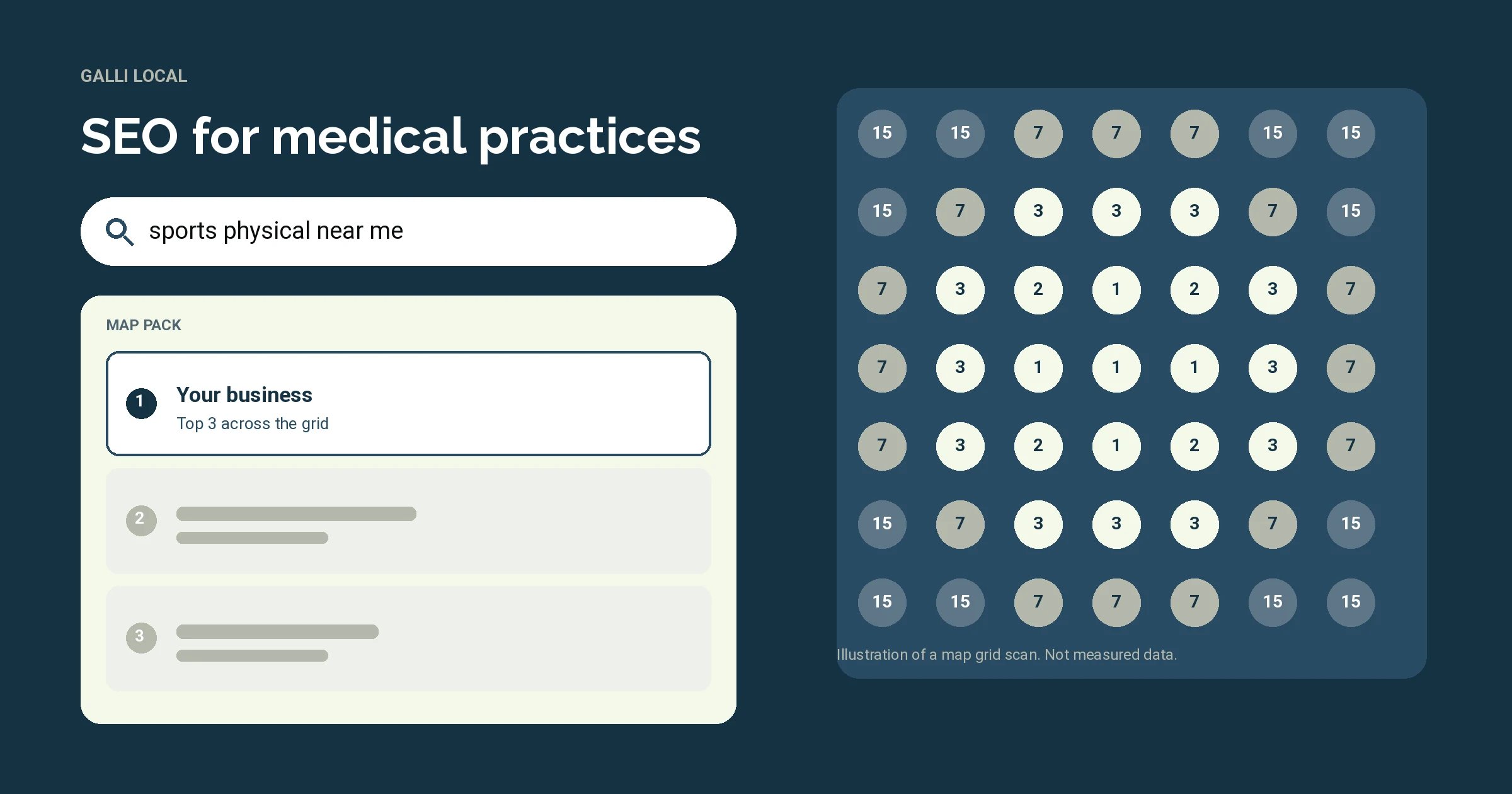
Quick summary: SEO for medical practices is the work of getting the whole website found, not only the map listing: a page for each visit type, provider bios, insurance and cost pages, medical schema, speed and links. Local SEO wins the "near me" search on the map. Full SEO wins the searches where a patient types a visit, a price or an insurance plan and lands on a web page.
What does SEO cover for medical practices?
The national version of this service is on the SEO services page, and the four medical pages start from the medical practice hub.
How do patients search beyond the map pack?
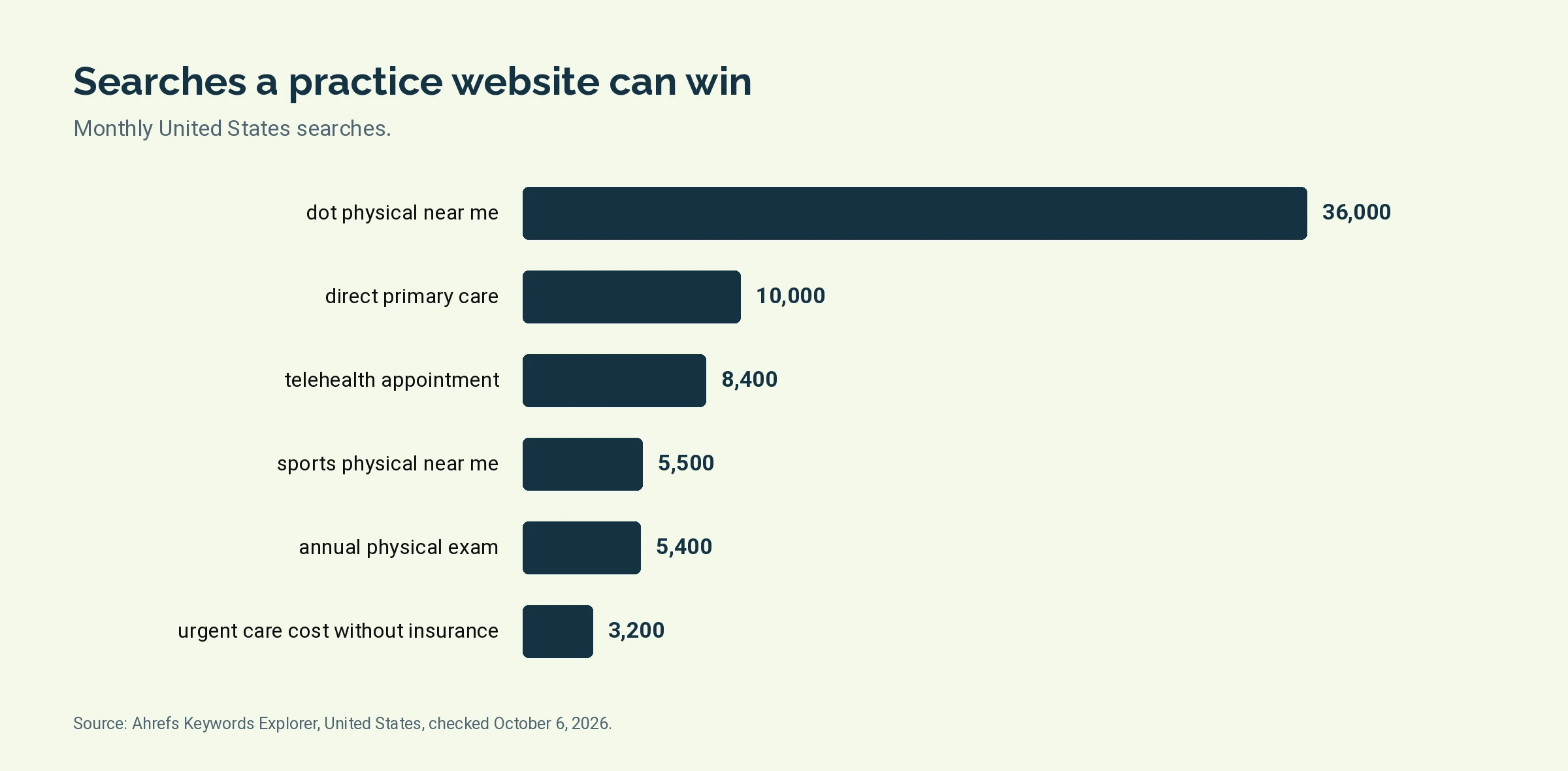
Patients search for a visit, a price or a payment model, and many of those searches are answered by a web page. These are the ones a website has to win.
Source: Ahrefs Keywords Explorer, United States, checked October 6, 2026.
"DOT physical near me" gets about 36,000 searches a month, more than twice "primary care doctor near me" at about 17,000. Many practices offer the visit and have no page for it. Narrow, priced, bookable visits like this are where a clinic site can gain fastest.
Which pages does a medical practice website need?
A practice site needs one page for each thing a patient can search for, and each page needs a way to book.
Many practice sites have a home page, an "our services" list and a contact page. A list of 30 services on one page gives Google 30 topics and no page to rank for any of them.
What technical points are specific to medical sites?
Three: the schema types, the booking path, and speed on a phone.
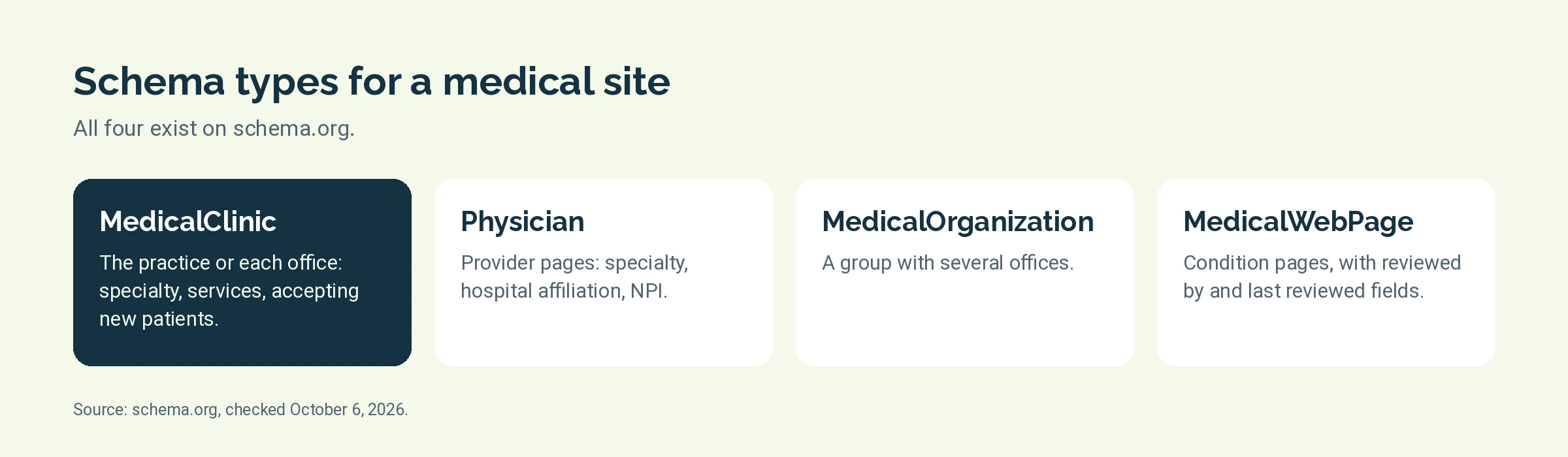
Schema. Schema.org has types written for medicine, and they fit better than the generic LocalBusiness type.
- MedicalClinic for the practice or each office. It can carry the specialty, the services offered and whether the office is accepting new patients.
- Physician for provider pages, with the subtypes IndividualPhysician and PhysiciansOffice. It has fields for the specialty, hospital affiliation and the provider's NPI.
- MedicalOrganization for a group with several offices.
- MedicalWebPage for condition and question pages. Its parent type has "reviewed by" and "last reviewed" fields, which is where the clinician reviewer goes.
Our LocalBusiness schema starter pack has the base markup these types extend.
Booking path. Many practices book through a patient portal or a third-party scheduler that opens on another domain. Check three things: the button opens the scheduler and not a login wall, a new patient can book without an account, and the phone number is tap-to-call.
Speed on a phone. A parent looking for a sports physical is on a phone in a parking lot. Large hero videos, chat widgets and several tracking scripts are the usual causes of a slow practice site.
Where do links come from for a medical practice?
Links come from organizations that already know the practice exists.
- Hospitals and health systems. A "find a doctor" profile for each provider with privileges or an affiliation.
- Medical societies. Your state medical society, a county society, and specialty groups such as the American Academy of Family Physicians or the American Academy of Pediatrics, where a member directory exists.
- Credential sources. Doximity profiles and board certification listings.
- Employers and schools. A company that sends drivers for DOT physicals, or a school district that lists where to get a sports physical.
- Local press and community groups. The chamber of commerce, a sponsored youth league, a local news story on a new provider or new hours.
What rules apply to medical practice SEO?
Three sets of rules shape the work. Your compliance officer and your state medical board have the final word, and we build that approval into every plan.
- HIPAA and marketing. The HHS Office for Civil Rights says the Privacy Rule requires a patient's written authorization before protected health information is used for marketing. On a website that covers testimonials, patient photos and case stories.
- Tracking tools. HHS guidance on online tracking technologies says tools on logged-in pages such as a patient portal may only use patient information as HIPAA allows, and that a vendor receiving it needs a business associate agreement. On June 20, 2024 a federal court in Texas vacated one part of that guidance, the part about visits to public pages that do not require a login. Appointment forms that collect a name and a reason for the visit still need review.
- Google's standard for health content. Google's guidance for site owners places health among "Your Money or Your Life" topics and says trust matters most. It asks whether a visitor can tell who wrote a page. For medical pages that means a named author or clinician reviewer with a bio.
State medical boards also regulate advertising claims, including claims about results and board certification. The rules differ by state, so check yours before a claim goes on the site.
How does this differ from local SEO?
Local SEO works on the map: the practice and provider Business Profiles, reviews, health directories and grid tracking. It is the right first step for most practices and it has its own page, local SEO for medical practices. The Local SEO program starts at $850/mo per location and includes page recommendations. Writing the pages and technical work are part of full SEO, which is quoted on the packages page.
Is full SEO a good fit for your practice?
Common questions about SEO for medical practices
How is SEO different from local SEO for a medical practice?
Local SEO works on the Google map listing, and SEO works on the website. A practice needs the map for "near me" searches and the website for visit, cost and insurance searches that show standard results.
How long does SEO take for a medical practice?
SEO content usually takes 3 to 6 months to produce steady gains. Local SEO moves faster: first map grid movement in 1 to 3 weeks, and the top 3 on competitive terms in 30 to 90 days.
Which schema type should a medical practice use?
Use MedicalClinic for the practice and Physician for each provider page. Both exist on schema.org and carry medical fields such as specialty and new-patient status that the generic LocalBusiness type lacks.
Should we publish prices on the website?
Yes, for self-pay visits where you can state one. Cost searches such as "urgent care cost without insurance" get about 3,200 searches a month in the United States, per Ahrefs, and few practice sites answer them.
Can we use patient testimonials on the site?
Only with the patient's written authorization, which HIPAA requires before patient information is used for marketing. Your state medical board may add its own limits on testimonials, so check both.
Do tracking pixels on our site break HIPAA?
It depends on the page and the data, and your compliance officer decides. HHS guidance still treats logged-in pages and forms that collect health details as covered, although a court vacated one part of it in 2024.