
☰
All servicesLocal SEOGBP managementAEO | GEOSEO contentTechnical SEOLink buildingDesign & CROPPC managementIndustriesLaw firmsHome servicesPlumbersHVACElectriciansRoofersMedical practicesOrthopedicsPhysical therapyDental practicesGeneral dentistsOrthodontistsPeriodontistsEndodontistsRestaurants and coffee shopsTour operatorsAuto repair shopsLocationsPennsylvaniaState CollegeBellefonteAltoonaWilliamsportLock HavenLewistownPhiladelphiaPittsburghAllentownHarrisburgNew YorkNew York CityBuffaloRochesterAlbanyTexasHoustonDallasSan AntonioAustinUtahSalt Lake CityProvoSt. GeorgeConnecticutBridgeportNew HavenHartfordStamfordOhioColumbusClevelandCincinnatiWashingtonSeattleSpokaneTacomaNevadaLas VegasRenoHendersonPackagesAboutResourcesArticles
Home / Industries / Medical practices / AEO | GEO
AEO | GEO for medical practices
Quick summary: AEO | GEO for medical practices is the work of getting a practice named when a patient asks ChatGPT, Gemini, Perplexity or Google's AI Overviews a health care question. AI tools name practices they can confirm in several places, so the work is mostly making your provider data match across health directories and writing pages that answer patient questions in the first two sentences.
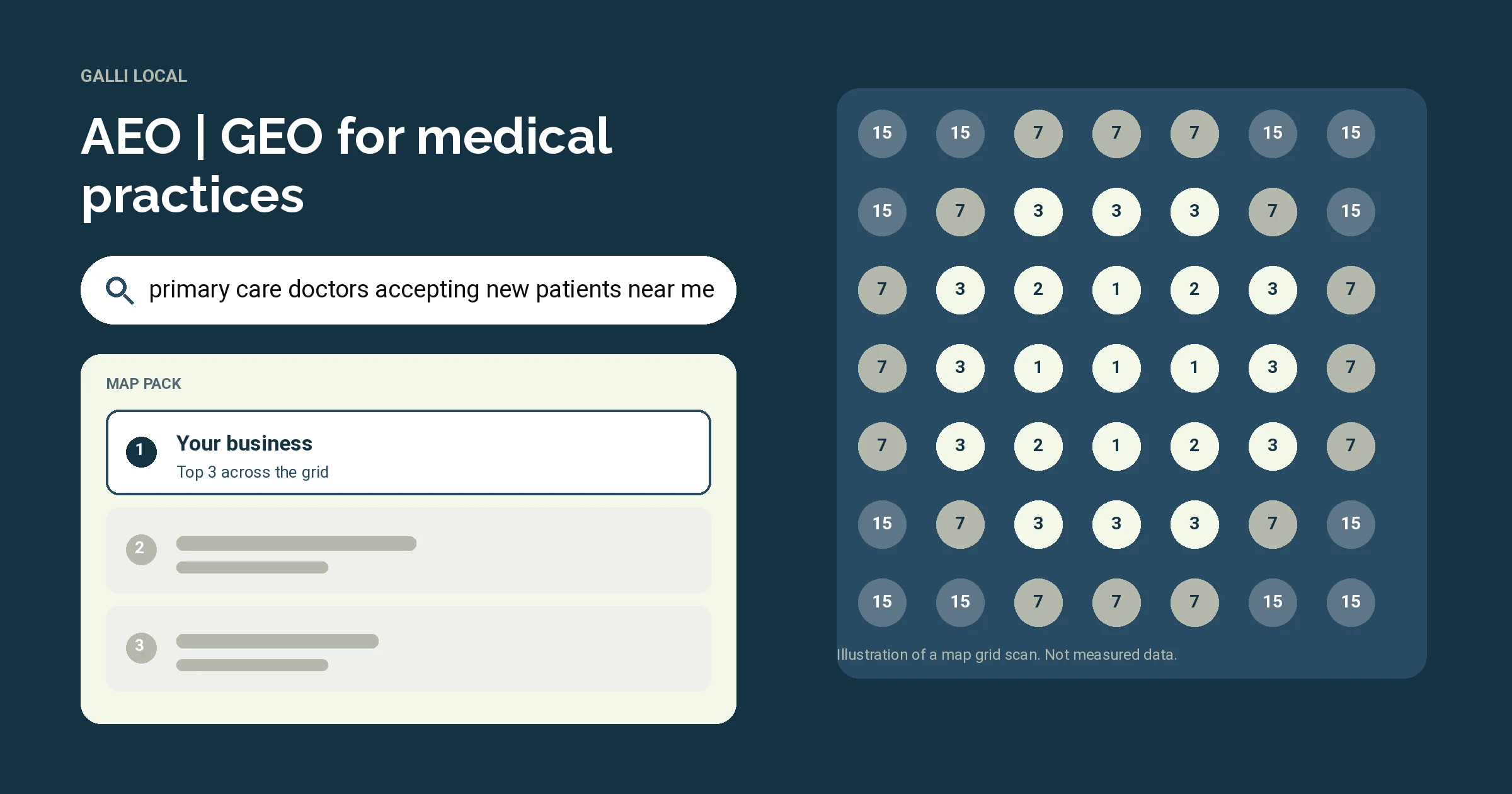
What do patients ask AI tools about medical care?
Patient questions fall into four groups.
The "what kind" and "how it works" groups have real search demand. Ahrefs Keywords Explorer shows these monthly searches in the United States:
- md vs do: about 24,000
- nurse practitioner vs doctor: about 7,300
- how to find a primary care doctor: about 5,200
- family medicine vs internal medicine: about 4,600
- what is a primary care physician: about 3,000
- when to go to urgent care: about 2,700
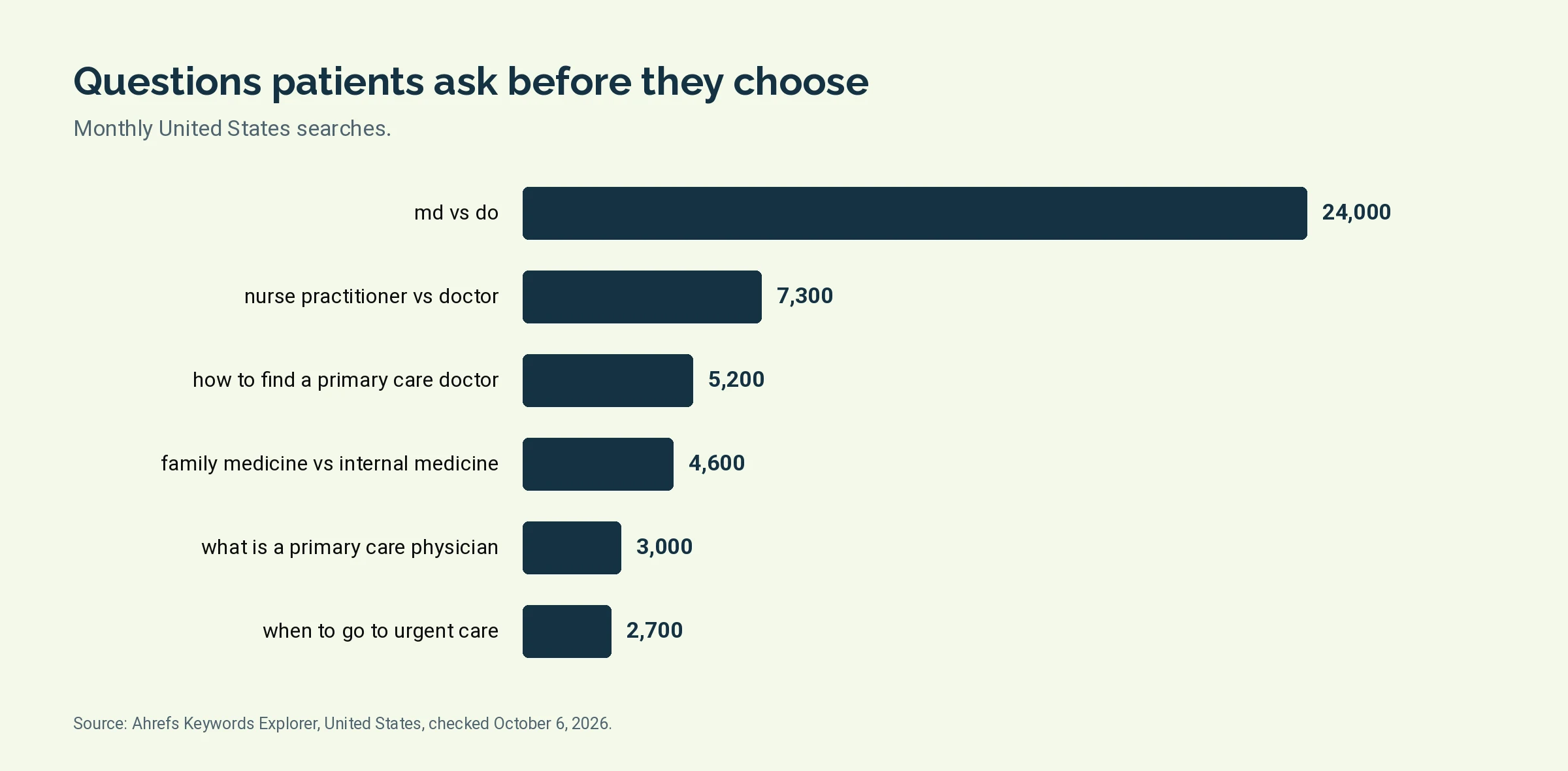
National health sites own answers like "MD vs DO". The questions a local practice can win are the ones with a place, a plan or a time in them: who is accepting new patients in this town, who takes this insurance, who is open tonight.
Where do AI tools get their answers about medical practices?
AI tools build an answer about a practice from pages they can read and compare. For a medical practice, these are the sources that describe you:
- Your Google Business Profiles, for the practice and each provider
- Health directories: Healthgrades, Zocdoc, WebMD Care and Vitals
- Doximity, a professional network that holds physician profiles
- Insurer provider directories, which state which plans you take and often whether a provider is accepting patients
- The NPI registry (NPPES), the federal record of each provider's name, practice address and specialty code
- Hospital and health system "find a doctor" pages
- Your state medical board's license lookup
- Your own website, above all provider bios and insurance pages
We do not publish a figure for how often each of these is cited, because no reliable one exists for local medical questions. In month 1 we record which sources the tools cite for your questions in your market, and that list sets the order of work.
The usual problem is drift. A provider leaves or the practice moves, and each directory updates on its own schedule or never.
What makes a medical practice easy for an AI tool to name?
Four things.
- One version of the facts. The same practice name, address, phone, provider list and specialties on every source above. Start with the NPI registry, because it is the public federal record and CMS publishes its data for others to use.
- Schema that states what you are. MedicalClinic markup for the practice and Physician markup for each provider, with specialty, new-patient status and links to official profiles. The types are explained on our SEO for medical practices page.
- Answer-first pages. A page titled "Are you accepting new patients?" that says yes or no in the first sentence, names the providers, and gives the date it was last checked.
- Reviews where patients and AI tools both read them. Google first, then the health directories. Review requests and replies are covered on the local SEO page. A reply must never confirm that the reviewer is a patient.
What does Galli Local do for a medical practice?
The work follows the same steps as our national AEO | GEO service, applied to health sources.
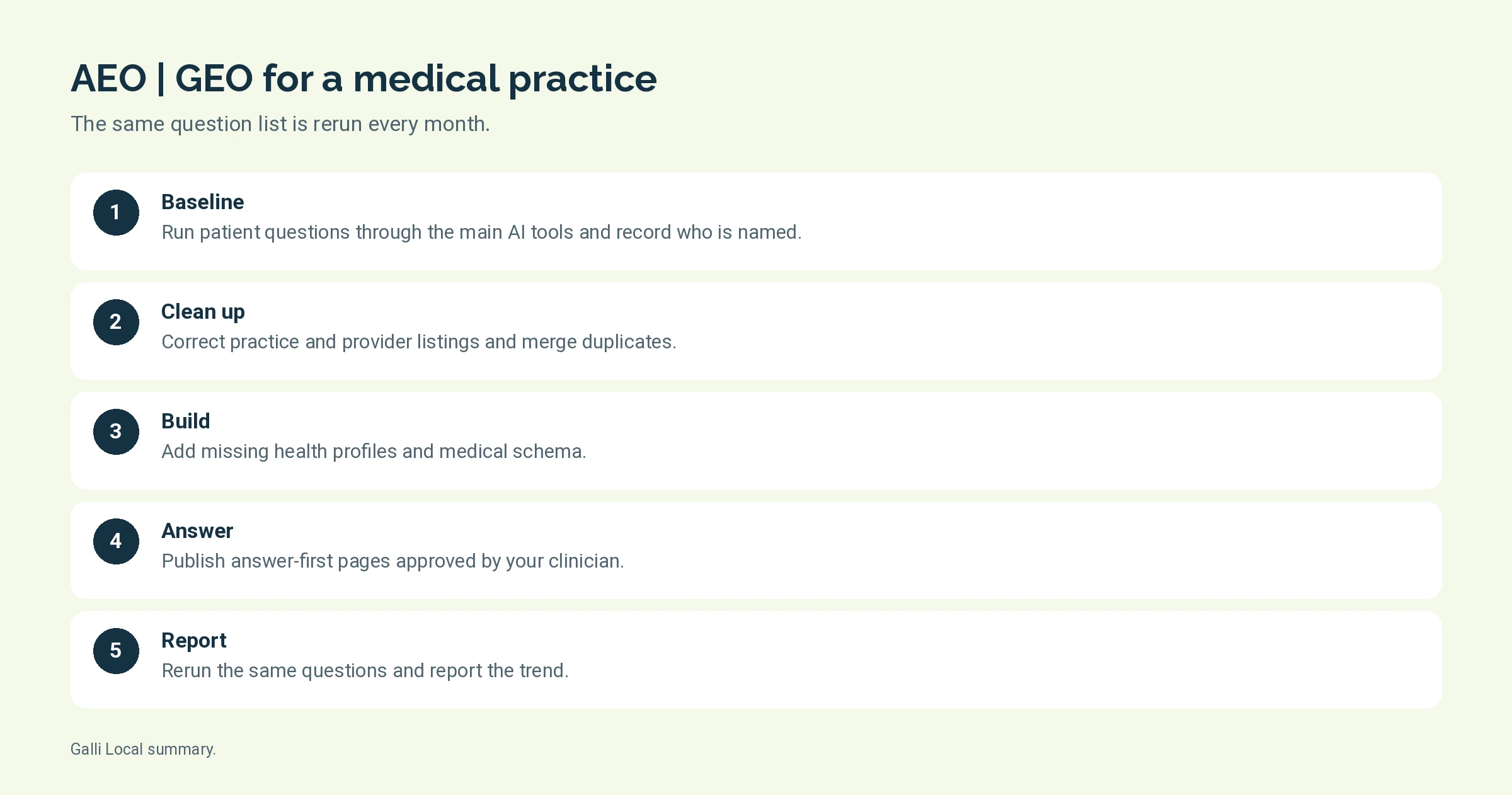
Some corrections only the practice can make. NPI registry records and insurer directories are updated by the provider or the credentialing staff. We give you the exact list of what to change and where.
AEO | GEO is sold as a bundle with the Local SEO program and GBP management, because the cleanup serves both. Pricing is on the packages page. To check where you stand first, run the AI visibility self-test.
What does the evidence show so far?
AI tools disagree with each other more than most owners expect. In our State College AI study, Galli Local asked 10 local questions of four AI tools on October 5, 2026. The tools named 83 businesses in total. Of 88 question-and-business pairings, 52 were named by only one tool, and 5 were named by all four.
One test in one tool tells a practice little, which is why the monthly report tracks a fixed question list across several tools.
What do we not promise, and what will we not do?
We cannot guarantee that an AI tool will name your practice. Listing fixes take 4 to 8 weeks to spread, and AI mentions follow over the next few months.
We will not:
- Post fake reviews or ask staff to review the practice
- Seed forum or Reddit threads that pose as patients
- Write medical claims your clinician has not approved
- Use any patient information to do this work
Which matters more for a practice: the map pack or the AI answer?
The map pack matters more for a practice that needs new patients now. Steven Galli's view is that the map pack and standard results still win buying searches, and AI answers lead question searches. In health care, "urgent care near me" and "pediatrician near me" are buying searches.
AI answers lead for the research that comes first: what kind of provider to see, whether a problem can wait, how a membership practice works. So the order is local SEO first, then AEO | GEO on the same cleaned-up data. All four services are laid out on the medical practice hub.
Common questions about AEO | GEO for medical practices
Can you get our practice recommended by ChatGPT?
Nobody can promise that. We make the practice easier to find and confirm across health directories and your website, and we measure mentions every month.
Which directories matter most for AI answers about doctors?
The ones that hold provider data: Google Business Profile, Healthgrades, Zocdoc, WebMD Care, Vitals, Doximity, insurer directories and the NPI registry. Which of them a tool cites varies by market, so we record it in the baseline.
Do we need to fix the NPI registry?
Yes, if the address, practice name or specialty code is out of date. The record is public, and other directories can draw on it. The provider or credentialing staff makes the change.
How long before AI tools start naming us?
Listing fixes take 4 to 8 weeks to spread across directories, and AI mentions follow over the next few months.
Is AEO | GEO safe under HIPAA?
Yes, as we run it. The work uses public business and provider data, not patient data. Anything that touches patient stories, forms or tracking tools goes to your compliance officer first.